
Biomethane: from promise to plant
At EOI in Madrid, the regulator, the grid, industry and developers set out how Spain gets from 30 biomethane plants to 300. Most of the pieces are moving. The missing one will be settled village by village.
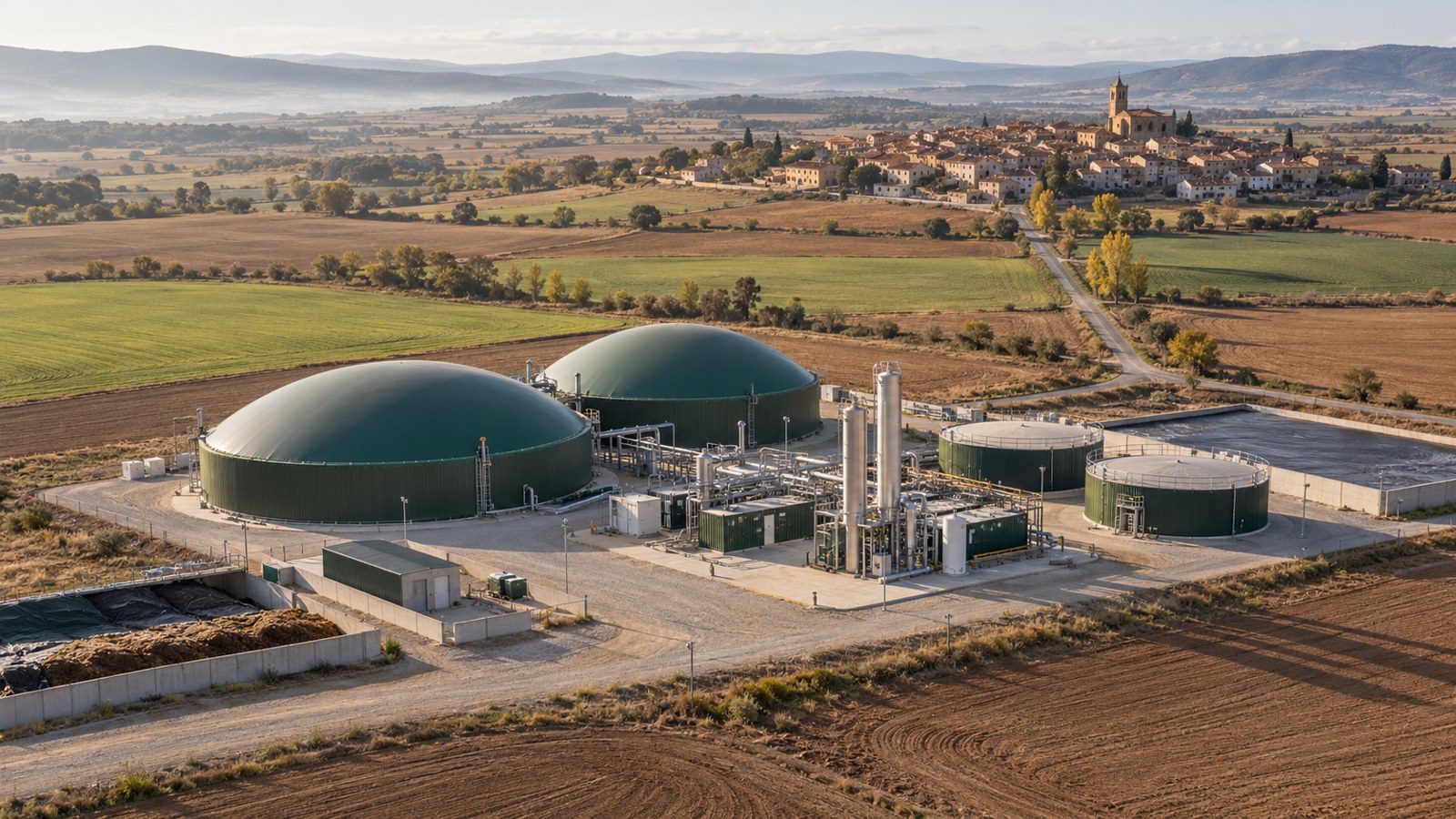
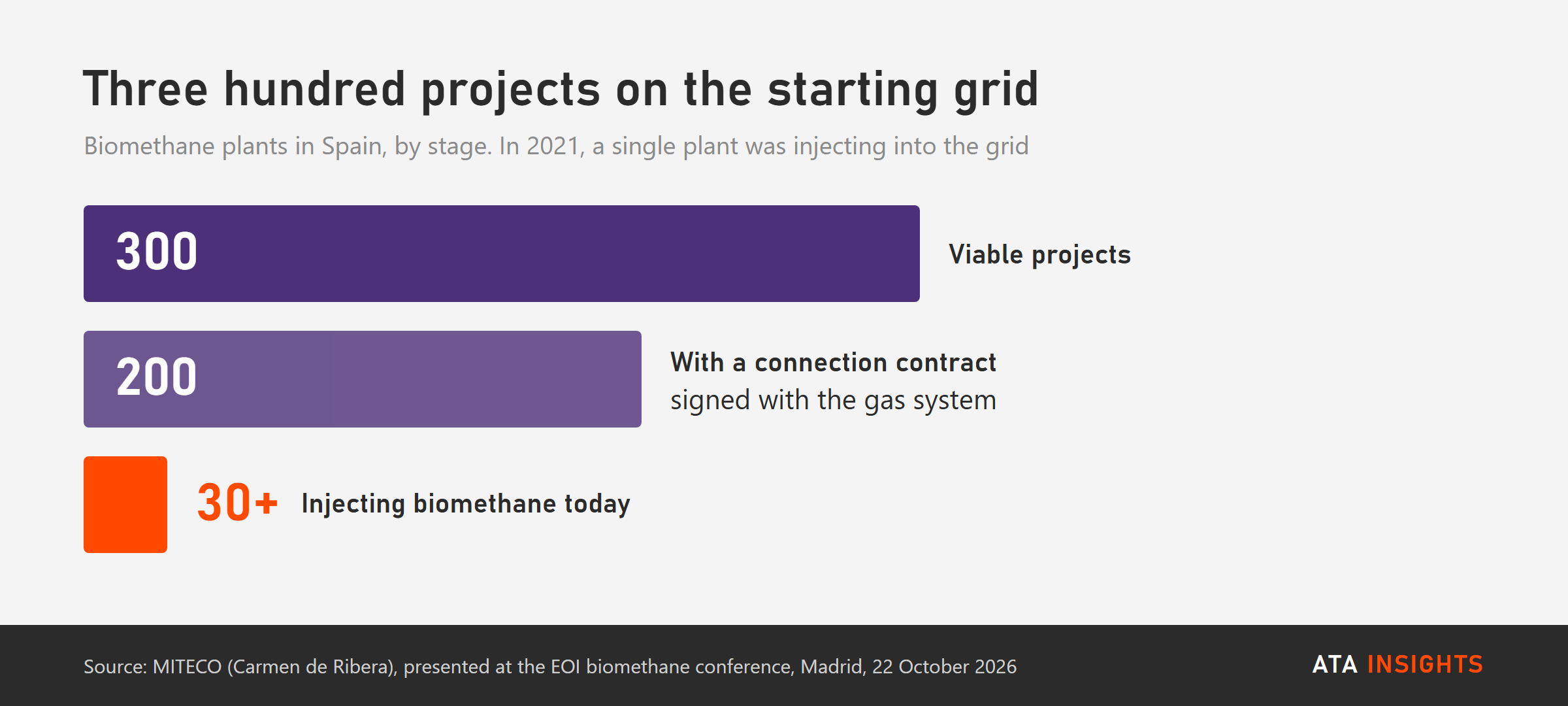
When MITECO, Spain's energy and environment ministry, was drawing up its biogas roadmap in 2021, the country had only one plant injecting biomethane into the grid: Valdemingómez, in Madrid. Today there are more than thirty. Three hundred projects have been cleared as viable and 200 have signed a connection contract. "Growth has been exponential," said Carmen de Ribera, head of area at the ministry's Sub-Directorate General for Hydrocarbons and New Fuels.
She was speaking on 22 October at "Biomethane: industry, territory and energy transition", organised by EOI (Escuela de Organización Industrial, a Madrid business school), Sedigas (the Spanish gas association) and RENMAD Biometano. Diego Crescente, EOI's director-general, set the theme: biomethane is "ceasing to be a promise and genuinely establishing itself as an industrial reality". Joan Batalla, president of Sedigas, supplied the scale. Nine new plants this year and seven the year before, yet output is still only around 0.16% of natural gas consumption. For the road ahead, Batalla drew four boxes to tick: regulation, infrastructure, industry and territory.
Demand by decree
The big news of 2026 is that biomethane now has buyers obliged by law. Royal Decree-Law 7/2026, approved in March, instructed the government to set quotas, and the draft Royal Decree to promote biomethane spells them out: gas suppliers and direct consumers will have to certify 0.5% biomethane in 2028 and 6% in 2035. Alejandro Bonitch, a partner at Cuatrecasas, called the decree-law "a paradigm shift", because the demand it creates is "legally binding". For Lorenzo Chacón, senior biomethane expert at ATA Renewables, it finally supplies "the energy leg that makes projects economically viable".
The text is still a draft, and elections have been called. On the planned seal of excellence, De Ribera previewed two principles: it must not become "a barrier to entry", nor bring "improper retroactivity" for plants already operating or going through permitting. Luis González, a partner at Watson Farley & Williams, reached for a proverb: "the excellent is sometimes the enemy of the good".
Lessons from the wires
Second box: the grid. Agustín Alonso, head of area at the Natural Gas Sub-Directorate of the CNMC, Spain's energy and competition regulator, described the upheaval: from a handful of tightly controlled entry points to hundreds of plants, many at the far end of a distribution branch. Circular 2/2025 brings order through "conditional capacity": what a plant can inject depends on how much gas is consumed on its stretch of network. Where local demand falls short, a reverse flow sends the surplus back up to the transmission network.
The regulator has also learnt from electricity. A connection permit is tied to its plant and can only be transferred with it. Whoever obtains one has two years to start injecting or loses the right, unless the delay is beyond their control and justified every three months. Guarantees carry a regulated minimum of 10% of the connection cost, capped at €100,000. The door to speculating in permits is shut. Alonso hopes that next year people will be talking about "between 40 and 50" plants rather than 30.
Buyers on the dotted line
Then there is the buyer. Miguel Mayrata, managing director of Redexis Renovables, did the sums: if electricity is 23–24% of final energy, decarbonising 42% with electricity alone does not square. "For me, the numbers don't add up." Antonio Illescas, director of biomethane business development and operations at Enagás Renovable, pointed to the first customers: ceramic and glass kilns, steam processes, breweries. All need steady heat that is hard to electrify, and all can switch gas without touching the boiler.
The contracts already exist. Redexis Renovables' two plants, in Lorca and Almazán, sell their entire output for 15 years to Shell Energy Europe, which buys it at the virtual balancing point (PVB, the Spanish gas hub) and sells it on. "We wouldn't approve an investment in a plant if we had to depend on a single consumer," said Mayrata. What the buyer is really paying for is the proof of sustainability (PoS): the lower the carbon intensity, the more the gas is worth. The banks are in, too. González's firm has just taken part in financing one project and holds mandates on others.
Where there's muck, there's brass
In the closing interview, Jesús Rodríguez of RENMAD Biometano asked Nuria de Lucas, head of energy transition for renewable gases at Naturgy, whether biogenic CO₂ and digestate are an asset or a liability. Added value, she replied, and something to think through "at the design stage".
The CO₂ separated when biogas is upgraded already sells to the food industry if it meets food-grade (E290) quality, but its big market will be synthetic fuels. De Lucas cited a sector observatory published this year which estimates that 1.57 million tonnes of biogenic CO₂ will be needed in 2030 and more than 8 million in 2040. Smaller plants will have to pool theirs at district hubs, because "if the logistics don't work, you get nowhere". Properly treated, digestate replaces mineral fertiliser that now sells "for the price of gold", and its liquid fraction can stretch irrigation water.
All permitting is local
If regulators and developers agreed on anything, it was where the game is now played. "Today the risk is not technological," said González. "The risk is social." Chacón's figures make the point. Of the 29 plants injecting in July, the vast majority were built on facilities that already existed: wastewater treatment plants, slaughterhouses, biogas or biodiesel plants, farms. Only six were new builds. Those took between 18 months and four years to obtain their integrated environmental permit, and between four and just over six years from application to first injection. In September Navarra, a northern Spanish region, extended its moratorium on new plants to 31 December 2028. Bonitch called for a move "from moratoriums and local referendums" to a framework with "parameters of reasonableness".
The industry came with its homework done.
Start with the paperwork. A single plant, De Ribera noted, touches four layers of authority at once: land-use planning, which is municipal; the environment, split between the state and the regions; national regulation; and European rules. The seal of excellence, she said, was created so that public opposition does not stall plants that comply with the law. Chacón added that it can give cover to town halls, which recognise a project's public interest during the planning procedure with residents breathing down their necks. Illescas asked for a one-stop shop, more resources for the authorities and consistent criteria across regions. He also wants the environmental impact statement to carry the planning approval with it, as it already does for solar PV. "Don't put that load on a mayor's back," he said.
Next, tell the story better. Batalla had set the tone in his opening. Residents have a right to know which feedstocks a plant will take in, what traffic it will bring, how odours will be controlled, how much water it will need and what will happen to the digestate. Answering requires "verifiable commitments" and channels kept open for the life of the facility. Buenaventura Gómez, director of industrial business at Valoriza, offered a mea culpa. The complaint residents' groups repeat most is "they hid the whole procedure from us", because people only hear of a project once it goes out to public consultation. "The sector's approach to municipalities has to change."
De Lucas got down to detail. You don't talk to a village of 200 people the way you talk to a town of 20,000, and the first question is always "what's in it for me?". Often the answer is in plain sight. The farm was there before the plant. If the plant takes the slurry, the fields stop smelling and the lorries stop rumbling down the road the village shares with the next one. Mayrata's comparison explains it best: farming generates 172 million tonnes of waste a year and people 5.6 million, and the human share goes to wastewater treatment plants "and nobody questions it". There are about 2,900 of those, De Lucas added.
Finally, prove it with engineering. What Naturgy has heard in the villages, De Lucas said, is already in its designs: enclosed reception, enclosed tanks, enclosed transport, and odours measured before, during and after. That means more investment and higher operating costs, and the company accepts both. Her request to government and society: "let us show you that we can build plants properly."
In a word
Illescas closed the industry panel with three questions for any factory still in two minds. Does it have an electricity connection? Does that connection actually deliver the capacity it would need? And how much is it willing to pay for its CO₂? The gas burners and pipework, he pointed out, it already has. He then invoked Pepu Hernández, who after leading Spain to the 2006 basketball World Championship summed it all up in one word: basketball. "Here, I'd say biomethane."
The promise now has its plants. Next, it has to win over the village.
About the conference
"Biomethane: industry, territory and energy transition" took place on 22 October 2026 at the Escuela de Organización Industrial (EOI) in Madrid, in person and streamed live. It was organised by EOI, RENMAD Biometano and Sedigas, the Spanish gas association.
You reached this analysis because ATA Insights puts independent energy-transition intelligence in front of 86,000+ professionals across the sector. That's exactly what we do for funded projects, events and companies — turn your work into reach.
See how we disseminate work like this →Next stop: RENMAD Biometano 2027
The conversation continues at RENMAD Biometano, the fourth edition of our biomethane conference, on 10–11 February 2027 in Toledo.
The energy transition, in your inbox
Join 86,000+ professionals reading our independent briefings across five sectors.