
Designing for 45°C Coolant
Artificial intelligence has made data-centre racks four times hotter in the space of a few years. Air cooling has quietly given up. Two engineers explain how the industry learned to stop worrying and love a warm liquid.

For most of computing's history, the goal of data-centre cooling was to keep things cold. Cold air, cold water, cold rooms so aggressively chilled that engineers wore fleeces to work in them. The logic was intuitive: chips make heat, heat is the enemy, so pour on the cold. It was also, it turns out, an expensive habit—cooling swallows roughly 60% of the energy a data centre uses that does not go directly into computing—and one that artificial intelligence has just made obsolete.
The trouble is density. A rack of servers that a few years ago drew around 40 kilowatts and could be cooled by blowing air across it now draws 120 or more once it is packed with the graphics chips that train and run AI models. In the same room that once dissipated 600 kilowatts, operators are now trying to reject 2,400. Air, a famously poor conductor of heat, simply cannot carry that much energy away fast enough. The fans get bigger, then louder, then pointless. Something has to touch the chip.
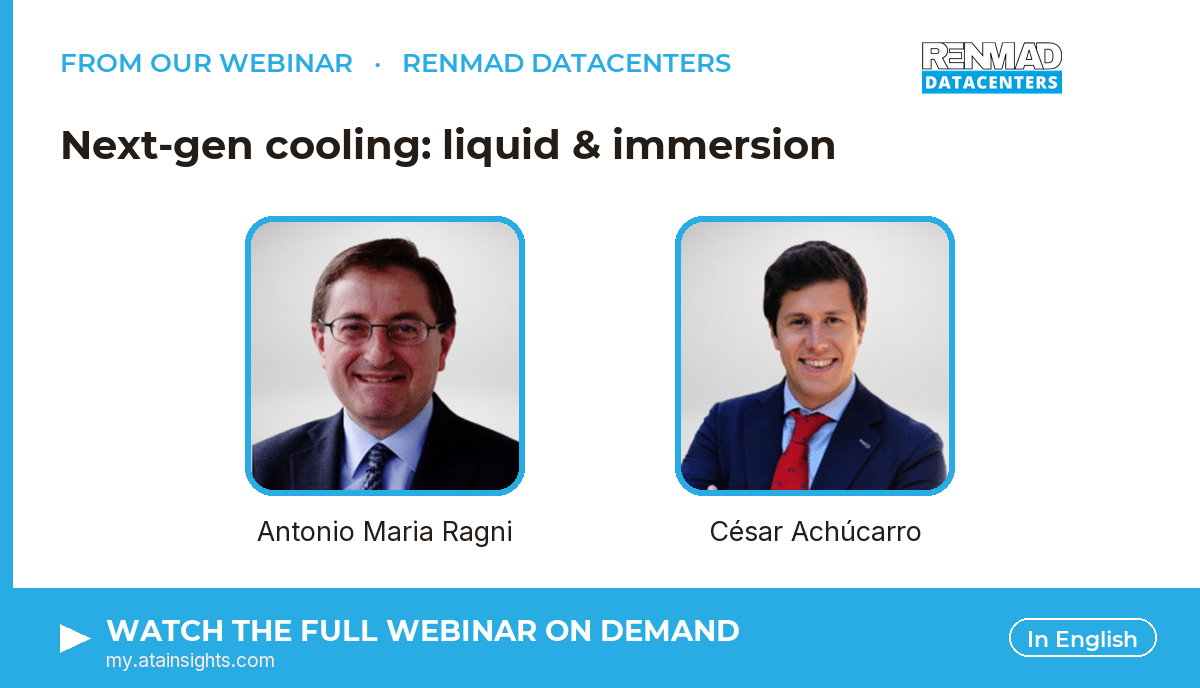
This was the subject of a recent ATA Insights webinar on next-generation cooling, moderated by Belén Gallego, in which two engineers who spend their days inside this problem—Antonio Maria Ragni of Carrier and César Achúcarro of the Spanish sales agency ACR—walked through what the density surge is doing to the machinery, and why the counter-intuitive answer is to run the coolant hotter, not colder.
The steepest curve anyone has seen
Mr Ragni has spent thirty-five years in heating, ventilation and air-conditioning, twelve of them at Carrier, latterly running its Italian data-centre business and personally overseeing the commissioning of two large facilities in Milan. He is not a man given to hyperbole about growth curves. He used hyperbole anyway. "I've never seen a growth so steep in my life," he said of the data-centre market—a line he returned to twice, as if still slightly startled by it.
The steepness is the whole story. When racks were modest, the industry had slack: it could waste energy on over-cooling and nobody much cared. AI removed the slack. It also, unhelpfully, arrived at the same moment as three other constraints that Mr Achúcarro laid out with the weariness of someone who negotiates them for a living. Power supply is limited—Spain's grid gave everyone a reminder of that during a nationwide blackout weeks before the webinar. Water is increasingly rationed and, more to the point, permitted grudgingly. And space, especially the roof space where chillers traditionally sit, is scarce and expensive.
"Today, cooling is not just only a technical choice," Mr Achúcarro said. "It's also a business decision that affects cost, permits and the project's future." He offered a neat way to think about it: a triangle of compromise between energy efficiency, water conservation and space. You can optimise for two corners; you cannot have all three. Every data centre is an argument about which corner to sacrifice.
When cold water becomes a liability
Here is where the physics turns the old intuition on its head. The colder you want your coolant, the harder your chillers have to work, and the more electricity they burn producing that cold. If you can persuade the servers to accept warmer coolant, you can make less cold, run the compressors less—or switch them off entirely and let the outside air do the work, a trick the industry calls free cooling.
For decades that was a marginal saving. Mr Ragni noted that older designs supplied chilled water at around 15°C; he is currently retrofitting a bank's data centre still built to that spec. Modern designs push the supply temperature up to 20°C, and the newest thinking goes much further. The higher the temperature the electronics will tolerate, the more hours of the year you can cool them for almost nothing.
That is the quiet revolution behind direct liquid cooling. Instead of chilling a whole room, a coolant is piped directly to the chips through devices called coolant distribution units—essentially plate heat exchangers with redundant pumps and obsessive filtration, keeping the fluid clean to 25 microns and microbiologically controlled, because a blocked cold plate on a GPU is a catastrophe rather than an inconvenience. The facility water and the fluid that touches the servers are kept as separate loops, the second usually a propylene-glycol mix chosen precisely because it resists biological growth.
The elegant part is what higher tolerances do to the chiller. Design the heat exchangers with a tight temperature approach—Mr Ragni cited 2.5°C rather than a cheaper 4-5°C—and you can raise the chilled-water temperature feeding the whole plant, which raises the chillers' efficiency across the board. Warmth, deployed deliberately, becomes an asset.
The number that changes everything: 45
Direct-to-chip cooling, for all its momentum, has a ceiling. As Mr Achúcarro pointed out, cold-plate systems still want coolant at roughly the same temperature as the air systems they replace—around 30°C—which caps how much free cooling they can unlock. The technology moving the ceiling is immersion cooling, where the servers sit in a sealed tank of dielectric fluid.
"In some setups, it's now possible to operate with coolant temperatures as high as 45 degrees," Mr Achúcarro said. That single figure is the reason immersion has gone from curiosity to serious contender. A system that is happy at 45°C can, in most climates, reject its heat to the outside air using only an adiabatic cooler—one that occasionally sprays a little water to boost its reach—with no mechanical chiller running at all, even in summer. Higher working temperatures, he argued, open the door to "improve overall efficiency, reduce energy demand and greater compatibility with free cooling strategies."
This is the inversion in full. The hotter the system is allowed to get, the cheaper and greener it becomes to keep it from overheating. Designing for 45°C coolant is not a compromise forced by AI's heat; it is the escape route from it.
Spain's awkward geography
None of which fully rescues Spain, whose climate is the industry's stress test. Mr Achúcarro reeled off the record highs his colleagues design against: 41.4°C in Madrid, 42.5°C in Zaragoza, 43°C in Valencia, and a scorching 45.9°C in Seville—figures drawn from twenty-year averages, and figures Ms Gallego gently suggested felt conservative to anyone who has actually spent a Madrid August outdoors.
Those peaks matter less than they appear, though, and here the panel offered a useful corrective to the intuition that hot places doom data centres. Pressed on what a ten-degree gap between Barcelona and Seville does to cost, Mr Ragni was almost dismissive: the extreme temperatures last only "five hours, 10 hours" a year, so their effect on annual energy use is "some percent, maybe three, four, five percent." What the heat really threatens is not efficiency but availability—the risk that on the worst afternoon, with chillers packed onto a roof recirculating each other's hot exhaust, a machine simply drops out when it is needed most. Hence the industry's growing fuss over anti-recirculation barriers and acoustic packaging, the unglamorous plumbing of reliability.
ACR's own answer for Spanish conditions is deliberately unromantic: a hybrid of chillers plus dry coolers, which uses no water at all. On one Madrid project, Mr Achúcarro said, dry coolers in free-cooling mode covered 67% of the year's cooling needs, with another 29% in mixed mode—leaving the plant running effectively water-free for 96% of the year and achieving a PUE of around 1.2. In a country where, as he put it, "the water license to use it, it's very hard to get," designing out water is as much a permitting strategy as an environmental one.
The catch in the tank
The efficiency case for going liquid is now backed by more than vendor enthusiasm. Mr Ragni flagged a study Microsoft published in the journal Nature in 2025—the first full cradle-to-grave life-cycle assessment of cooling methods, covering not just operation but the emissions and water embedded in manufacturing the equipment. Its finding: cold plates and immersion can cut greenhouse-gas emissions by 15-21%, energy by 15-20%, and water by anywhere from 31% to 52% against traditional air cooling.
The largest water savings came from two-phase immersion, in which the fluid boils off the chips and condenses back—which is also where Mr Ragni sounded a warning that the study makes explicit. Those two-phase fluids currently rely on PFAS, the "forever chemicals" now facing tightening restrictions in both the European Union and the United States. The most thermally impressive option, in other words, may be legislated out of existence before it scales. It is a familiar shape of problem for anyone in energy: the cleanest-looking technology on the spreadsheet carries a regulatory time-bomb the spreadsheet does not show.
The direction of travel
For all the caveats, the panel was unanimous on where this goes. Climate change is nudging the baseline up—Mr Ragni noted, with a touch of melancholy, that the Milan of his childhood snowed every winter and topped out around 35°C in summer, and does neither now—which pushes designers toward warmer, harder-working systems even as it makes the old cold-everything approach untenable. The positive trend in design, higher tolerated temperatures, is racing against the negative trend in the weather.
The workaround the whole industry is converging on is the one that would have seemed backwards a decade ago. Stop fighting to make the coolant cold. Make the chips tolerate it warm. Every degree you can add to the tank is a degree you no longer have to pay a compressor to remove—and in a world where AI is multiplying the heat by four and the grid is not multiplying the power to match, that arithmetic is no longer optional. The future of keeping computers cool, it turns out, is letting them run hot.
The full session — "Next-gen cooling for data centers: energy efficiency and sustainability" — is available to watch on demand from ATA Insights, and the conversation continues in person at RENMAD Datacenters in Zaragoza.
You reached this analysis because ATA Insights puts independent energy-transition intelligence in front of 86,000+ professionals across the sector. That's exactly what we do for funded projects, events and companies — turn your work into reach.
See how we disseminate work like this →Where this analysis came from
This piece draws on the ATA Insights / RENMAD webinar Next-gen cooling: liquid & immersion. Watch the full session on demand.
The energy transition, in your inbox
Join 86,000+ professionals reading our independent briefings across five sectors.