
Get Paid to Stand By
Spain has 35 gigawatts of batteries queuing for the grid and almost none plugged in. Two new money pipes — a tertiary-reserve product for demand, and a capacity market a decade in the making — are quietly changing the maths.
The cheapest megawatt on Spain's grid is the one you agree not to use. That is the unglamorous premise behind a product almost nobody outside the control room talks about, and it is now paying enough to put a battery on a balance sheet.
The product is called SRAD — servicio de respuesta activa de la demanda, demand active response. It is a tertiary-reserve service: the grid operator pays you to be ready to cut your consumption on short notice, and pays you again on the rare occasions it actually asks. For years it sat in the background, a niche tool for very large consumers. For 2026 it has been redrawn in ways that bring it within reach of a much smaller crowd, and the income on offer is the kind that makes a behind-the-meter battery pay for itself in a handful of years.
That shift, and two others alongside it, were the subject of the last RENMAD storage webinar of 2025, where a regulatory lawyer, the head of Spain's storage association and a market consultant walked through what changed in a busy legislative autumn. The short version: the rules got better, then briefly got worse, and the money is starting to add up.
The standby cheque
Start with the cheque, because it is the part that surprises people. Until this year SRAD asked a lot of you: a single connection point of at least one megawatt, a willingness to drop consumption for three hours, fifteen minutes' notice, and an annual contract.
For 2026 every one of those thresholds came down. The minimum connection point drops to 100 kilowatts, provided several are pooled to reach a megawatt of offered capacity. The required hold falls from three hours to two. The notice shrinks to 12.5 minutes. And the contract goes from annual to half-yearly, so you are no longer betting a full year at a time.
"This is one of the tools we at the association consider key to driving the development of behind-the-meter battery systems tied to demand," said Raúl García Posada, director of ASEALEN, the Spanish energy storage association. His point is that the product is being deliberately reshaped to pull demand-side flexibility into the market, and a battery is the cleanest way to supply it.
The numbers explain the enthusiasm. Assigned capacity went from a trial-sized 497 megawatts in the first year to 1,700 megawatts for the first half of 2026. Assignment prices have held in a band of roughly 50 to 65 euros per megawatt per hour. Multiply that out and the availability payment alone — the money for simply standing ready, before a single activation — lands somewhere around 200,000 to 300,000 euros per megawatt per year.
Set that against the cost of the asset. "With an investment that should sit below 500,000 euros per megawatt, you should be able to amortise a storage installation in two, three, four years at most," García Posada said, "and then it's entirely yours to use." Activations have been vanishingly rare — one in 2023, four in 2024, none so far in 2025 — which means the battery spends almost all its time free to chase other revenue.
Not a fire alarm
The natural worry is that this is disaster insurance: a mechanism that pays you to sit idle for a once-a-decade emergency. The webinar was firm that it is not.
"Our view is that this is not a capacity mechanism, it's not something that might never be used," said Javier Revuelta, senior principal at consultancy AFRY. "It's a tertiary service. If you take part, you can be called — and you can be called several times a year." The grid, he explained, will reach for SRAD whenever it is simply the cheaper or faster option than conventional tertiary reserve, not only when the lights are about to go out. The newspaper framing — "we were on the brink of collapse" — misreads what is a routine efficiency tool.
There is a catch worth understanding, and García Posada spelled it out in response to an audience question. You cannot game the service by shuffling your own electrons. If you are told to reduce your draw from the grid, you cannot quietly run your rooftop solar harder, or discharge a battery you were already discharging, and call that a reduction. The rules require that the activation genuinely cut consumption from the grid. Used honestly, though, a battery is exactly the asset that makes a clean, controlled cut possible — twelve minutes is too little time to gracefully wind down a furnace or a pump, but a battery can absorb that on your behalf.
One step forward, two steps back
While SRAD was being sweetened, the rulebook for building batteries got a long-awaited fix — and then an accidental setback in the same season.
The fix arrived in Royal Decree 997/2025, published in November. Its headline measure unblocks hybridisation, the practice of bolting a battery onto an existing solar or wind plant. The old rule treated a hybrid plant's installed power as the simple sum of its parts, which meant adding a battery could tip a project over the 50-megawatt line that decides whether a regional government or the national ministry authorises it — sending a half-finished project back to the start of the queue.
"This was a measure that was being demanded a great deal," said Lidia Fernández, senior associate at law firm Watson Farley & Williams. The decree adds a crucial qualifier: where a hybrid plant shares a common element — an inverter or a transformer — the installed power is capped by that shared, more limiting component rather than the raw sum. The decree also exempts hybridised storage inside an already-assessed site from a fresh environmental impact study, and promises a faster administrative track. Fernández was careful not to oversell the speed-up: "Let's not fool ourselves into thinking that processing a battery will now take half the time, because unfortunately it isn't that automatic."
Then came the own-goal. The same decree had tidied up article 23 bis, governing demand-side guarantees, to fix inconsistencies around storage. "And ten days ago," Fernández said, "we found that the Sustainable Mobility Law" — through an amendment carrying an outdated version of the same article — "reverted it. So now we're back to the original wording, and those changes are no longer in force." The sector, she noted drily, took "one step forward and two back." Nobody thinks it was deliberate; it reads as a drafting error in the rush of overlapping bills, and a fix is expected. But it captures the texture of the moment: progress arriving faster than the legislative machinery can keep straight.
Thirty-five gigawatts, almost none of it real
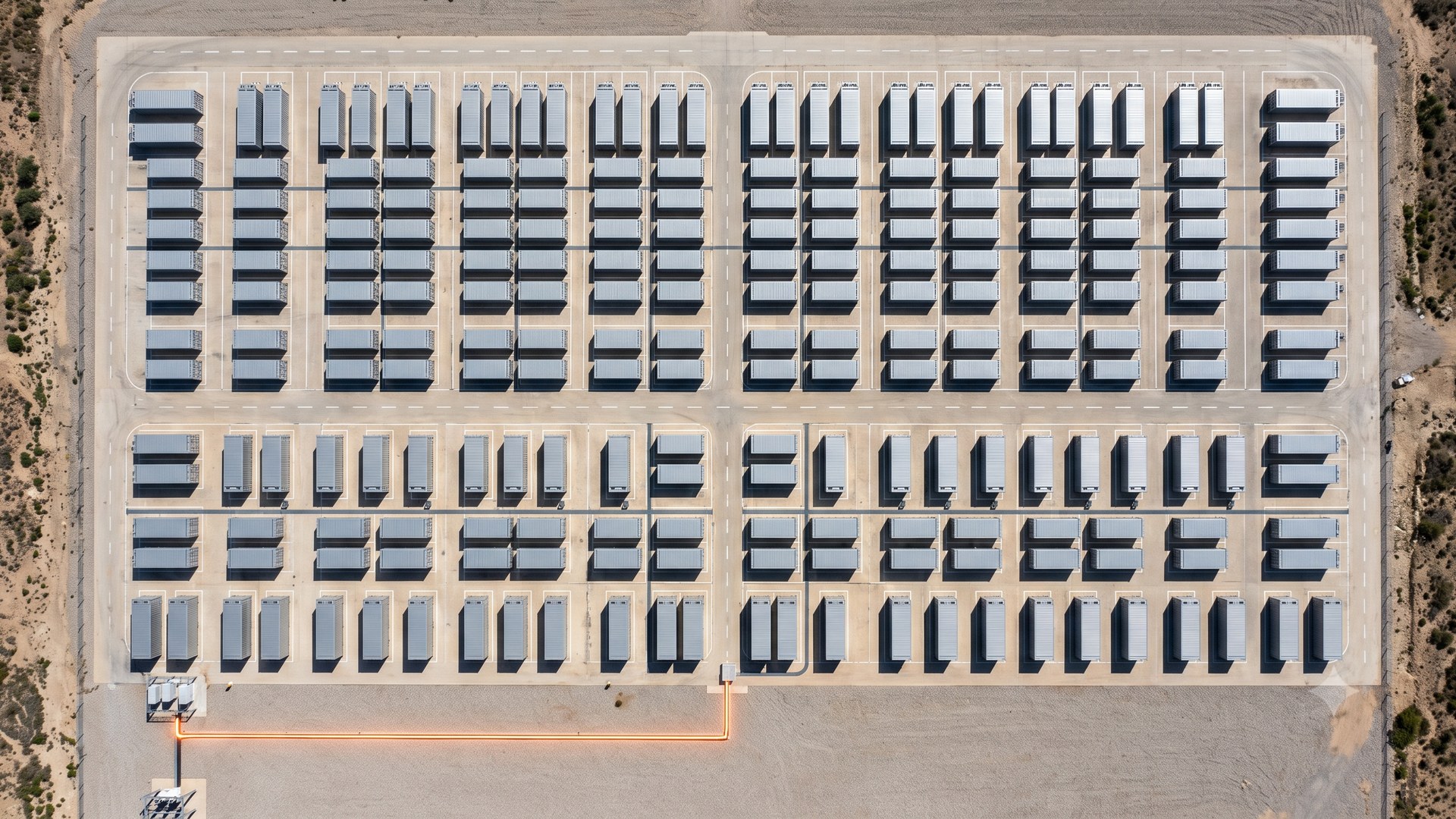
All of this matters because of a striking gap. By the grid operator's count, roughly 35 gigawatts of batteries sit somewhere in the access-and-connection process — about 15 with access granted, another 20 still requesting it. Connected and running? Close to nothing.
"We have something like twenty megawatts connected — practically zero," Revuelta said. The bottleneck has been permitting, not appetite. He expects the first real wave to clear environmental approval in the first half of 2026, with perhaps half a gigawatt to just under a gigawatt actually built by year-end. After years of paper, the concrete is finally about to be poured — but only just.
The reason so little has been built is not only red tape; it is doubt about whether the money works. A four-hour battery today might, in theory, earn 200,000-odd to 300,000 euros per megawatt of gross margin from day-ahead arbitrage plus grid balancing services. But those figures assume "perfect foresight," Revuelta cautioned — a theoretical ceiling no operator will ever hit, because nobody knows in advance when a thermal plant will trip or a wind forecast will miss. Worse, the richest balancing revenues are expected to cannibalise quickly: the volumes are small and the prices spike, so a handful of new providers can flatten the returns. Ask three consultants whether a battery is bankable, he said, and you will get three answers.
The bankability top-up
Which is where the third pillar comes in: Spain's long-delayed capacity market, a roughly nine-billion-euro mechanism the European Commission has now cleared. Its job is not to make batteries rich. It is to make them financeable.
The mechanism works by comparison. The grid operator decides how much firm capacity it needs — on the order of 47 to 50 gigawatts by the early 2030s — and then runs auctions that pit existing plants against new ones on the basis of how little public money each needs to be viable. An idle combined-cycle gas plant might ask for around 25,000 euros per megawatt per year just to cover its fixed costs. A battery might need, say, 18,000 euros per megawatt per year of "missing money" to make its financial model close. When the battery is the cheaper way to keep the lights on, the auction picks the battery.
That guaranteed strip of income is what unlocks debt. "A bank can say: I can lend, because there are now guaranteed revenues," Revuelta explained. Developers are weighing two paths — keep every euro of uncertain merchant upside, or sign away part of it through a tolling deal for the visibility that brings in cheap debt and a lower required return. The capacity payment tips that calculation toward "build."
AFRY's read is cautiously optimistic: somewhere around five gigawatts of batteries by the end of the decade, possibly more, from a blend of merchant projects, subsidised ones, and capacity-market winners. Much more than that and the arbitrage revenues cannibalise and the sums stop working; much less and the queue stays a queue. The auctions themselves will be dynamic — principal auctions on a five-year horizon, triggered whenever the loss-of-load expectation drifts above the new 1.5-hour reliability standard, with shorter adjustment auctions in between.
Why 2026 is the year
Put the three pieces together and the timing is the story. SRAD scales up and opens to smaller players. The hybridisation fix clears a path through permitting, legislative wobbles aside. And the capacity market — talked about for two years, always "next quarter" — finally arrives to backstop the projects that pencil out everywhere except the bottom line.
None of it makes a battery a sure thing. The merchant revenues are uncertain, the rulebook is scattered across too many overlapping laws, and the connection queue is still mostly paper. But for the first time the income stack has three legs instead of one, and the first of them pays you to do nothing at all. In a grid straining to absorb its own renewables, getting paid to stand by may turn out to be the most reliable business in the building.
These themes — SRAD, RD 997 and the capacity market — run through the agenda at RENMAD Almacenamiento in Seville on 17–18 March. Watch the full webinar recording for the worked examples behind the numbers above.
You reached this analysis because ATA Insights puts independent energy-transition intelligence in front of 86,000+ professionals across the sector. That's exactly what we do for funded projects, events and companies — turn your work into reach.
See how we disseminate work like this →Where this analysis came from
This piece draws on the ATA Insights / RENMAD webinar the session. Watch the full session on demand.

The energy transition, in your inbox
Join 86,000+ professionals reading our independent briefings across five sectors.