
How a Refinery Got to Yes
Europe's green-hydrogen survivors are not the ones with the loudest press releases. They are the ones that found a buyer, a rule to lean on, and money that arrived on time.
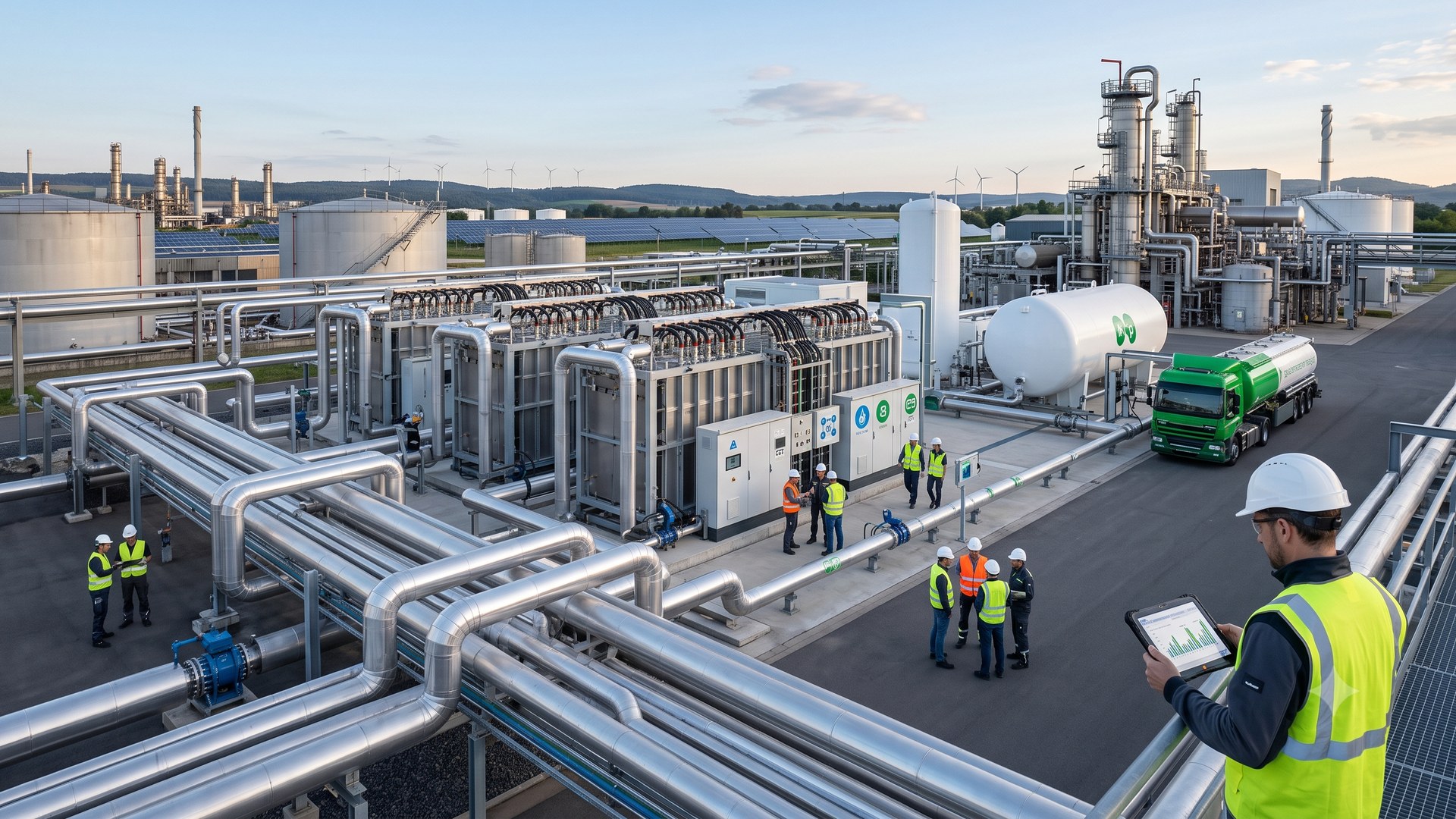
In November 2024, a refinery on the edge of Bilbao made a decision that most of its peers across Europe still cannot. Petronor's board signed off on a 100-megawatt electrolyser, one of the largest green-hydrogen plants to clear that bar in the European Union. No ribbon, no fanfare about a clean-energy future. Just a final investment decision, the moment a project stops being a slide deck and becomes a construction site.
That distinction matters more than it used to. Three or four years ago, hydrogen announcements arrived weekly, each one bigger than the last. The gap between what was announced and what got built has since become the most honest number in the sector. Of the 27 projects in the EU's Hy2Use programme that responded to a recent survey, only six had reached a final investment decision. The rest are still talking.
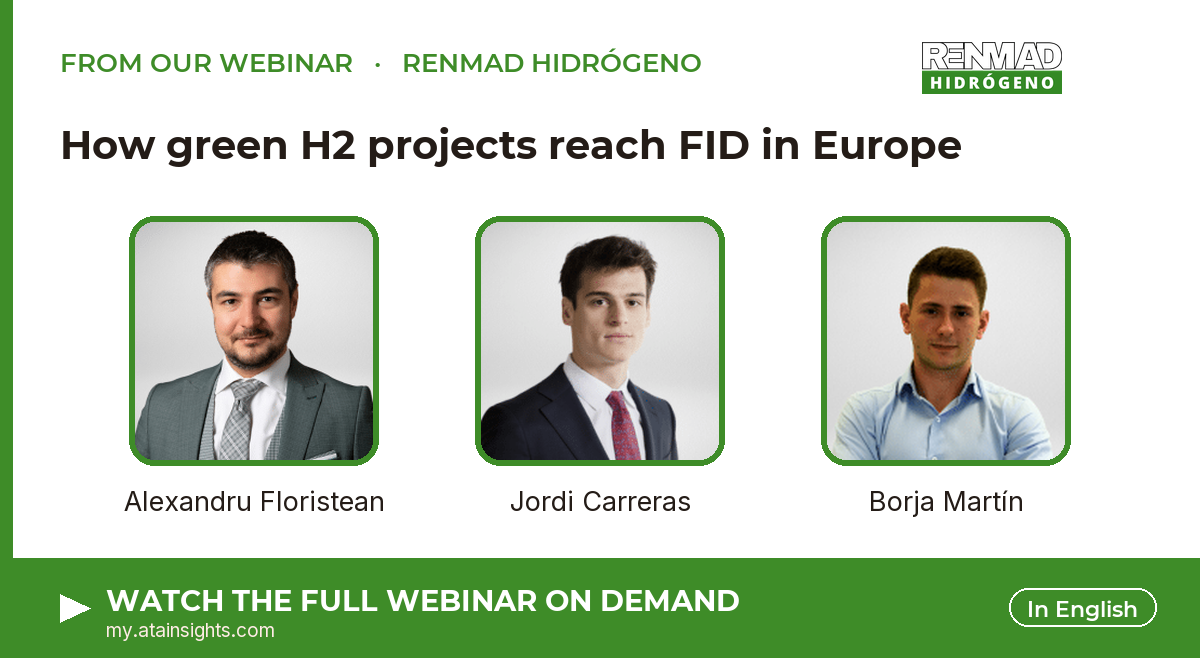
A RENMAD webinar hosted by ATA Insights, "How green hydrogen projects can reach FID in Europe," put three people who actually move the money in one room: an investor, a banker, and the refinery that got to yes. What they described was less a technology story than a story about discipline. The projects that survive look like businesses. The ones that don't look like ambitions.
The hype is over, and that's the good news
It is now safe to say the word out loud. The hydrogen hype is finished.
"Hydrogen is well past the hype stage," said Alexandru Floristean, an operating partner at Hy24, the world's first private-equity manager dedicated entirely to hydrogen. "The peak hype was 2021 and 2022, around the time the EU regulations were just about to be adopted. Since then there was a lot of maturity into the projects, where the initial excitement hit the reality of how difficult it is to reach FID." His firm has raised more than two billion euros and has over five gigawatts of electrolysis capacity in advanced development across Europe, with roughly 1.3 gigawatts already past the decision and into construction. That puts Hy24 in the rare position of seeing the whole market at once, from steel in Sweden to maritime fuel to Spanish refineries.
The collapse of the hype did something useful. It cleared the field. What is left, Floristean argued, is a "valley" where only the well-built projects cross. Jordi Carreras, a vice-president in BBVA's low-carbon transition advisory team, agreed and called it good news. "What we're seeing now is this valley where the best projects actually reach FID," he said, "which is very good, because we can learn from them and help the full ecosystem with solid projects, with good fundamentals, to go ahead and produce the clean molecule we all want."
So what separates the projects that cross from the ones that stall? Strip away the jargon and three things keep appearing: a real buyer, a rule worth betting on, and money whose timing lines up.
A buyer, not a hope
Most of the difficulties in building a hydrogen plant are not new. Land, grid connection, permitting, construction, even the financing structure of project debt plus equity, these are problems the industrial world solved decades ago. "Project developers know exactly how to deal with that," Floristean said, "and frankly so do banks, and so do equity investors."
The genuinely new part is the business plan, and at the centre of the business plan sits the buyer. Floristean was blunt about where it ranks. "I left the best for last. A solid offtake. When you're building a business case on the basis of regulation, you either exist or you don't exist on the basis of having an offtaker willing to go together with you all the way."
A bank views the same buyer through a narrower lens. Carreras laid out what makes one acceptable. "As a bank, what we want is certainty on revenue, uncertainty on cost," he said, "so that we can get back the money that we lend." In practice that means an offtake agreement of at least ten years, written with take-or-pay clauses or tolling structures that push market risk out of the equation, and backed by a buyer with an investment-grade balance sheet. A handshake and a memorandum of understanding do not finance a plant.
This is where Petronor's plant has a structural advantage that few standalone projects can match. The buyer is the refinery itself. Borja Martín, energy-transition project manager at Petronor and deputy chair of the Hy2Use working group inside the EU's IPCEI programme, explained that the molecule never has to find a market. "Our 100-megawatt project, and Petronor itself, is the main consumer, using renewable hydrogen for the decarbonisation of our activity," he said. The refinery is already a large hydrogen user and, crucially, it is subject to obligations under the Renewable Energy Directive. It has to buy green hydrogen. The plant simply supplies it.
The rule that pays for the molecule
That obligation is the quiet engine under almost every European hydrogen plant that has reached a decision. The value of green hydrogen today does not come mainly from the market. It comes from a law.
Floristean spelled it out in answer to an audience question about whether operating subsidies, not regulation, are what really drive the sector. "To be extremely clear about the engine of the vast majority of projects that have reached FID, it is the implementation of the Renewable Energy Directive," he said. "It is a mandate, an obligation on fuel suppliers to integrate minimum amounts of RFNBOs in the fuels they sell in a given country. In the refinery route, the ability to consume hydrogen within a refinery in the production of conventional fuels and biofuels is the most economically effective way to comply with that obligation."
RFNBO is the EU's term for renewable hydrogen and its derivatives. The directive forces fuel suppliers to blend in a minimum share or pay penalties, which means they will pay a premium for the molecule. Public grants, in this reading, are not the prize. They are a sweetener. Floristean was emphatic that the much-criticised European Hydrogen Bank auctions were never meant to bridge the full cost gap between grey and green hydrogen on their own. "They don't even come close," he said, calling the subsidy "a cherry on top of the cake." The directive is the cake.
Which makes the directive's slow rollout the single biggest brake on the sector. The EU passed the rule. Member states then have to write it into national law, and most have not. "The biggest barrier that has held back the development in the sector, by far, was the delay in the transposition of the Renewable Energy Directive across Europe," Floristean said. Equity, debt, and buyers are being asked to commit capital on the basis of a regulation that, in most countries, has not been filed.
One country is the exception, and the contrast is stark. "The only one that did an amazing job at transposing the directive, also one year late I might add, is Germany," Floristean said. "Germany has fully transposed the Renewable Energy Directive, with clear targets in 2030 up until 2040, giving market visibility for 15 years, and de-risking projects." He expects a wave of decisions in Germany and in Denmark, building to supply Germany on the strength of that visibility. Spain, by contrast, has a draft and a promise. The transposition was pledged for the summer but has not been filed. Until it is, Spanish developers are guessing at demand past 2030.
Money that arrives on time
The third ingredient is the least glamorous and, in the wrong order, the most fatal. A buyer and a rule are worthless if the capital does not show up when it is needed.
Carreras described how a bank actually sizes its loan: take the offtake contract, the construction package, the technology, and the operating plan; run them through standard debt-service cover ratios; and only then decide how much debt the cash flows can carry. He stressed one point that kills more projects than any other. The equity and the debt have to move together. "It's very important that the timelines are aligned," he said, "given that financial close will not be reached until you have all the sources of capital well aligned, going in parallel, and able to be triggered where needed." A project with committed debt but no equity, or grant money that lands a year after the construction bills, never closes.
Petronor's plant shows what alignment looks like in practice. The funding gap was bridged by roughly 160 million euros of support through the IPCEI scheme, channelled via Spain's IDAE. "This was essential for achieving the economic feasibility," Martín said. Better still, the terms let the company draw the grant up front rather than waiting for milestones. "The conditions provided by IDAE allowed us to receive the full advance payment of the grant, and this significantly improved the project's liquidity." Cash that arrives early is worth more than cash that arrives correctly but late.
Around that core sat the rest of the puzzle, assembled at the same time rather than in sequence: technology de-risked alongside the electrolyser manufacturer and Repsol's technology lab, permits secured with the grid operator and the Basque government, and the whole effort anchored in the Basque Hydrogen Corridor, a cluster that ties producers to users within a 40-kilometre radius of the refinery. Martín's summary of the lesson was unfussy. To reach a decision, all six elements, funding, demand, partnerships, financing, technology and regulation, "must come together simultaneously." Not in a tidy line. At once.
What the survivors have in common
Martín pointed to a warning sign the sector keeps ignoring. In one Innovation Fund auction round, several developers bid so aggressively that they won support and then withdrew, unable to make the numbers work at the price they had offered. Winning a subsidy is not the same as having a viable project, and a competitive auction that rewards the lowest bid can hand prizes to plants that will never get built. Spain's own auction-as-a-service budget, Martín noted, went under-allocated. The hard part is not handing out money. It is designing support so that feasible projects can actually move to construction.
That is the through-line connecting an investor in Brussels, a banker in Madrid and a refinery in Bilbao. The hype generation chased scale and announcements. The survivors do something less exciting and far harder. They find a buyer who is contractually bound to take the molecule, anchor the revenue to a rule that has actually been written into law, and line up debt, equity and grants so they trigger together. Everything else, as Floristean put it, the sector already knows how to do.
The next test is whether the rules catch up with the projects. Germany has given its developers a 15-year horizon. Spain has given its developers a draft and a deadline that keeps slipping. The plants are ready. The question is whether the law will be on time, or fashionably late.
Petronor got to yes because, for once, all of it lined up at the same moment. The uncomfortable truth for the rest of Europe is that yes was never about the technology. It was about whether anyone had bothered to build a business.
You reached this analysis because ATA Insights puts independent energy-transition intelligence in front of 86,000+ professionals across the sector. That's exactly what we do for funded projects, events and companies — turn your work into reach.
See how we disseminate work like this →Where this analysis came from
This piece draws on the ATA Insights / RENMAD webinar How green H2 projects reach FID in Europe. Watch the full session on demand.
The energy transition, in your inbox
Join 86,000+ professionals reading our independent briefings across five sectors.