
Many unhappy returns
A lithium cell starts ageing at the factory; its warranty, months later, at provisional acceptance. That gap shifts risk from supplier to owner without anyone signing for it, and now that Spain's capacity market rules are in the official gazette, it is starting to carry a price.

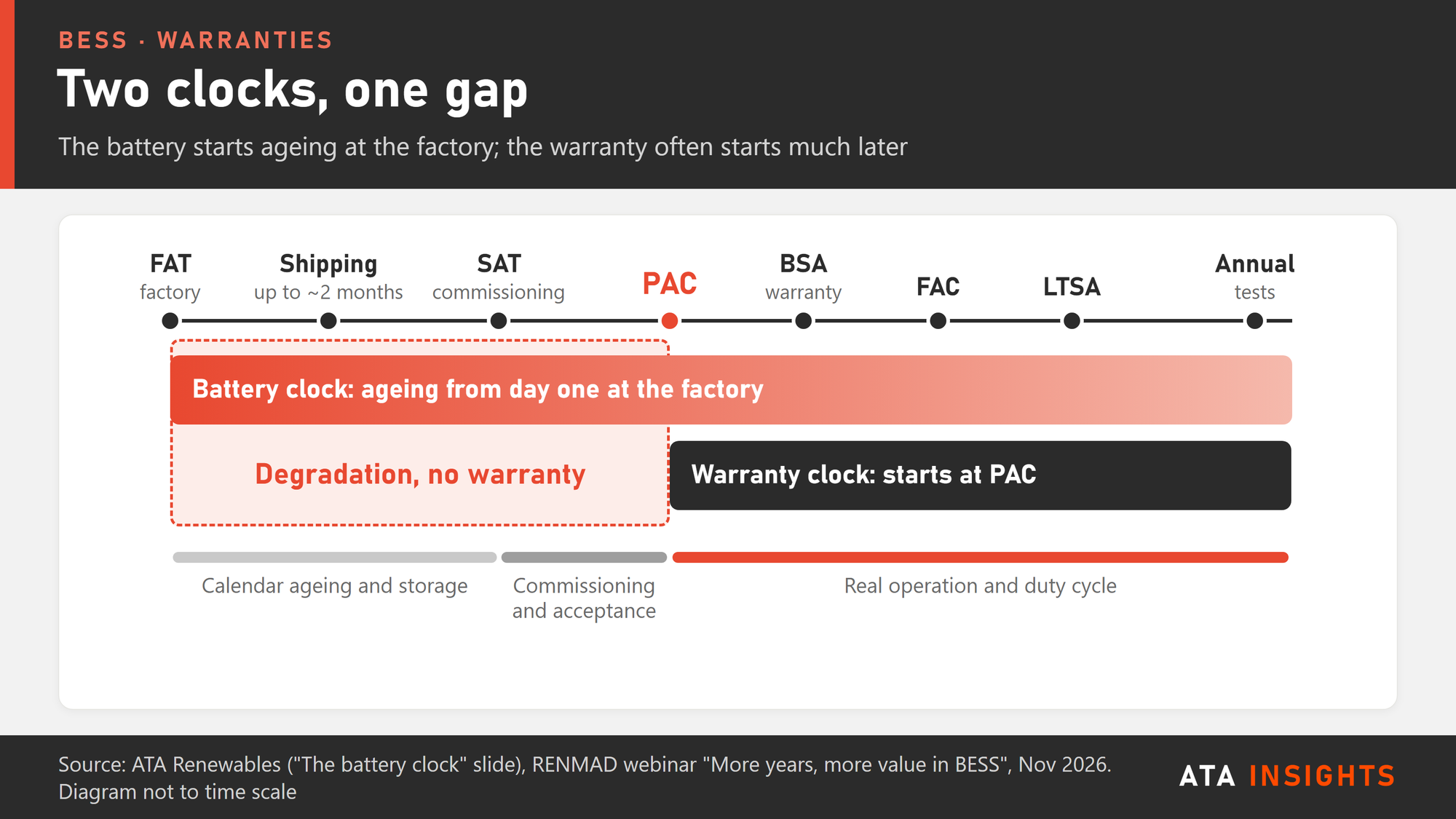
Battery storage has a birthday nobody celebrates. A lithium iron phosphate (LFP) cell begins to age the moment it leaves the assembly line, whether or not any contract has noticed: the factory turns the hourglass over. The performance warranty usually starts much later, at the plant's provisional acceptance (PAC). In between there is room for weeks at sea, months in a storage yard and the odd commissioning that drags on. The bill for that gap lands, almost always, with the owner.
Sergio Sáenz Robles, head of storage at ATA Renewables, put it plainly at the RENMAD webinar "Más años, más valor en BESS" ("More years, more value in BESS"): "We can set two clocks: the battery's natural clock and the contract's clock." In a market that hopes to grow its battery fleet twentyfold by 2030, the gap between those clocks is no longer a footnote.
Front-loaded
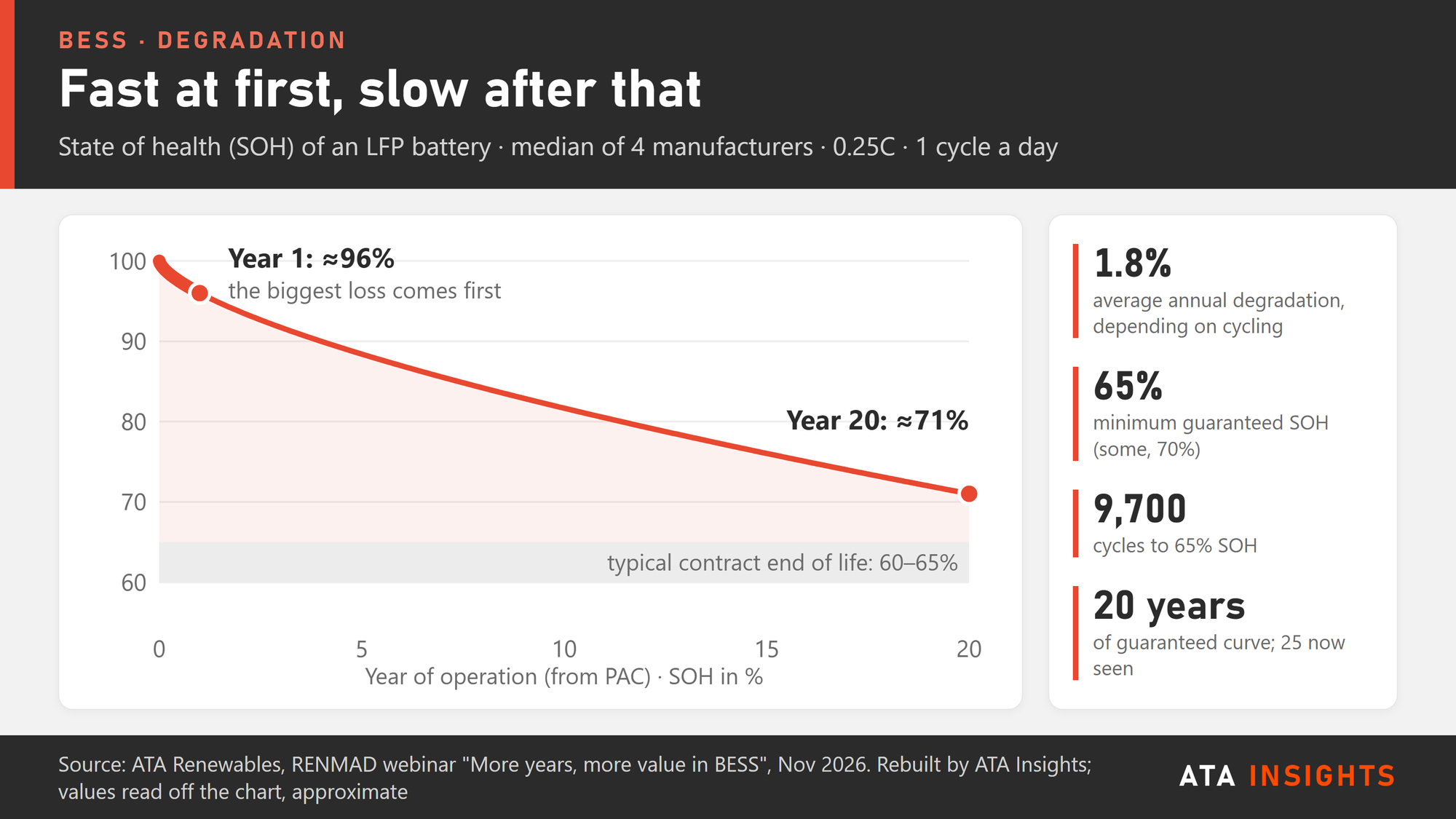
Mr Sáenz's headline number is average degradation of 1.8% a year, though that depends on how the battery is cycled and on its p-rate (power divided by energy). For a four-hour battery (0.25C) cycling once a day, he cautioned, it is lower. In that case the median of four manufacturers puts state of health (SOH, usable energy as a share of nameplate) at around 96% after the first year and close to 71% after twenty. Warranties typically set a floor of 65% SOH (70% in some cases) over a 20-year curve.
The shape matters more than the average. In LFP, Mr Sáenz warned, the first and second years bring the steepest degradation, which can reach 4% a year; after that the curve flattens. That first drop, the one in operation, is already drawn into the warranted curve. What no paperwork shows is the drop that comes before it.
The sand keeps falling in the yard
Calendar degradation is what a battery suffers "simply by existing", in Mr Sáenz's words, and it depends mainly on the temperature and state of charge (SOC) at which it is stored. In a 30-month test on commercial LFP cells (IEEE, 2020), a cell stored at 70% charge lost 0.33% of its capacity at 10°C and 5.33% at 35°C. At 35°C, a cell stored full lost 8%, and one at 20% charge a third of that. In the test's other LFP cell, storing it at low charge only halved the loss. Nor is any of it reversible: some of the lithium ends up trapped in the film that grows on the electrode.
Now put that on a real site. A container waiting in a yard in southern Spain in August, its cooling off because the plant is not yet energised to run its auxiliaries, ages faster than any agreed curve; if it was left at high charge after the first tests, worse still. Transport, Mr Sáenz noted, "is no small thing": it can take up to two months. Then come the site acceptance tests (SAT), commissioning and slippage in the commercial operation date (COD), which in Spain seldom depends on the supplier alone. A shared substation or a late export line is enough. "If I have delays on site and the batteries arrive in the field and can't be commissioned, there will be degradation there that the manufacturer's contract won't cover," he summed up.
So the risk changes hands by the back door. If the warranted curve starts from the SOH measured at PAC, everything lost before it (at the factory, at sea, in the yard) falls outside the cover. And if the delay is the site's fault, the supplier will have a good case for not carrying it. The owner finds out late, when the energy in the financial model fails to show up on the meter.
Five clauses to stop the leak
The good news is that this leak can be plugged with ink. Mr Sáenz's presentation yields five terms worth negotiating in the battery supply agreement (BSA) and in the long-term service and warranty agreement (LTSA).
It all begins with the starting SOH. "It is essential that I agree with the manufacturer what my starting point is going to be," he insisted.
Next comes the delay adjustment: if SAT or COD slips, the warranted curve shifts or the starting SOH is corrected, with the storage conditions set down in black and white. And watch for double counting. Some technical advisers are already warning of contracts in which the curve and the delay clause both deduct the same calendar loss, so the owner pays for it twice.
The third issue is where the energy is measured. When the battery and the balance of plant (BOP) are bought separately, Mr Sáenz explained, defining the point of interconnection (POI) causes "a lot of disputes": losses in the inverter (PCS), the transformer, the auxiliaries and the cabling that nobody wants to own. Guaranteed energy should be fixed at the POI, year by year.
Then there is the test protocol. "A good test is not the one that passes; it is the one that later stands up to a technical and contractual dispute," reads his slide. That means fixing the initial and final SOC, rest periods, temperature window and calibration, and repeating the PAC method every year, with IEC 62933-2-1 and IEC TS 62933-2-3 as the reference standards.
Finally, the remedy: a cure period, a retest and a defined outcome, whether more batteries at the supplier's expense or liquidated damages.
Firm, and frozen
All this would matter less if batteries lived on arbitrage alone. Brussels cleared Spain's capacity mechanism at the end of May 2026, worth an estimated €9 billion over ten years, and Order TED/966/2026, published in the BOE, Spain's official gazette, on 17 September, set it in motion. New installations can commit for up to 15 years, and article 15.12 leaves no wriggle room: "The award price and the firm capacity awarded shall not be subject to updating."
The battery signs up to a number that stays put while the battery itself does not. The system operator will test it at least once a year, during stress periods, with payments "of a deterrent nature" if it fails. What degradation steals is hours: with 10% less energy, a four-hour battery can no longer hold its rated power for the full four hours. How heavily that counts will depend on the firmness coefficients for storage, still unpublished, as is the date of the first auction. But anyone who bids without allowing for degradation will be selling capacity they will not have in year twelve.
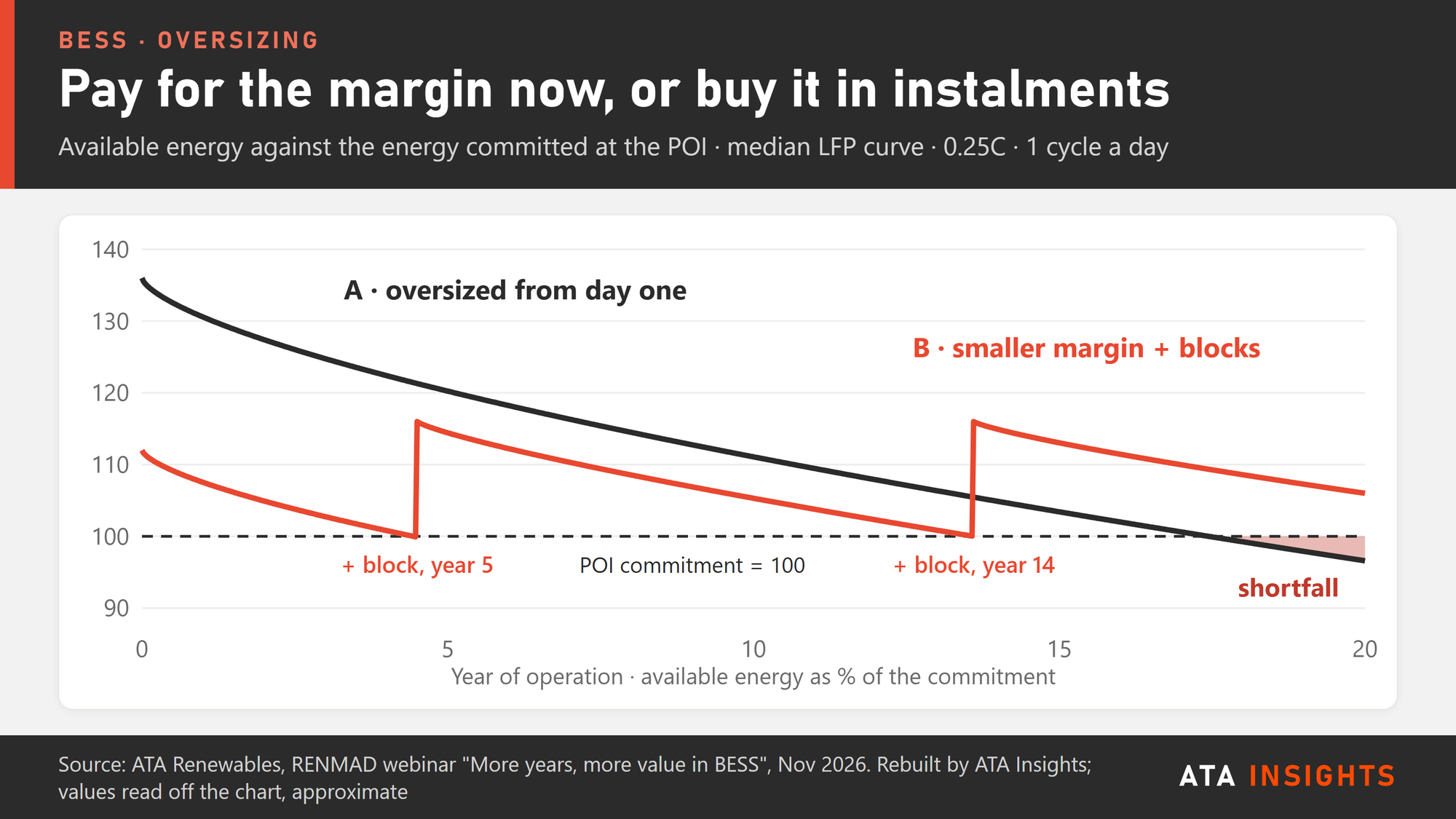
That is where augmentation comes in. Faced with a contract that demands constant capacity, Mr Sáenz set out two routes: oversize heavily at the start, or add blocks along the way. In his example, option A starts with more than a third extra energy and still falls short around year 18; option B starts leaner and adds blocks around years 5 and 14. "Oversizing or augmenting is a cash-flow decision," as his slides put it. One rule admits no exceptions: never mix old and new modules in the same container, because the most degraded cell sets the limit.
Whichever route an owner takes, every point of SOH lost before PAC will have to be replaced sooner than planned, and with the owner's capital.
Set the clock, collect the cheque
According to AEPIBAL, Spain's battery and energy storage association, the country has some 300 MW of batteries in operation and close to 37 GW in grid access and connection applications. Its central scenario for 2030, presented on 12 November, is 6 to 8 GW. That pipeline will arrive at the same ports and substations at roughly the same time. Delay will be the norm.
Which is why the developer who comes to the table with the starting SOH, the delay adjustment and the POI tied down turns an invisible loss into a bankable asset: a model a lender can believe, and a capacity bid that will not fall short halfway through the contract. When drafting the remedies, Mr Sáenz urged, "it is always essential to assume the worst"; when modelling the business, he suggested working with the degradation actually expected rather than the warranty's most conservative figure. The two can coexist, provided the contract makes clear who pays for each month of waiting.
"A battery is bought once and managed for twenty years," ran the closing line of Mr Sáenz's presentation. The factory turns the hourglass over. The contract had better notice the same day.
All of this will be back on the table at RENMAD Almacenamiento, in Seville, on 31 March and 1 April 2027.
You reached this analysis because ATA Insights puts independent energy-transition intelligence in front of 86,000+ professionals across the sector. That's exactly what we do for funded projects, events and companies — turn your work into reach.
See how we disseminate work like this →Where this analysis came from
This piece draws on the ATA Insights / RENMAD webinar More years, more value in BESS: degradation, augmentation and end of life. Watch the full session on demand.
The energy transition, in your inbox
Join 86,000+ professionals reading our independent briefings across five sectors.