
Mind the gap: the control-room AI wringing more out of green hydrogen
With the money for Onuba and Petronor now on the table, Spain's first large hydrogen plants will win or lose their margins in operation: in how load is shared between stacks, how shutdowns are avoided and at what hour it pays to produce
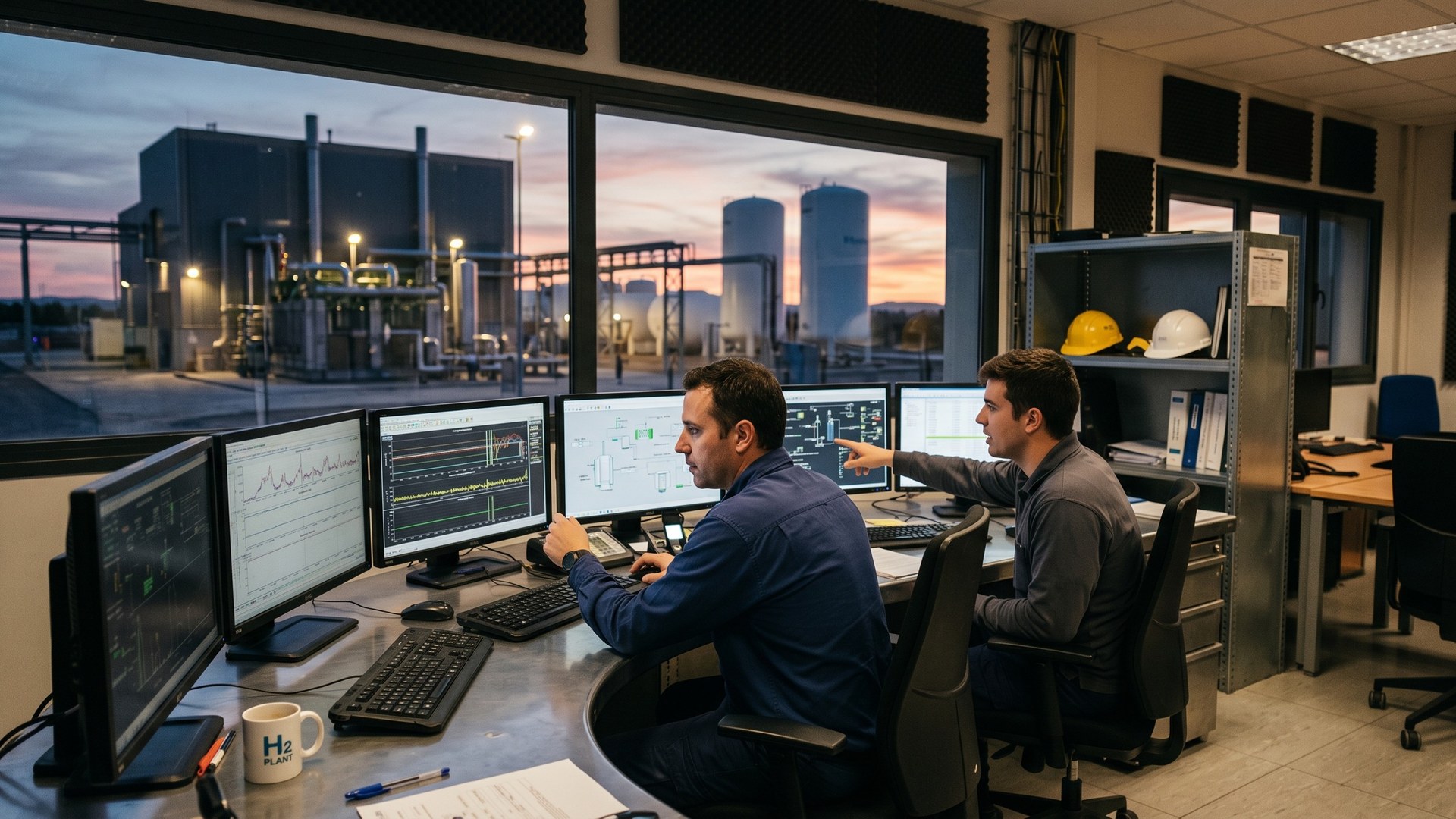
For years Spain measured its green hydrogen in megawatts announced. In 2026 the yardstick has become millions committed. On 26 January Repsol announced that it will install its second 100 MW electrolyser at Petronor, a €292m investment, with commissioning planned for 2029. In early March Moeve's board took the final investment decision on Onuba, in Huelva: 300 MW, more than €1bn and some 45,000 tonnes a year, with the foundation stone set for 17 September. In May the European Hydrogen Bank's third auction selected nine projects to share €1.09bn in fixed premiums per kilo produced, paid for up to ten years. And on 6 August MITECO, Spain's Ministry for the Ecological Transition, allocated €274.2m to four Spanish projects (102.27 MW) that had been left on that auction's reserve list.
The lowest bids in the auction hover around half a euro per kilo. That is the support a developer asks for, not what the hydrogen costs to produce, so the margin will have to be found elsewhere. One place almost nobody looks when closing the financial model is the control room. That was the thread running through the webinar on AI in hydrogen that ATA Insights held on 8 September.
The gap the spreadsheet misses
Schneider Electric gave the problem a name: the distance between the plant "as designed" and the plant "as operated". Lenders finance the first, with its rated consumption and running hours. Operators inherit the second, whose stacks each age at their own pace and whose alarms are cleared by trial and error. Without visibility, the bill arrives as higher operating costs (OPEX), higher electricity consumption, more shutdowns and shorter useful life. All of it pushes up the LCOH, the levelised cost of hydrogen: what each kilo costs on average over the life of the plant.
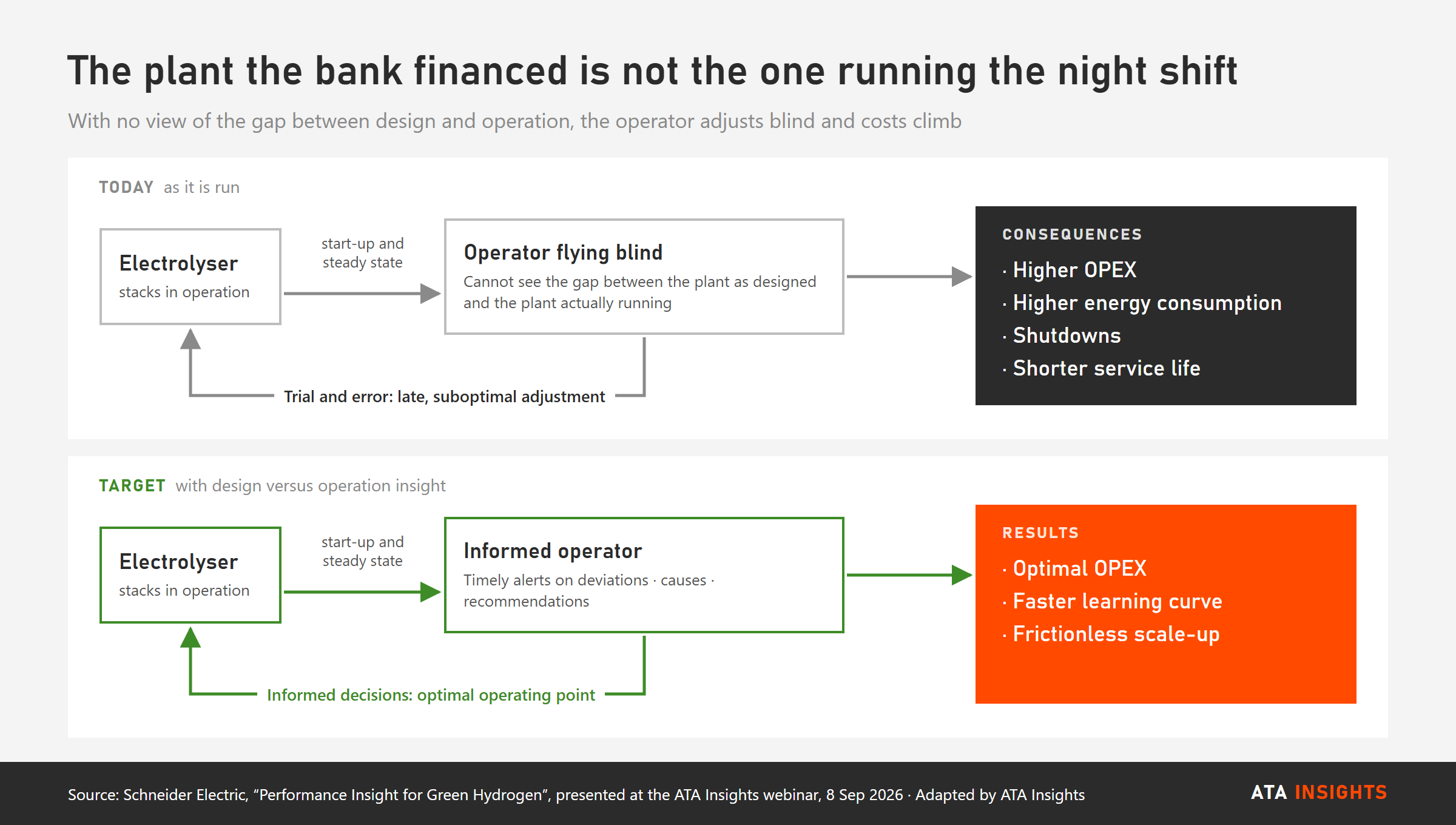
That gap matters more in hydrogen than in a conventional chemical plant, and Manuel Járrega of Schneider Electric explained why: "green hydrogen plants are not process plants with a bit of electricity [...] here the electrical side matters a great deal." Electricity is the biggest line on an electrolyser's operating bill, so every kilowatt hour wasted ends up in the price of the kilo. Hence his conclusion that these plants "have to be born digital natives", with data designed in from the basic engineering stage rather than bolted on afterwards.
Share and share unalike
The first lever is the least glamorous, and the only one that came to the webinar with a number attached. A large electrolyser is built from several stacks, the assemblies of cells in which water is split into hydrogen and oxygen. No two are alike: each carries its own history of running hours, starts and degradation. Splitting the load equally looks sensible, but it fails to exploit precisely those differences.
In the case Schneider Electric showed, a ten-stack plant runs at 80% load, with 86% of its capacity available and a production target of 311.7 kg/h. The optimiser recommends loads ranging from 66.45% (stack 03) to 90.82% (stack 06). That split cuts average specific energy consumption (the kilowatt hours needed to produce one kilo) from 44.63 to 44.07 kWh/kg: a saving of 0.56 kWh/kg, or around 1.25%.
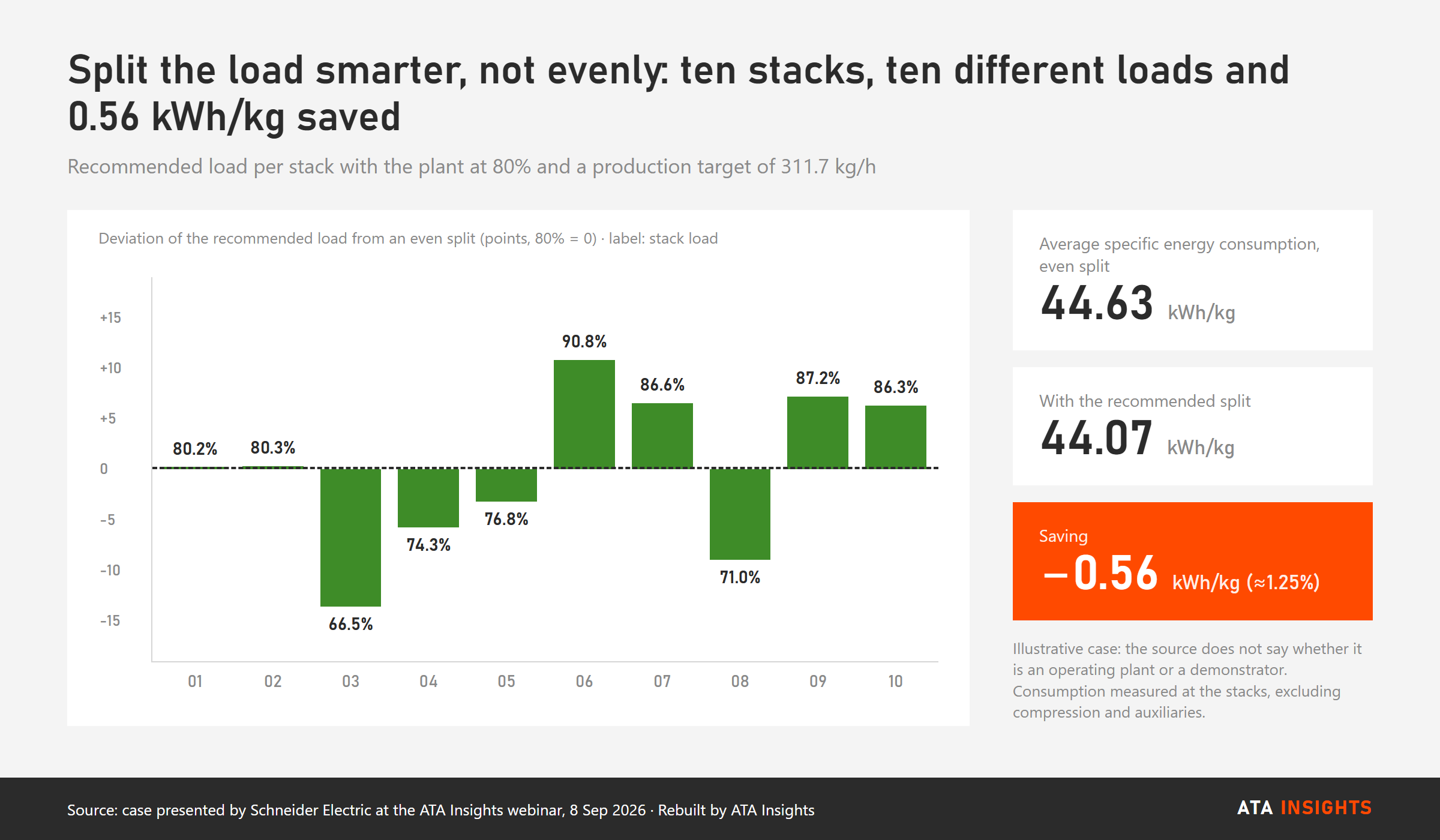
The number should be taken for what it is: an illustrative case. The slide does not say whether it comes from an operating plant or from a demonstration of the tool. Everything points, too, to consumption being measured at the stacks alone, not across a full system with compression and auxiliaries. And for now the tool recommends and the operator decides; letting it act on its own, in closed loop, is listed as a possible extension.
Still, do the sums. At that output, 0.56 kWh/kg is about 175 kW of continuous load that the plant no longer pays for while it runs at that operating point. At an illustrative power price of €60/MWh, the saving comes to around 3.4 cents a kilo, nearly 7% of that half-euro premium. All without buying a single extra stack.
A stitch in time
In the closing round the moderator asked the panel to name the AI application that will do most for plant competitiveness over the next three to five years. Samuel Ormaechea of ITG opened with "I'm going to stick my neck out a bit" and settled on "good predictive maintenance of hydrogen generation systems". His reasoning was that the technology is not new, but the market is still in its infancy and costs are "really quite high". A tool able to give "the supplier or the operator of the system visibility of that monitoring and that predictive maintenance", he added, "will mean as little as possible of the money invested in running the system is lost".
Járrega agreed ("I loved Samuel's answer"), calling it the application that makes it possible to "maximise the life cycle of the assets". CGI, which builds agentic AI into its platform, said it was "completely in agreement". In that platform, too, the agents do not outrank the data. Earlier, during the audience questions, Virginia Jiménez of CGI had set out the pecking order: "all the parameters are set by the predictive models, and the agents simply do the managing."
Predictive maintenance spots failures in the operating data before they force a shutdown, but it needs something more prosaic than any algorithm: reliable data. Ormaechea flagged the problem while discussing digital twins: "with a lot of manufacturers", the data supplied to parameterise the plant does not always match the way it actually runs. That is where the opportunity lies. Whoever is first to build up an operating history for Spain's early plants will have a head start on availability and useful life.
Just enough, just in time
Another lever cuts against the instincts of anyone who has built a business plan on capacity factor. Jiménez put it this way: "Optimisation should not simply chase [...] the largest possible quantity of hydrogen." The aim, she added, "will be to produce the quantity needed to guarantee supply" on the best technical and economic terms.
Storage is what makes that possible. In her words, "there is no need to produce the hydrogen at the same moment it is consumed, as long as adequate storage levels are maintained and the committed supply is guaranteed." With a tank between the plant and the customer, the electrolyser turns into a flexible load that can concentrate its output in the sunny, low-price hours. Járrega summed it up as AI "to store or produce at the right moment, depending on prices".
That requires seeing the good hours coming. ITG's platform, tested on the experimental plant at its laboratory in A Coruña, forecasts generation up to 72 hours ahead. That, Ormaechea said, makes it possible to run the plant "with far, far more flexibility than doing it blind or with simple market values".
Dress rehearsal
Many of these levers can be tested before the plant exists. In Schneider Electric's version, a digital twin (a virtual replica of the installation fed with engineering and operating data) has three lives. In the first it validates the design. In the second it enables virtual commissioning of the control system and doubles as an OTS, an operator training simulator in which staff learn to run the plant without risk. Schneider points to an OTS for Yara's 24 MW electrolyser at Porsgrunn, in Norway, and to virtual commissioning and an OTS for a 200 MW plant in the Netherlands.
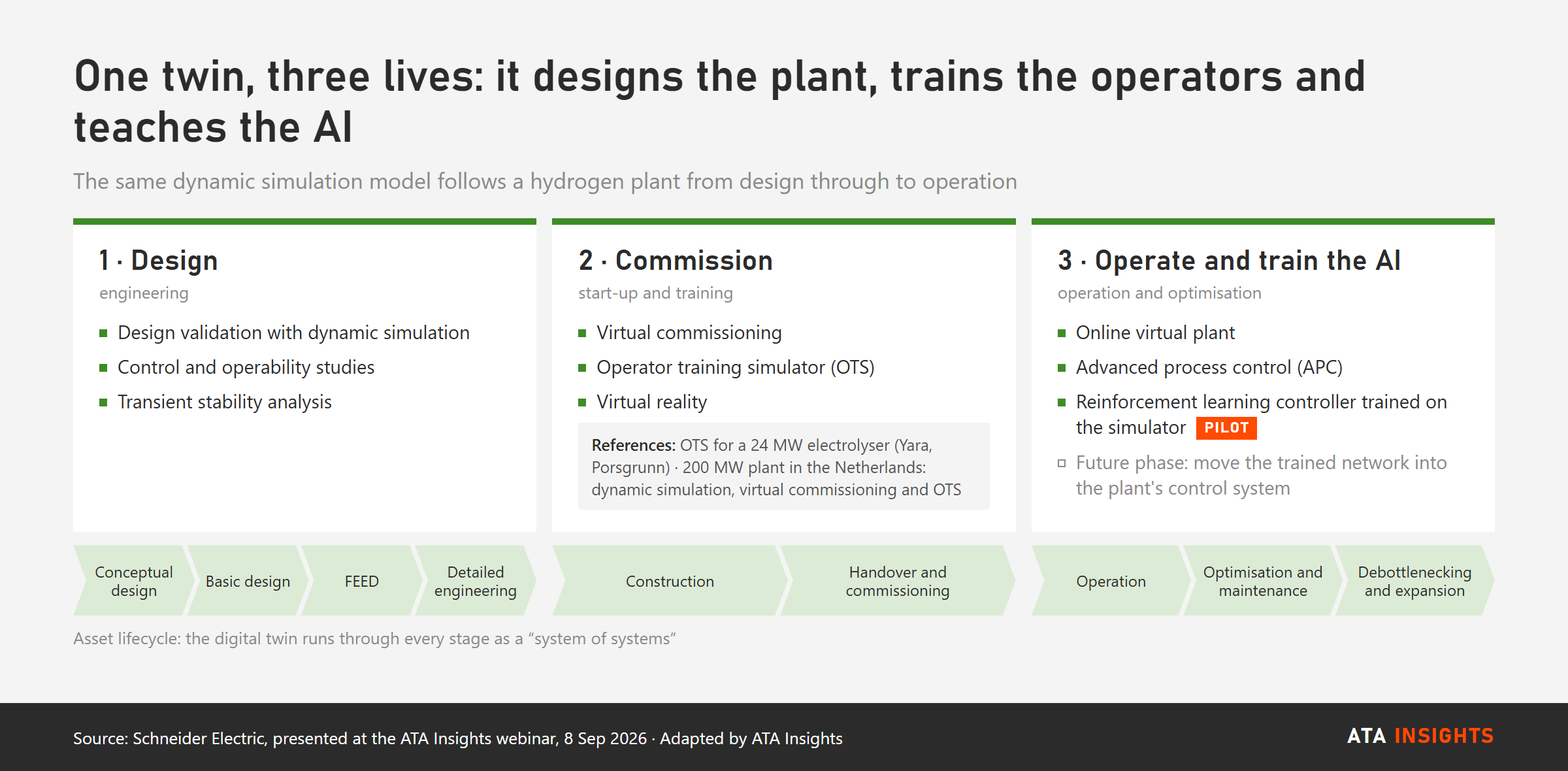
In its third life the twin trains the AI itself. Using reinforcement learning, a neural network is put through many copies of the simulator and drilled on the situations where operators struggle to react in time, before it goes anywhere near a real stack. "We are already doing pilot plants," Járrega said, though taking that network into the plant's control system is still a future phase. He also set a condition: if the trained model "does not behave like the real plant, the model is not valid". For projects still on paper or under construction, the time to think about that twin is now, because the first of its three lives cannot be had after the fact.
Does it stack up?
The sharpest question came from a member of the audience, and it was only half answered. If the cost of replacing a stack changes, because the new one is better quality and carries a different price, should the old stack's protection against degradation and the plant's minimum operating load not change too? The panel replied that the solutions can be parameterised.
Every start, and every ramp to catch a cheap price, speeds up stack wear, and that wear carries a price that depends on what a replacement costs. The optimisers shown at the webinar already track the condition of the stacks. The next step will be to weigh the euro of electricity saved today against the euro of useful life it takes from tomorrow. Nobody at the webinar put a number on that trade-off. Whoever does will have turned degradation, today a risk in the financial model, into just another operating variable.
Mind the gap, the Tube tells its passengers. Hydrogen operators can do rather better than mind theirs: the gap between the plant as designed and the plant as run is now measured in kWh/kg, and what gets measured can be trimmed.
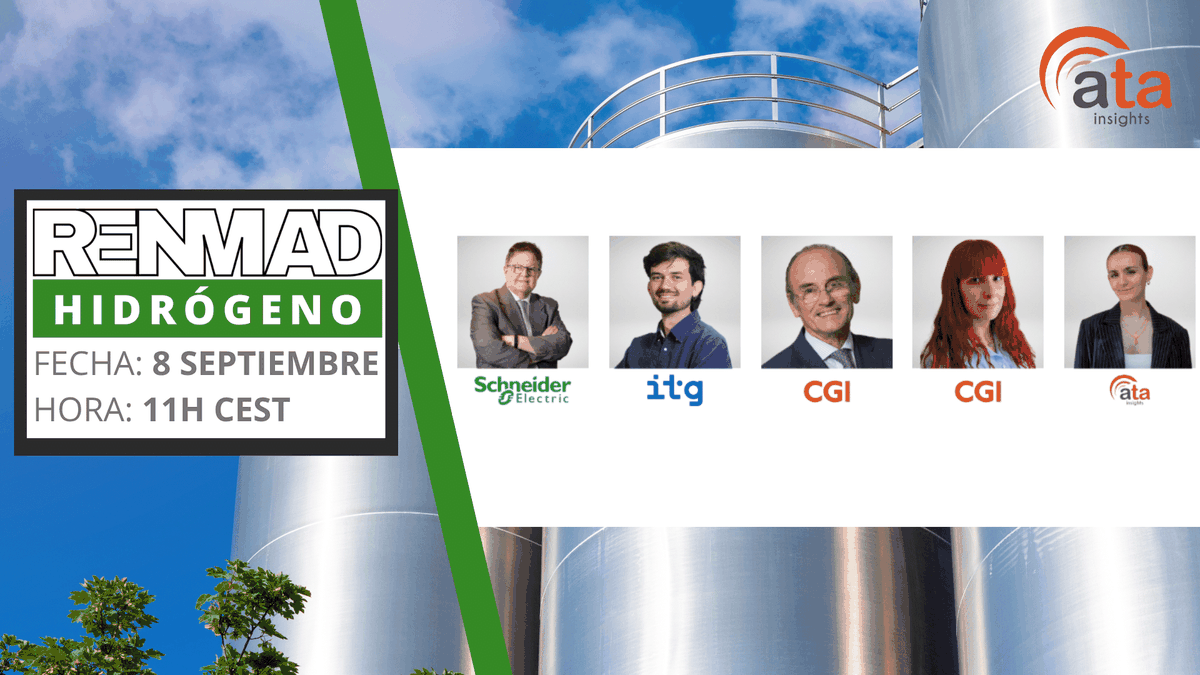
This article is based on the ATA Insights webinar "IA aplicada a la optimización de la producción y operación del hidrógeno" (AI applied to optimising hydrogen production and operation), held on 8 September 2026, with Carlos Navares and Virginia Jiménez (CGI), Manuel Járrega (Schneider Electric) and Samuel Ormaechea (ITG). The debate continues at RENMAD Hidrógeno in Zaragoza on 18 and 19 November 2026.
You reached this analysis because ATA Insights puts independent energy-transition intelligence in front of 86,000+ professionals across the sector. That's exactly what we do for funded projects, events and companies — turn your work into reach.
See how we disseminate work like this →Where this analysis came from
This piece draws on the ATA Insights / RENMAD webinar AI applied to optimising hydrogen production and operation. Watch the full session on demand.
The energy transition, in your inbox
Join 86,000+ professionals reading our independent briefings across five sectors.