
Pay up or power down
Since the 2025 blackout, Spain has been paying to keep the lights on: €3.9bn between January and October, on technical constraints alone. Nobody questions that insurance. The RENMAD webinar asked something else: what is inside a balloon that never stops swelling, who collects, and why those of us who pay for it never get to see the receipt.

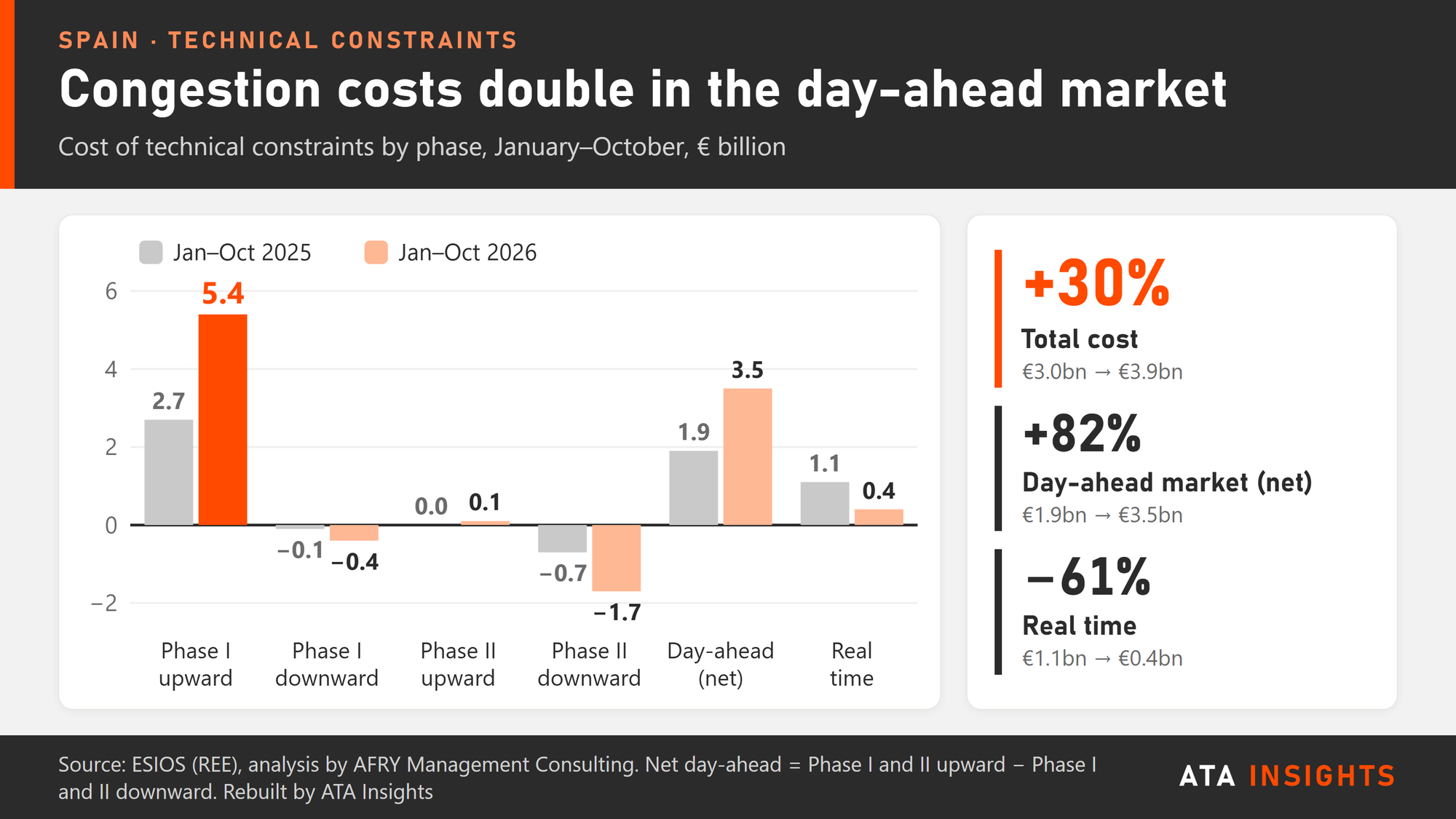
Nobody wants another 28 April. Since the blackout, Red Eléctrica, Spain's transmission system operator, has been running the grid in "reinforced operation", a tighter security regime that keeps more combined-cycle gas plants switched on to hold the network's voltage steady. That security is paid for through a component of the electricity bill that almost nobody looks at: technical constraints, the cost of squaring what the market schedules with what the wires can actually carry. According to Red Eléctrica data analysed by AFRY Management Consulting, constraints cost €3.9bn between January and October 2026, 30% more than a year earlier.
That is why, in November, RENMAD devoted a webinar to them, under a title that skipped the anaesthetic: "4.000 millones en tiritas" (€4bn in sticking plasters). The bill had been climbing for years and the blackout sped it up, but the real cure, more grid, is running late: the bulk of the investment lands from 2028 onwards. In between lies another year of patching, and one question: who gets paid for the patches.
To answer it, the webinar brought together Marcela, an energy consultant at AFRY Management Consulting in Madrid, and Belén Gallego, founder of ATA Insights, who moderated. Belén opened by conceding the obvious: paying extra on the bill to avoid another blackout "makes all the sense in the world". The problem lies elsewhere. This market, she said, "keeps growing and growing and growing, like an enormous balloon", and "nobody really knows what's in there". The aim was to understand "where this €4bn is going, whose balance sheet it is sitting on, and why". Here is what came out when they pricked it.
One market, one price
The first revelation: Spain's day-ahead market is a single market with a single price for the whole country. It matches supply and demand as if Spain were one point on the map, with no cables and no distances. Red Eléctrica then checks whether that schedule fits the real grid and, since it rarely fits as it stands, orders some plants to ramp up and others to ramp down.
In upward Phase I — the first round of fixes to the day-ahead schedule, which deals with local problems — the operator calls on whoever can solve them at that point on the grid and pays them whatever they bid. "Because it's very local, let's say there's little competition," Marcela explained. "Maybe at a node where you've got this problem there are only a couple of units, a couple of combined cycles, that can solve it." AFRY's term for this is blunt: market power.
Downward Phase I works the other way round. Where there is too much generation, usually solar in the south and in Extremadura, the operator orders output cut and the plant hands back what it earned on the day-ahead market, with no compensation. Marcela's conclusion: "the node your plant is on is becoming more and more important." There is one price; the map decides who gets paid.
Same bill, different till
The second revelation: the bill is not only growing, it is also moving house. Under reinforced operation, the gas plants are now scheduled in the day-ahead market rather than called up in real time. From January to October, set against the same months of 2025, the cost of day-ahead constraints has almost doubled, from €1.9bn to €3.5bn, while the real-time cost has fallen by 61%. The money has not vanished; it has simply moved to another till.
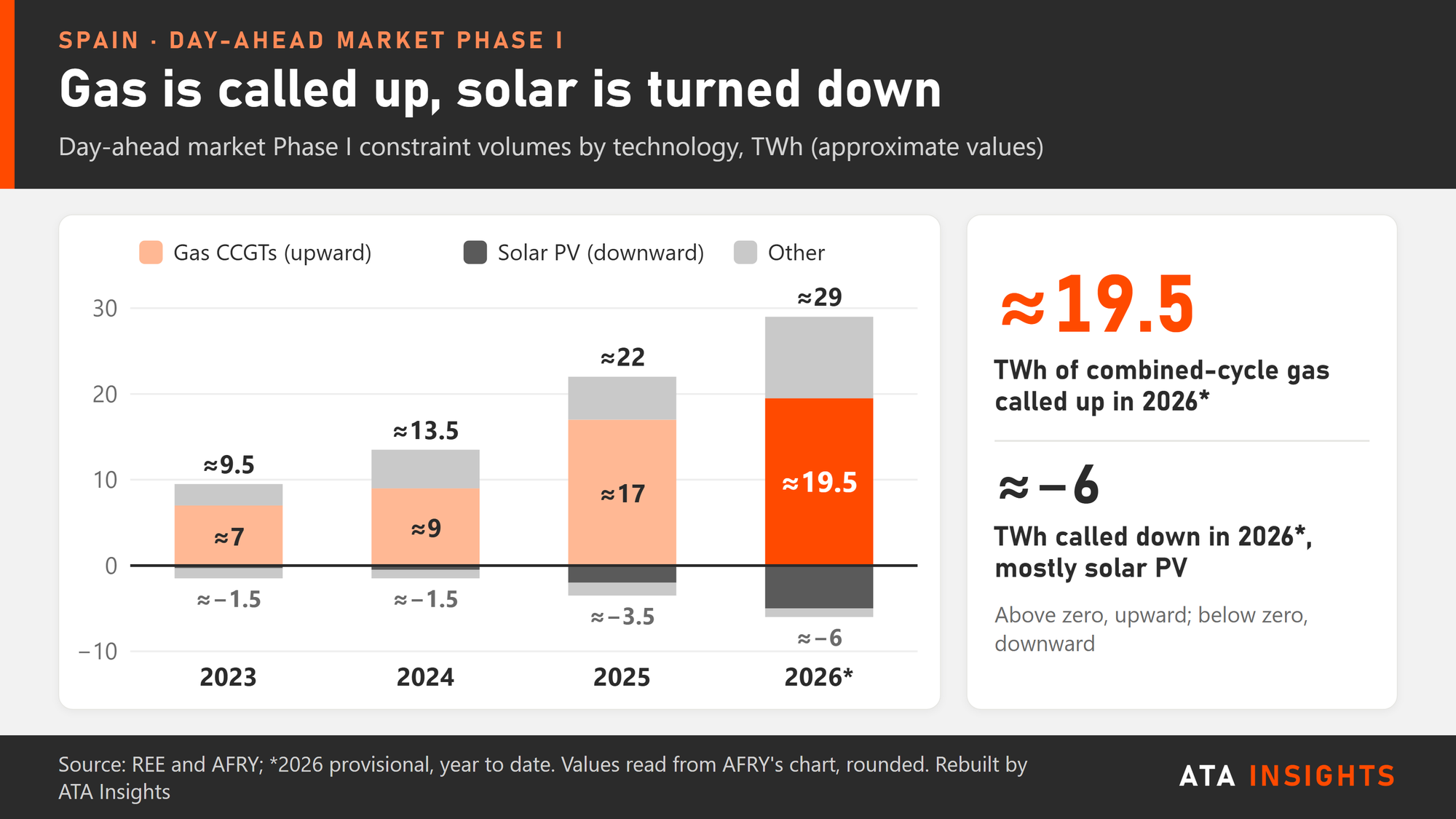
Behind that till, above all, sits gas. The volume of upward Phase I has doubled since 2024, to almost 29 terawatt hours, and most of it is combined-cycle plants called on for voltage control (keeping voltage within its permitted range).
Belén admitted that, as a consumer, she finds it a little infuriating: that month, she said, she had paid "one of the most expensive bills of the year, with one of the lowest consumption levels of the year". Bills are rising for several reasons, gas first among them, and she pointed to it herself. But gas does not stop at the day-ahead price. The combined-cycle plants that burn it are precisely what Red Eléctrica calls on to resolve constraints, and according to AFRY their bids set the price of most upward redispatch. Marcela dated the latest surge in this cost to March 2026, with the conflict in the Middle East and the jump in gas prices. Gas gets paid twice.
What became clear, and doesn't add up
Some uncomfortable certainties emerged as well. The first: you pay a single price for a problem that is solved node by node, and the cost is spread blindly across everyone. Red Eléctrica does publish the data unit by unit, but 90 days later and in a form meant for specialists. If you are on the PVPC, Spain's regulated retail tariff, constraints do not even get a line of their own: they are folded into the price of energy. And no bill, regulated or free-market, tells you which node you paid for, or who got the money.
An observatory backed by utilities, industry and consumer groups puts the average extra cost of system services (the wider family of grid-operation charges that constraints belong to) at €22.46 per megawatt hour in 2026: around 7% of a household bill and up to 13% for an energy-intensive industrial user. Red Eléctrica puts the effect of reinforced operation at two euro cents a day for a PVPC customer using 300 kilowatt hours a month. Both figures can be true, and that is the trap: the small slice gets argued over in public; the big one lands on the bill.
The second: the till has few owners. Spain has some 26 gigawatts of combined-cycle capacity, and most of it belongs to a handful of large utility groups: the biggest alone operates 17 plants with 7.4 gigawatts. Nor is the risk theoretical. In July 2023 the CNMC, Spain's competition and energy regulator, fined the owner of a combined-cycle plant in Galicia €6m: according to the regulator, between March 2019 and December 2020 it took advantage of moments when "competition in the constraints market was limited" to raise its prices. The company announced an appeal. Nobody has shown that anything similar is happening today, but the playing field is the same.
The third is a question Belén asked out loud: does the way the system is operated today guarantee technology neutrality and, if not, who benefits? Marcela suggested that management complexity could lead the operator to prefer a gas plant: "if I've got four batteries of five megawatts each and one combined cycle, maybe it prefers to dispatch a combined cycle rather than several batteries." With enough batteries at those nodes, she said, it will be possible to measure "how neutral it is being".
Seven years of warnings
The fourth certainty stings most: there was an alternative. In 2019 the CNMC proposed updating the voltage-control service, in place since 2000; in 2022 it opted for two pilot projects. The reform was approved in June 2025, seven weeks after the blackout, and real-time voltage setpoints, which open the service to renewables, did not start until 17 March 2026. Meanwhile, according to Red Eléctrica data reported in the press, the cost of constraints rose from €247m in 2019 to €2,522m in 2024.
When the door finally opened, plenty came through it: 23.9 gigawatts qualified to provide the service by 30 June, with solar PV the big newcomer, and redispatch for voltage control down 63% since March, according to CNMC data analysed by AFRY. Nobody credits the whole fall to the new arrivals, but the door could have been opened years earlier.
Belén drew the comparison that hurts: for a €1bn capacity market, she said, "several ministers come out" to argue about it; here "we are spending much more" without knowing whether it buys anything beyond, "so to speak, surviving".
The steel will arrive late. Spain's 2025–2030 transmission network plan, still awaiting approval, proposes €17,143m, but 84% of it falls between 2028 and 2030. For 2027, Marcela warned, "there won't be anything very immediate". As Belén had said at the start of the webinar, we will go on patching. And paying for the patches at operating-theatre prices.
Untying the knot
Transparency is the cheapest tool for bringing this bill down, and nobody has to wait until 2030 to use it. Belén summed it up at the close: "it can't simply be a catch-all for everything, for ever; we have to start seeing the receipts for what we're paying." Three things would need to change.
The first: receipts by node. A regular, readable report on what it cost to resolve each zone, which technologies were paid and at what average price. Back in July the CNMC required periodic information on zonal needs and the resources available; publishing it openly is the natural next step.
The second: data to answer the neutrality question. Which technologies were available at each node, which one was called and at what price. If the operator is choosing well, publishing it can only prove it right.
The third: real competition at the till. For storage, AFRY advises locating where upward Phase I is needed most, because "you're going to help the system resolve technical constraints at a lower cost than combined cycles". Every battery at a congested node is one more competitor, the best price cap there is and, into the bargain, a cushion against gas. We will be talking about exactly that at RENMAD Almacenamiento, our storage event, on 31 March and 1 April 2027.
You cannot untie a knot you cannot see. And today the only people who see this one up close are the ones who get paid for it.
You reached this analysis because ATA Insights puts independent energy-transition intelligence in front of 86,000+ professionals across the sector. That's exactly what we do for funded projects, events and companies — turn your work into reach.
See how we disseminate work like this →Where this analysis came from
This piece draws on the ATA Insights / RENMAD webinar €4bn in sticking plasters: technical constraints and investment in grid resilience. Watch the full session on demand.
The energy transition, in your inbox
Join 86,000+ professionals reading our independent briefings across five sectors.