
Storage's Double Tax
Spain treats a battery as both a power plant and a factory. That means paying twice to get on the grid — and the new access rules and saturation maps don't fully fix it.

A battery does one thing: it takes power off the grid and, hours later, puts it back. Spain's grid code sees two things. To the connection desk a storage site is a generator when it discharges and a consumer when it charges, and it must clear both gates before a single cell is installed. That accounting quirk is why a standalone battery posts two sets of financial guarantees, faces two capacity contests, and can be turned away twice over.
That was the puzzle RENMAD's webinar caught in mid-air, on the very morning Spain published a draft decree on storage connections. Half a year on, the drafts have become law. A resolution dated 1 December 2025 sets the technical rules for how demand and storage reach the transport grid; a royal decree of urgent measures landed in November. And in April 2026 the CNMC, Spain's energy regulator, folded the scattered capacity maps into one public platform it now refreshes every month. So the question has shifted. The rules are out and the maps are live. Did anyone fix the double charge — and where can a battery actually plug in?
Two hats, two bills
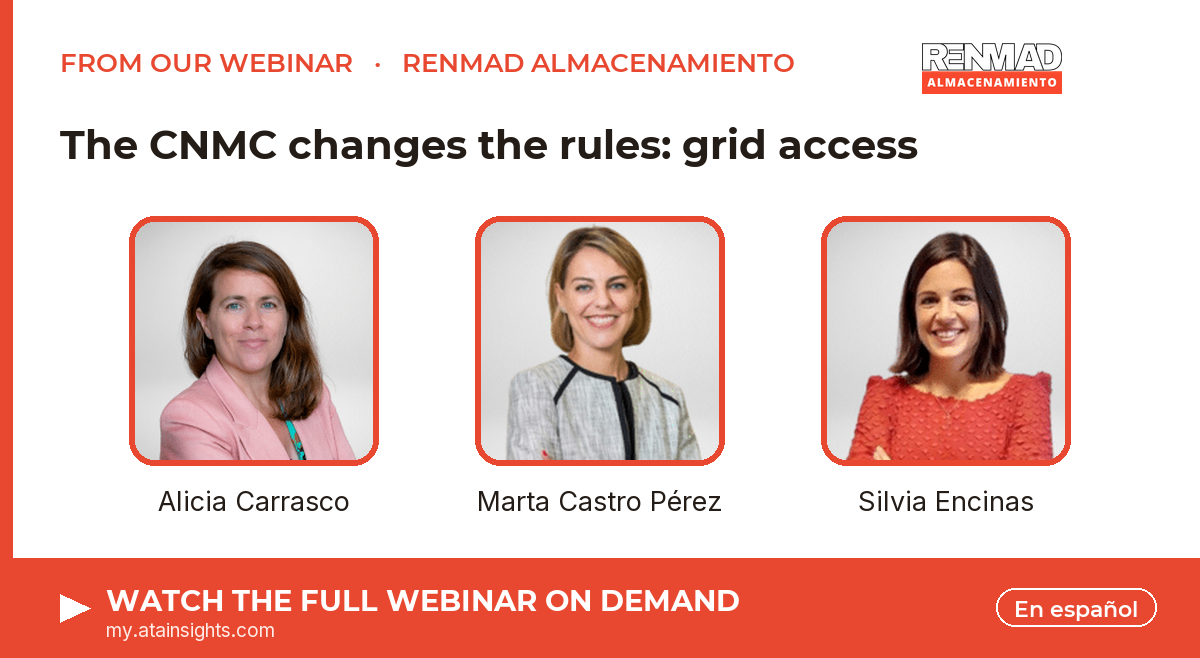
Silvia Encinas, Director of Strategic Growth for Renewables in Spain at EDP, laid out the mechanics with the patience of someone who has filed the paperwork. On paper, she noted, a storage plant that can pour energy back into the network is treated as generation. In practice the circular tells the distributor to assess it twice. "The evaluation of access capacity for this type of installation has to be done with a dual character," she said, "applying the criteria both of its condition as demand and of its condition as generation."
The catch is that the two assessments rarely agree. A distributor would often look at a node, find room on the generation side — that data already existed — and wave the battery through as a generator. Then it would check the consumer side and balk. "You have capacity to behave as a generator, but not to draw from the grid," Encinas recalled being told. For a standalone battery that answer is useless. It is not a net generator; charging is the whole point. So the project sat in limbo, waiting on the long-promised rules for flexible access.
The dual character is not just a scheduling nuisance. It carries a price. To request access as a generator, Encinas said, a developer posts 40,000 euros per megawatt; "as a consumer, 20,000 euros additional." Sixty thousand euros a megawatt before a single permit is granted, against forty for a plain power plant or twenty for a plain factory. The battery, by being both, pays the sum of the parts.
Blocked coming and going
The toll does not stop at guarantees. Spain has begun running capacity contests — competitive auctions for the right to connect at congested nodes — and here too the battery wears both hats. A storage project, Encinas warned, "could be planted at a node that is blocked twice over: blocked for a generation capacity contest, and blocked for a demand capacity contest." Lose either lottery and the door shuts.
The contests have their own history of stuck queues. For generation, Encinas pointed out, more than 350 nodes have been reserved since 2020 and not one auction has been held — "around 150 gigawatts blocked there," capacity that exists on paper but cannot be awarded because the mechanism to award it never ran. The first batch of demand contests has now opened, at eight transport nodes, and developers cannot see the logic behind the choice. "We're not able to understand what the criterion was for selecting these nodes," she said. Her ask was modest and telling: a calendar. Give projects visibility on which nodes will be auctioned and when, so a developer can judge whether a project is worth maturing at all.
The famine on the grid
Why does any of this bite now? Because everyone wants the same wire. Marta Castro Pérez, head of regulation at Aelec, the association whose members run more than 80% of Spain's distribution, brought the numbers. By the close of 2024 her companies were sitting on roughly 67 gigawatts of access requests, nearly 19 of them from new industry. In the first half of 2025 alone another 27 gigawatts arrived — and 14 of those had to be refused for lack of capacity.
"This gives us a sense of the hunger there is to connect," Castro said, and the word — hambruna, famine — ran through the session. The grid, she argued, simply cannot absorb the electrification on offer "unless we optimise its use, on the one hand, and unless it grows the capacity to hold it, on the other." Access, she added, must not become "a barrier to the rollout of new demand." That is the opportunity buried in the problem: refused gigawatts are not dead projects but factories, data centres and chargers queuing for a connection Spain wants them to have.
Castro's prescription was three words she repeated like a refrain: regulation, investment, planning — plus operating procedures. Flexibility can squeeze more demand onto existing wires, but only if distributors are handed the tools transmission operators already hold, from anticipatory investment — building the line before the demand turns up — to real-time control. "If you want flexibility, you also have to adapt the grid," she said, "and that's investment." Her warning carried a deadline: the new payment framework due the following week, in her reading, "discourages investment rather than encouraging it" — the wrong signal at the wrong moment.
What flexible access is meant to unlock
The fix everyone has been waiting for is flexible access: connections that accept being curtailed at the grid's worst hours in exchange for getting onto a network that has no room for one more firm megawatt. Alicia Carrasco, co-founder and executive director of entra — the Spanish association for aggregation and flexibility — and chief executive of Olivo Energy, has watched other countries get there first. "Flexible connections in other countries are already a reality," she said. "It's also a mandate from the European Union." Spain recognises three flavours: type 0, which only consumes in two off-peak windows; type 1, which accepts disconnection without compensation but can run an estimated 90% of the time; and type 2, the fully flexible option — which, she noted with some frustration, has been left to the transport grid and kept off distribution, exactly where most new demand wants to sit.
Carrasco's worry is that the reform, for all its ambition, leaves money on the table. The new capacity maps are a genuine step — for the first time developers can see which substations have room. But she pressed for guardrails: the rules ask for no proof that a project is mature, so a speculator can grab a node and sit on it while a real project queues behind. "At no point is the project required to have a maturity," she said, "to a degree of preparation that doesn't take that available capacity away from a more mature project." Her remedy: maturity tests, strict expiry of idle permits, and a fast lane for projects of strategic value to the country. Flexible access, she argued, should also reach ordinary homes with an electric car or a battery — let households flag part of their load as flexible, as the Nordics and Germany already do — rather than staying a tool only for industrial sites.
Did the new rules fix it?
Here is the score now that the ink is dry. The December 2025 resolution does what the panel hoped on the flexibility front: it moves flexible access from an afterthought to the centre of the system, and it explicitly treats storage in demand mode as a flexible connection rather than a firm one. That matters more than it sounds. As Castro argued in the webinar, a battery is flexible by nature, so granting it scarce firm capacity meant it was "hoarding capacity needed by other economic sectors" that have no such flexibility. Routing storage through flexible access frees firm capacity for the factories that truly need it.
What the new rules do not do is retire the double charge. The dual character — generator and consumer, two guarantees, two contests — is baked into how Spain defines a storage plant, and nothing in the December text rewrites that definition. Carrasco flagged a fresh sting in the latest decree: demand and storage projects must now deposit a guarantee of 40 euros per kilowatt with the regional authority before they even know whether there is room on the grid. "If you don't yet know whether you'll have the space on the network," she said, "that's very limiting." Paying to find out is the old double-counting problem in a new coat.
And the maps? They are the clearest win. Since April 2026 the CNMC publishes a single platform, refreshed monthly, showing available capacity at every node above 1 kV. The headline it produced is sobering: 83.4% of distribution nodes are saturated. Read one way, that confirms the famine. Read another, it is the road map distributors have lacked — proof of exactly where the wires need reinforcing and where a flexible connection might still squeeze in. Castro called that visibility a route map "of where the investments should go," something the sector simply did not have before.
So storage in Spain enters 2026 carrying a lighter load and a heavier one at once. The flexible-access door it spent eighteen months waiting for is finally open, and the maps tell it which nodes are worth knocking on. But the battery still wears two hats at the connection desk, and still pays for both. The reform taught the grid to see where capacity is. It has yet to teach it that one machine, doing one job, should be charged once.
Want the regulators' own words on firm versus flexible access, the capacity contests and what to file before 2026's deadlines? Watch the full RENMAD webinar, "La CNMC cambia las reglas: cómo asegurar acceso a red en la nueva era de distribución," with Aelec, EDP and entra. And the conversation continues in person at RENMAD Almacenamiento in Seville on 17–18 March, Spain's reference event for energy storage.
You reached this analysis because ATA Insights puts independent energy-transition intelligence in front of 86,000+ professionals across the sector. That's exactly what we do for funded projects, events and companies — turn your work into reach.
See how we disseminate work like this →Where this analysis came from
This piece draws on the ATA Insights / RENMAD webinar the session. Watch the full session on demand.
The energy transition, in your inbox
Join 86,000+ professionals reading our independent briefings across five sectors.