
The 90% You Never Deliver
A RENMAD webinar on AI in battery storage revealed why the trades that pay best are the ones that vanish before dawn — and why no human desk can keep up.
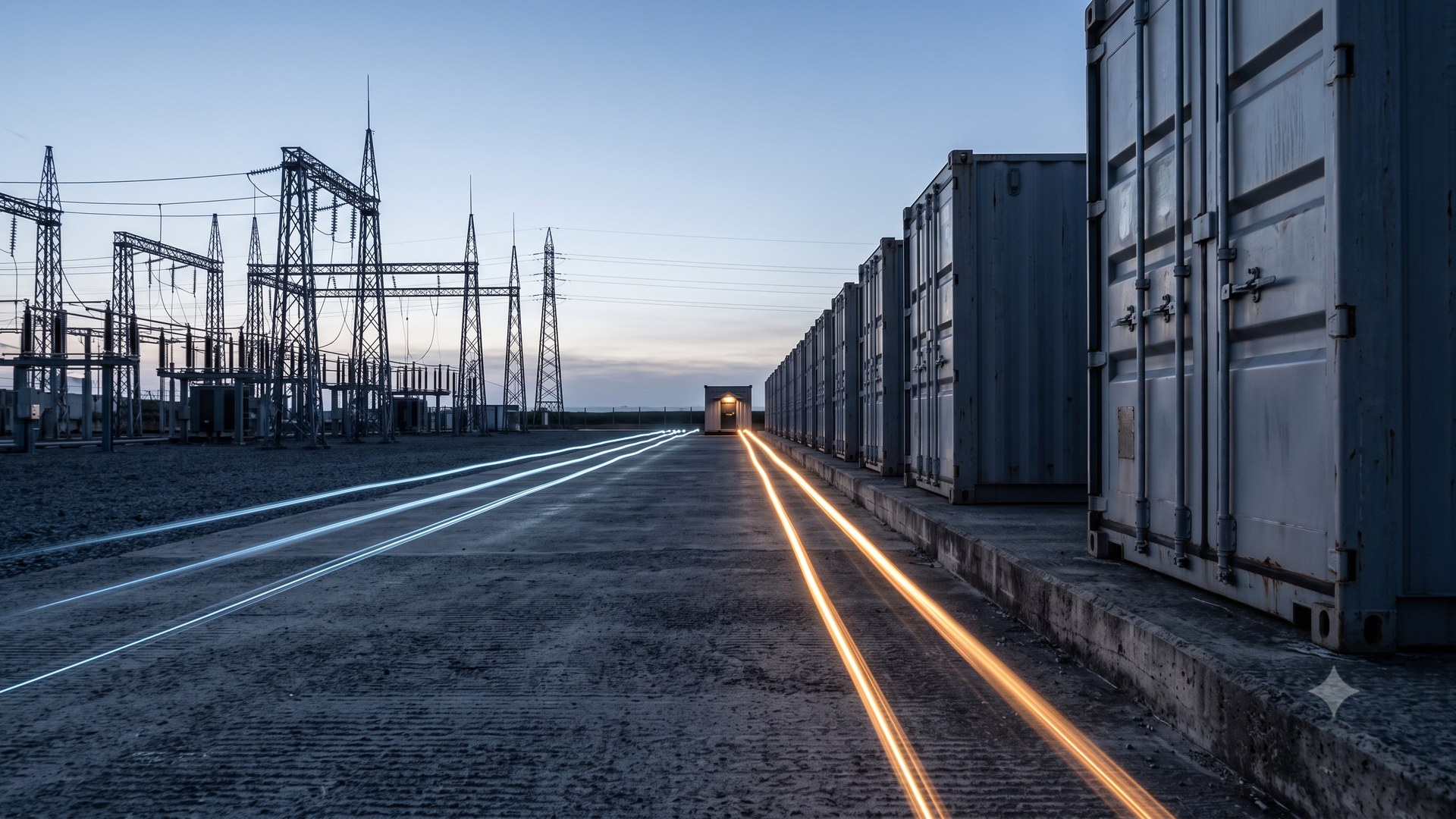
On a German power exchange, an algorithm running a grid battery will take thousands of positions in a single day. By the time the sun comes up, nine in ten of them are gone — re-optimised, withdrawn, replaced, never physically delivered. The battery itself may charge and discharge only a handful of times. The rest was thinking out loud at machine speed.
That figure — about 90% of trading positions are virtual — came up at a RENMAD webinar on the role of artificial intelligence in the new generation of battery energy storage systems (BESS). It is not a rounding error or a quirk of one trading desk. It is becoming the basic physics of how a flexible asset earns its keep, and it explains why the storage business is quietly turning into a software business.
The timing is not academic. Spain has set itself a target of roughly 22.5 GW of storage by 2030, and the European Commission approved a €9bn capacity market in late May. Ancillary and adjustment markets are multiplying. Each new market is another door a battery can walk through — and another reason the old way of deciding which door, by hand, has stopped working.
This is not intelligence for show. It is arithmetic that no human can do in time.
The human-first problem
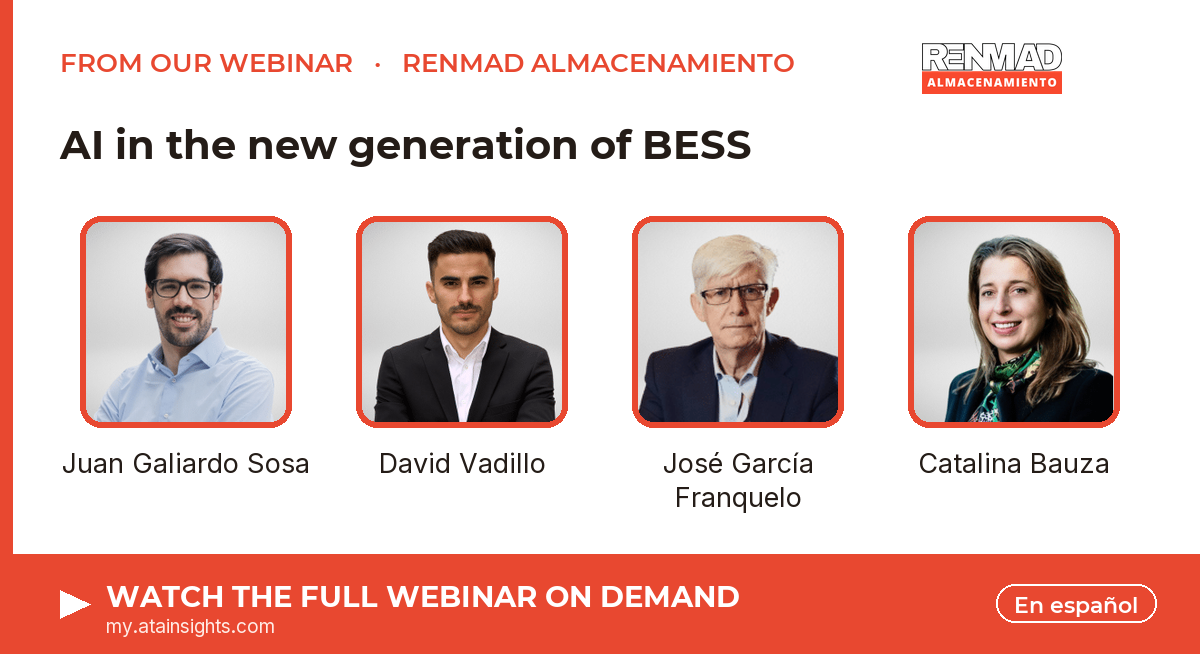
The case against doing this manually was made bluntly by Juan Galiardo Sosa, regional manager for Iberia at Entrix, a battery optimiser that manages around 2.5 GW of flexible assets across five countries.
"That model is essentially incompatible with the nature of a flexible asset," he said of the old, human-led trading desk. At any moment, a battery can act in the day-ahead market, the intraday continuous market, and a growing stack of adjustment markets — secondary reserve, capacity, and whatever the system operator dreams up next, voltage control included. The number of live options at any instant is simply more than a person can hold in their head, let alone act on before the price moves.
So Entrix does not try. Two-thirds of its hundred-odd staff are software developers, product people and data scientists. The company is, in Galiardo's framing, a software firm that happens to trade batteries rather than a trading firm that bought some software. The algorithm takes the positions; humans set the boundaries.
And here is where the 90% number earns its keep. Every position the algorithm takes is, in the jargon, asset-backed — it could be physically delivered if it had to be. This is not proprietary speculation with someone else's money. But as fresh information arrives through the day, the machine keeps adjusting, trimming, re-deciding. The point is not to cycle the battery harder. The point is the opposite: to find the best possible revenue while cycling it as little as possible, because every cycle is degradation, and degradation is money walking out of the door.
When Entrix compared its algorithm against a simpler, more rudimentary optimisation across 2024 and 2025, the uplift ran between 50% and 70%. "We're not talking about a small incremental change," Galiardo said. "We're talking about orders of magnitude." For an asset as complex as a battery, he argued, AI has stopped being a nice-to-have and become an imperative — though one still run by people who sit down every morning and ask the machine why it did what it did.
Garbage in, no insight out
If Entrix lives in the market, David Vadillo of Cellect Energy spends his time in the dirt of the physical asset — and his message was a useful corrective to the hype. Trading is the easy case for AI, he pointed out, because the data is abundant, clean and accessible. The battery itself is the hard case.
"Be suspicious of the state-of-charge value in certain applications," he said — a warning that lands harder than it sounds. State of charge is the single most important variable for trading decisions, and it is exactly the kind of physical reading that arrives noisy, non-standardised and differently formatted by every manufacturer. Feed a clever algorithm a wrong number and you get a confident wrong answer.
Vadillo's larger point was about foundations. Many storage assets already in operation, he noted, were built without anyone planning the data infrastructure underneath them. Some readings need to be captured every five seconds and stored for the entire life of the plant; do that badly at the start and, years later, when the asset misbehaves, there is simply nothing to run a model against. A battery generates vastly more data than a solar plant, and managing a portfolio of them — different manufacturers, different sizes, different SCADA and trading providers — is, he said, beyond what humans can do unaided. Predictive maintenance, performance correction, longer asset life: all of it depends on having captured the right data, at the right resolution, before you knew you needed it.
The opportunity, in other words, is real but conditional. AI in storage is not a layer you bolt on at the end. It is a decision you make at the beginning, in the unglamorous form of sensors and storage.
Two worlds, one brain
José García Franquelo, director of innovation at Bluence and a man with three decades of history in plant control and energy trading software, framed the whole problem as bridging two shores that rarely talk to each other: the control room and the trading floor.
"Doing this by hand is unthinkable," he said. In a day-ahead-only world you could just about manage with a spreadsheet. Today, with commitments rolling over from the previous day, intraday markets reopening, plant unavailabilities and grid events all colliding, the spreadsheet is dead.
His company's optimiser, he said, behaves like a satnav for a battery. It plots the most profitable route through the markets, then — when a curtailment hits, or a secondary-reserve activation arrives, or a deviation opens up against the committed schedule — it recalculates the route in real time, exactly as a navigation app reroutes you around traffic. Crucially, it does not replace the trader's judgement. It hands the trader a ready-made battery plan, which they can accept, tweak in their own tool, or override according to their own appetite for risk and degradation. Two traders with the identical software, he noted, will produce entirely different results.
The deeper insight was organisational, not technical. García Franquelo described companies whose engineering, construction and trading departments barely speak — each one solving its own piece and assuming someone else will sort out the rest. The battery, awkwardly, sits across all of them. Connecting those two worlds, market and machine, is where the value is, and where the AI actually does its work.
From box to platform
Catalina Bauza, strategic partnerships director at Maxxen Energy, a European storage manufacturer, pushed the argument to its conclusion: the battery is no longer a thing, it is a system.
"The battery is no longer understood as a box where energy is stored," she said. "It is understood as an intelligent system that collects data from thousands of sensors, interprets hidden patterns, makes automatic decisions, and turns optimisation into continuous economic value." That, she argued, is a change of paradigm — from a container of energy to a platform that thinks.
Maxxen runs two layers of intelligence: one watching the health of the battery, turning maintenance into prevention, and one making strategic dispatch decisions in milliseconds. The health layer alone, she said, cuts operating costs by around 30%, lifts availability by more than 20%, and extends useful life by more than 25%. In the Spanish market specifically — with its three pressures of solar curtailment, system volatility, and demand for millisecond flexibility — an intelligent BESS can capture more than 90% of the value potential on the table.
There is a neat symmetry in that number. The trader captures value by making ninety virtual moves for every real one; the manufacturer captures value by squeezing ninety per cent of the available revenue out of a single physical asset. Both depend on the same thing: a machine making decisions faster and more often than any human desk could.
The catch
None of the four panellists claimed the human is gone. In trading, the algorithm runs the show in real time because there is no time for anything else — human intervention, Galiardo said, is so rare as to be an anomaly, reserved for genuine faults. But the real work happens the next morning, when people sit down to evaluate what the machine did and how to make it do better. In predictive maintenance, the algorithm raises the alert and the human still picks up the phone to the technician. The loop closes with a person in it.
What changed at this webinar was the centre of gravity. For years, AI in energy has invited a fair question: do you actually need it, or would plain old automation have done the job without burning the planet? For a flexible asset earning across a dozen multiplying markets while quietly degrading with every cycle, the answer the panel kept circling back to was the same. This is not intelligence for show. It is arithmetic that no human can do in time.
The 90% you never deliver is not waste. It is the sound of a battery thinking — and, increasingly, the only way it pays.
This was a high-level first pass; RENMAD has promised to go deeper. You can watch the full Bater-IA webinar on demand, and the conversation continues at RENMAD Almacenamiento, the storage event on 17–18 March in Seville.
You reached this analysis because ATA Insights puts independent energy-transition intelligence in front of 86,000+ professionals across the sector. That's exactly what we do for funded projects, events and companies — turn your work into reach.
See how we disseminate work like this →Where this analysis came from
This piece draws on the ATA Insights / RENMAD webinar the session. Watch the full session on demand.
The energy transition, in your inbox
Join 86,000+ professionals reading our independent briefings across five sectors.