
When the Vendor Becomes the Bank
Half of Europe's coming battery fleet is too small for project finance and too big for an owner's chequebook. The companies that build and run the batteries are quietly filling the gap.

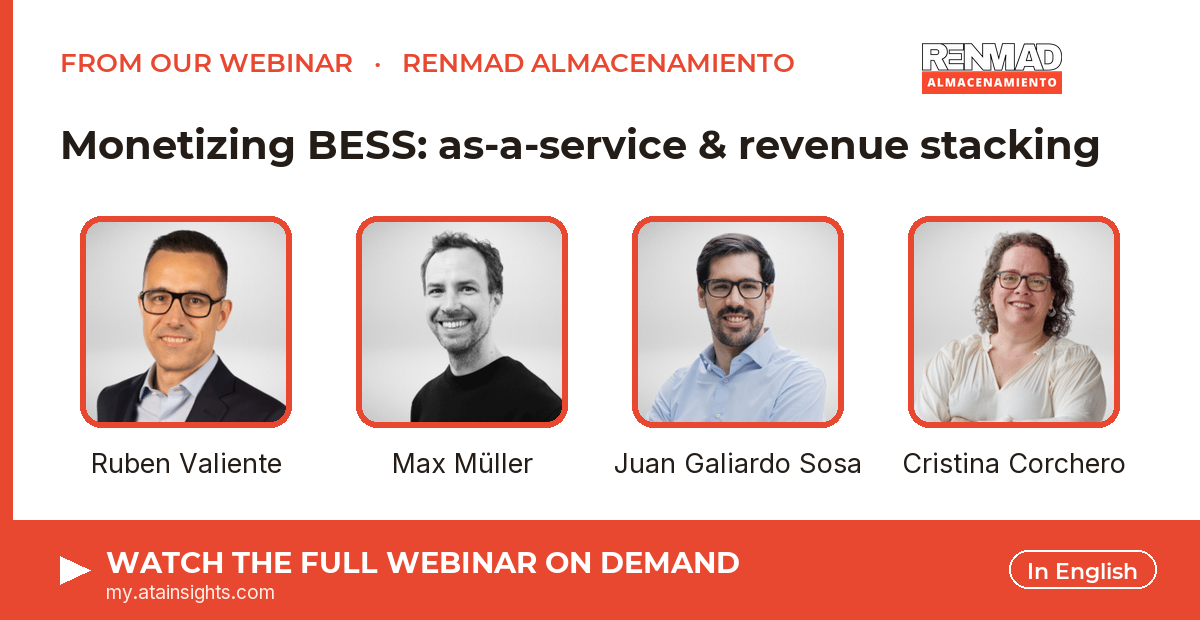
A battery project, Ruben Valiente likes to point out, is mostly somebody else's balance sheet. "80-90% of its capex is related to vendors like us," the managing director of Maxxen told a RENMAD webinar this month, run by ATA Insights' sister brand. Strip out the wiring, the transformers and the civil works, and what is left, the cells and the cabinets, belongs to the company that made them. Which raises an awkward question for the developer who has to pay for it all: if the vendor already owns most of the asset, why not let the vendor own the loan too?
That question is becoming the most interesting one in European storage. The hardware is no longer the hard part. Prices for lithium-ion cells have, in Valiente's word, been "plummeting," and the kit is abundant. What is scarce is the money to fund the mid-size projects that are about to flood the grid, and the cleverness to wring a return out of them once they are built. The webinar, titled "Monetizing BESS with as-a-service models and revenue stacking strategies," put four people who sell that money and that cleverness on the same screen. The picture they painted is of an industry where the financing gap, not the battery, is the bottleneck.
The missing middle
Start with the scale of what is coming. Bloomberg expects something approaching 500 gigawatt-hours of storage in Europe by the early 2030s; Valiente reckons the utility-scale slice is nearer 200, which still works out at roughly 5,000 separate projects. And here is the catch: at least half of them are mid-size or small.
Those are precisely the projects that nobody wants to finance. They are, as Valiente put it, "too small to have some attraction from institutional lenders, and maybe too big for the sponsors to fund on pure equity." Project finance, the cheapest capital around, comes with a due-diligence process that takes time and money and has to be repeated from scratch for every deal. For a large utility-scale battery, that overhead is worth bearing. For a 40-megawatt-hour project in the middle of nowhere, the legal bill alone can sink the economics. "Project finance is king," Valiente conceded, and it will fund most of the megawatt-hours. But it leaves a hole in the middle of the market.
Vendor finance fills it. Instead of selling a developer a battery and walking away, the manufacturer leases it, or sells the right to use it, and carries the debt. Because the vendor already supplies 80-90% of the capex, it can fund that same share, and in behind-the-meter projects sometimes the lot. The due diligence is lighter, the minimum ticket smaller, and the incentives are honest in a way arm's-length lending never quite manages. "If the battery doesn't work, the SPV will not pay the vendor, so it better work," Valiente said. It is more expensive than a bank loan and carries more risk. But for a project throwing off a double-digit return that cannot get a banker to return its calls, a more expensive yes beats a cheaper no.
A different Champions League winner every year
Funding the box is half the battle. Filling it with revenue is the other half, and that turns out to be a moving target.
Max Müller, who sells trading-as-a-service for the Austrian optimiser enspired, brought a chart of German battery revenues and, to keep the audience awake, a football analogy. Each year had a different Champions League winner, and each year had a different winning revenue stream. In 2023, wholesale and balancing energy paid most of the bills, until June and July, when capacity payments for automatic frequency restoration suddenly leapt from a tenth of revenue to well over half. In 2024, wholesale was back on top. By 2025, the capacity market was climbing toward half the take again, while the once-dominant primary frequency product, FCR, dwindled toward irrelevance. "It can change a lot over the year, and you can also see it can change abruptly," Müller said. The lesson is not that one market is best. It is that you cannot know in advance which will be, so you had better be able to slice a battery across all of them and re-slice it as prices move. The optimiser, not the cell, is the product.
Müller's sharpest point was about the small print. Two batteries that are physically identical can earn very different money depending on what their warranty allows. A required one-hour rest after each full cycle can cost up to 12% of revenue against a battery with no rest period. Tighten the cycle count, the state-of-charge window or the round-trip efficiency and the gap widens. On his worked example, a German battery earning 260,000 euros per megawatt a year could lift that by more than 11%, around 30,000 euros per megawatt, simply by negotiating better terms. Over ten years and a whole project, he reckoned, that was 15 million euros sitting in a clause most buyers skim. "Discuss it with your partners," he urged. The contract is a revenue stream.
Even in zero-price Spain
If Germany is where the markets are mature, Spain is where the doubters live, and Cristina Corchero went straight at them. The chief technology officer of Barcelona's Bamboo Energy opened with the complaints she keeps hearing: the numbers won't work, behind-the-meter needs more regulation, the models are too complex, the battery is already smart. She picked the last one apart with relish. "The batteries are not smart enough yet," she said. Left to itself, a battery sitting behind a factory meter does not know the local solar forecast, the site's consumption, or the day's prices. An optimiser does.
Her proof came from Spain at its worst, the noon hours when solar floods the grid and the wholesale price falls to zero. A factory with rooftop panels and a battery does not just store its own surplus; it charges from the grid as well, because the power is free, then discharges into the evening peak or sells it back. Behind-the-meter sites Bamboo manages have lifted self-consumption by up to 42% and cut energy costs by 35%. "Behind the meter has opportunities today," she said, "if you know how to capture them." In a country where solar can be worth nothing at lunchtime, that is a striking claim, and it rests entirely on the software, not the steel.
The floor beneath the merchant
Juan Galiardo Sosa closed by explaining why this all matters now, in Spain in particular. The regional manager for Iberia at Entrix, an algorithmic optimiser, laid out a market on the turn. Solar capture prices have slid as panels pile in, probably past the halfway point already, and may fall below 40% of the average by 2027. That misery for solar is the reason storage stole the show at Spain's biggest solar event last week: a battery is the lever that drags a renewable project's economics back into the black.
The pipeline reflects it. Spain has barely 30 megawatts of utility-scale storage running today, against 20 gigawatts of projects holding grid connections and a five-fold jump in environmental-assessment filings in a single quarter. What has been missing is a way to finance the merchant bet. A fully merchant battery is lucrative but hard to bank; a full tolling contract is bankable but, in Galiardo Sosa's words, "you're likely going to leave a lot of money on the table." His preferred middle path is a revenue floor with an aligned counterparty, enough certainty to satisfy a lender while keeping the upside of Spain's juicy balancing markets. The missing ingredient, a contracted floor for the whole system, is arriving: "we're cautiously optimistic that in the first half of next year" the long-delayed, roughly nine-billion-euro capacity market will launch. A merchant case and a contracted floor, forming at the same moment, is what turns a pipeline into a fleet.
The kit was never the problem
Pull the four threads together and a single story emerges. The battery is cheap and getting cheaper. The returns are real but they hop between markets, hide in warranty clauses and depend on an algorithm cleverer than the hardware. And the money to build the unglamorous middle of the market, the thousands of mid-size projects that institutional finance finds too small to bother with, increasingly comes from the people who built the batteries in the first place.
That is the quiet shift behind the jargon of as-a-service. When the vendor finances the asset, the optimiser earns its keep, and the state guarantees a floor, the developer's job shrinks to assembling the pieces. As Valiente put it, with a salesman's flourish that happens to be true: "Welcome, everyone, to join the BESS revolution." The revolution, it turns out, is less about the battery than about everyone willing to lend against it.
Watch the full RENMAD webinar, "Monetizing BESS with as-a-service models and revenue stacking strategies," on demand, and continue the conversation at RENMAD Almacenamiento in Seville on 17–18 March.
You reached this analysis because ATA Insights puts independent energy-transition intelligence in front of 86,000+ professionals across the sector. That's exactly what we do for funded projects, events and companies — turn your work into reach.
See how we disseminate work like this →Where this analysis came from
This piece draws on the ATA Insights / RENMAD webinar the session. Watch the full session on demand.
The energy transition, in your inbox
Join 86,000+ professionals reading our independent briefings across five sectors.