Who's watching whom: the AI that supervises the operator, not the other way round
Naturgy is putting a copilot into the SCADA at its renewables control centre. It watches you operate and corrects you when you are about to act inefficiently, but the final say stays with you. Javier Marín, who works on digital transformation and analytics in the company's renewables division, explained how at UsefulAI 2026. If you run a fleet with one supervisor per plant, the way Naturgy has set it up is worth a close look.
What the control-room copilot does
In operations, AI is almost always sold on the same formula, human in the loop: the machine proposes and the person decides. At its Renewables Control Centre in A Coruña, Naturgy is setting up something that reverses that order. The man putting it in place described it like this at the session on 3 June:
> "We have a decision tree, but here what it does isn't that the operator supervises the AI. Here the AI supervises the operator, and when they are about to act, or do act, in a way that isn't efficient or correct, that's when it corrects them […]"
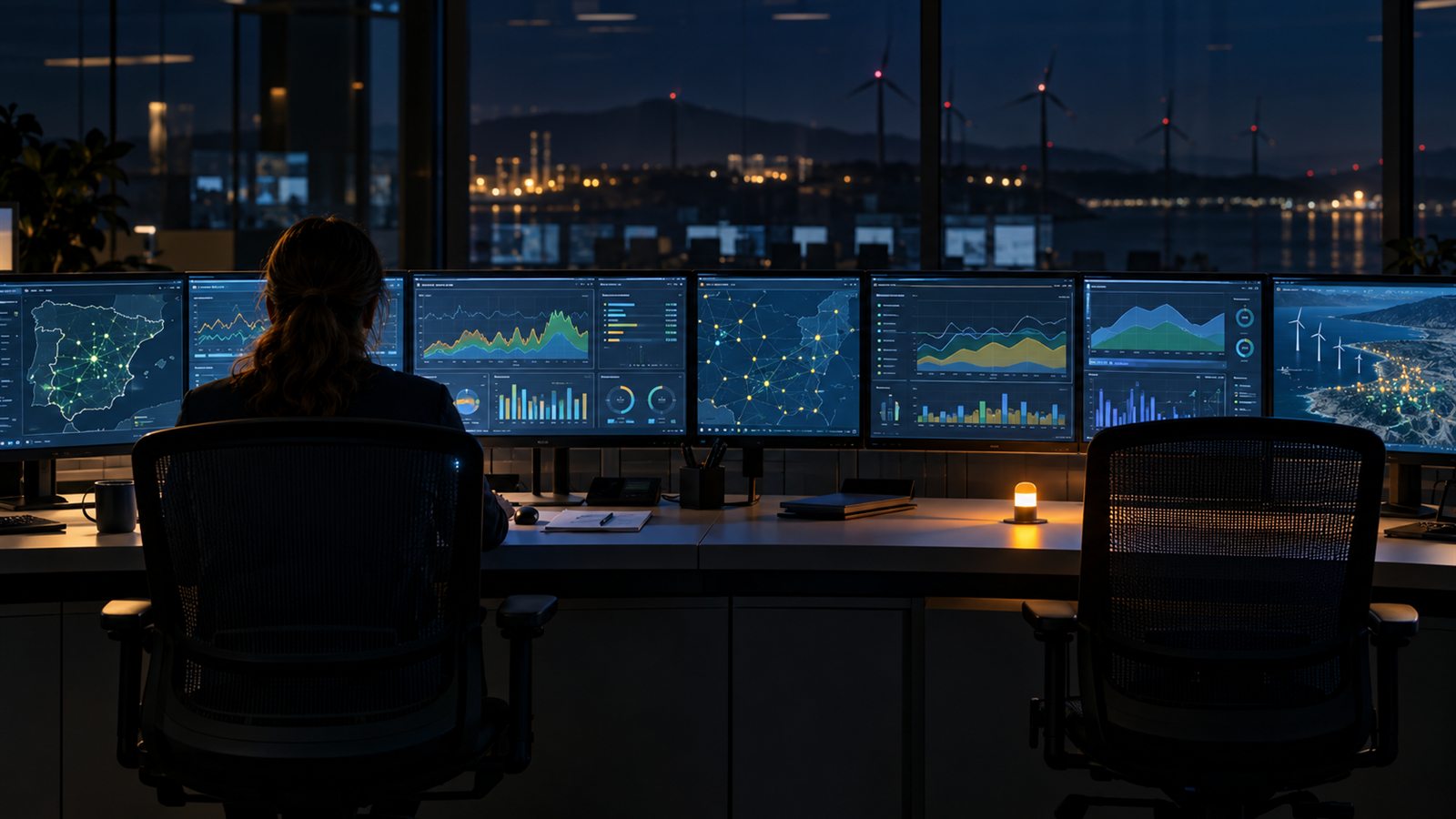
The system sits inside the SCADA, the software through which the wind farms and solar parks are operated remotely. It watches the person with their hand on the mouse and assesses the action, both before and after it is carried out. He is explicit about the purpose: "what we're introducing is first the AI so that it sees how the operators act, and to try to standardise the way the operators act".
He is just as explicit about the limit:
> "It's acting, so to speak, as a copilot, but supervising the operator and giving them recommendations on what to do, but the action is always theirs. It isn't going to say to them: 'Do you want me to reset this alarm?' We haven't got that far."
The machine recommends. The hand on the mouse is still yours. The copilot comes from a technology partner. "This isn't ours," he points out; what came before "we did in-house […] All in-house. This isn't in-house." Nobody had asked.
Why there are so few people watching the plants
Behind the change sits a prosaic reason: headcount. Marín moved into renewables in 2020 from a combined-cycle plant, and the move explains his argument. The plant had "people from electrical, mechanical, instrumentation, quality, health and safety, environment. I mean, we had staff". This is how he summed up what he found on the other side: "I ran into the reality that renewables is the low cost of the low cost of the low cost of the low cost".
In control-room terms:
> "Meaning that, if we're lucky, we have one supervisor per plant. If we're lucky. In some cases we have one supervisor for several plants. What these people who are out in the field or operating don't have is time to look."
Notice where he draws the line. He talks about time and takes his people's technical ability for granted, which reframes the debate about AI in O&M: what the agent brings is hours. The arithmetic gets worse with scale. The company's renewables portfolio is spread across Latin America, the United States, Australia and Spain, and one asset is enough to give you the idea. Take Cunderdin, its Australian hybrid, which according to Naturgy pairs 125 MWdc of solar with a 55 MW/220 MWh battery. It generates millions of rows of data a day, and someone would have to look at them.
The room the copilot is going into shows the scale from the other side. According to the company itself, the centre manages more than 3.48 GW and supervises 93 wind farms, 24 solar plants and five cogeneration plants in Spain, plus two wind farms in Mexico, 24 hours a day, seven days a week. That is the centre's perimeter, not the international portfolio Marín describes, and the two should not be added together. Every gigawatt that comes into that room adds operator actions that someone has to watch.
One vibration analyst for three continents
The example is his own:
> "We have loads of machines, loads of situations, and as of today we have one vibration analyst. It's impossible for them to take on the analysis of the whole portfolio, talking from Australia to Latin America and Spain. I mean, it isn't humanly feasible."
A vibration analyst takes years to train, and that lead time is easy to forget when you think about hiring. The Vibration Institute's certification scheme, which follows a body of knowledge compliant with ISO 18436-2, requires 38 hours of training and 18 months of experience for Category II; for Category IV it asks for 130 hours and recommends 60 months. Multiply that by a fleet that grows every year and you will see why he treats this as a design problem.
The labour market shows how wide the gap is. The Global Wind Workforce Outlook 2025-2030 from the Global Wind Energy Council and the Global Wind Organisation, published on 4 December 2025, puts demand at around 475,000 wind technicians in 2025 and 628,000 in 2030, and warns that growth is particularly pronounced in O&M. Building up that workforce, the report says, can take up to ten years.
The vibration agent he showed does for diagnosis what the copilot does for the operator's actions. You feed it the plots, and the process works step by step towards a report that says whether a borescope inspection is needed to cross-check the data, whether the machine has to be stopped, or whether the failure is going to be catastrophic or imminent. The aim is for someone without a technical background to run it. "Those diagnoses today depend a great deal on the technician, on their experience, on the ability of the technician who is analysing these vibrations," he explains.
The alarm agent that standardises the response
The copilot follows a pattern already at work in the first system he showed. His alarm agent covers manuals from Vestas, Siemens Gamesa, Acciona and Nordex, each with its own codes, and always answers in the same structure: operator action, consequences, trip and a link to the source document. It runs on Azure APIs, "with guardrails and with a structure defined by the operators", and if it does not know the answer, it stays silent.
> "It's deterministic in the sense of it's always going to answer you with this structure, it's always going to summarise the information as much as possible so that in the shortest possible time the operator can act and can really see […] whether what the LLM is telling them is real or not real."
Determinism is what makes it useful. Two operators on different shifts, facing the same alarm, read the same thing, so they can act the same way. If you run turbines from several OEMs out of one control centre, that is where the value lies. The alarm agent normalises the information coming into the room; the SCADA copilot corrects the action going out of it.
Outside Naturgy, the machine that reads the operator is already in the research literature. A 2024 study by Abbas and colleagues tested a decision-support system with 47 participants in a control-room setting. The system measures the operator's state through a smartwatch, eye tracking and questionnaires, and adapts its intervention to the state of the system and the person's performance. What Naturgy adds is a real SCADA with gigawatts behind it.
The session gave no outcome figures
If you are looking for an outcome figure, there isn't one. He gave no numbers for failures avoided, availability recovered, MWh, euros, O&M savings, model accuracy or average warning lead time. The only time he mentioned money was to warn about the cost of the cloud: "this isn't cheap […] And if there's no usage and no return, it makes no sense". Nor did he hide the operators' resistance. The first thing that happens when you try to bring these tools in, he says, is that "they're reluctant because they lack trust. They trust their experience, their technical ability". He introduced himself as "pretty much a plant person, my profile is more on the machinery side", and then spent the talk on systems architecture.
The best operator's experience as a fleet asset
What remains is an asset-management opportunity. If the AI learns how your best operator acts and hands that pattern back to the night shift, and to the person covering several plants at once, that experience becomes a fleet asset. It is what lets a control centre keep adding gigawatts with the team it already has.
A machine that corrects your action and leaves you to carry it out keeps your responsibility intact, and that is why an operator ends up trusting it. Marín was clear on the point: they have not got as far as resetting the alarm. The day a tool like this moves from recommending to executing, the division of responsibility will have to be rewritten.
Javier Marín (Naturgy, digital transformation and analytics in the renewables division) spoke at RENMAD UsefulAI 2026, Madrid, 3 June 2026.
You reached this analysis because ATA Insights puts independent energy-transition intelligence in front of 86,000+ professionals across the sector. That's exactly what we do for funded projects, events and companies — turn your work into reach.
See how we disseminate work like this →Where this analysis came from
This piece draws on RENMAD UsefulAI 2026, 3 June 2026, Madrid.
The energy transition, in your inbox
Join 86,000+ professionals reading our independent briefings across five sectors.