
Your data, gone to California: why Brussels built its own AI
The European Union has a list of recommendations for research institutions that want to use artificial intelligence, and one of them is very specific: "create your own model". M. I. González Cuenca said so in Madrid on 3 June. Her own institution, the Joint Research Centre, had already done it in 2023, and the tool the whole Commission now uses was later built on that work. What matters to you is how they did it: a control layer in front of third-party models.
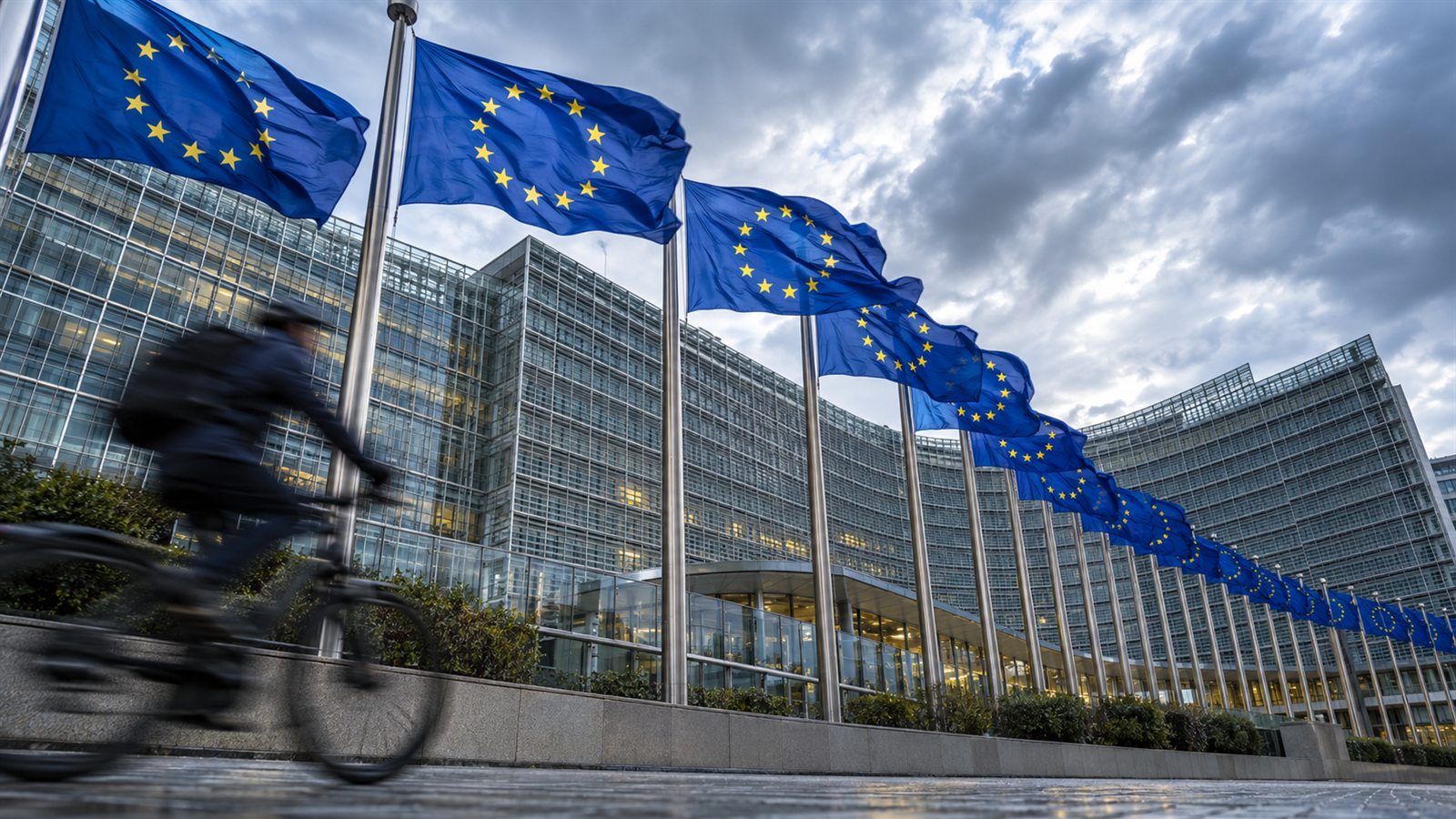
In her talk on 3 June at RENMAD UsefulAI 2026, M. I. González Cuenca, of the European Commission's Joint Research Centre, the JRC, explained how Brussels practises what it recommends. She made the point with an example of her own.
> "if I am carrying out a piece of research and I put in my data, for example, from a battery efficiency model and I run it through an application headquartered in California, that data is no longer mine, I no longer know where it is, it is no longer controlled."
Swap "battery efficiency model" for your fleet's degradation curve or a customer's operating data, and the case is yours. What breaks is custody of the data, and you can lose it while complying with the law to the letter.
What the JRC built, and why the whole Commission now uses it
Since 2023 the JRC has developed and run GPT@JRC, a platform that gives access to leading large language models with the security and compliance safeguards the Commission requires. A review published by its team in 2025 puts it past 10,000 user registrations. In October 2024 the Commission launched GPT@EC for its staff and put on record that it is built on GPT@JRC. What she called "an internal ChatGPT" in Madrid is where the tool the entire Commission now uses began.
This is how she described it.
> "we have our own data model that keeps improving based on different models and that is where we are allowed to use any artificial intelligence tool."
The Commission describes GPT@EC as a tool that gives access to several large language models and allows internal information to be processed without being shared with outside parties. Among the models on offer are open and sovereign ones, and sovereign here means European. What the JRC built is the gateway to all of them.
Control sits at the gateway, so you can keep using the best models available without your data leaving the building. For your company, that comes down to four pieces: a single point of entry, API keys that you hold, a catalogue of approved models and a log of who asked what. All four are architecture decisions.
Declaring AI use in reports
The JRC holds itself to one more recommendation.
> "if we produce a report with artificial intelligence, we have to declare it. If one of the images we use has been created with artificial intelligence, we have to say so, well, the usual, in the copyright, in the photo caption, etc."
There are now written rules behind that habit. On 8 May 2026 the European Research Area updated its living guidelines on the responsible use of generative AI in research, which rest on research integrity principles such as accountability, transparency and responsibility.
And the transparency obligations in Article 50 of the AI Act have applied since 2 August 2026. If you provide a system intended to interact with people, you must make it clear that there is a machine on the other side, unless that is obvious. If you provide one that generates text, images, audio or video, you have to mark that content in a machine-readable format. And if you are the deployer, the one putting it in front of others, you must disclose deepfakes and AI-generated text on matters of public interest.
The timetable has changed since 3 June. That day she listed three stages: 2024, August 2026 and summer 2027. Five weeks later the Digital Omnibus on AI, Regulation (EU) 2026/1744 of 8 July 2026, rewrote them. In force since 27 July, it pushed the bulk of the high-risk obligations back to two later dates, 2 December 2027 and 2 August 2028. The Article 50 transparency rules stayed put, and they are precisely what the JRC already practises in its figure captions.
The roadmap signed in Brussels that same afternoon
That afternoon, Brussels was signing the document that carries all of this into industrial policy. She mentioned it that morning.
> "there is an event this very afternoon in Brussels because it is being signed."
It was the Strategic Roadmap for Digitalisation and AI in Energy. Fourteen European energy and data centre industry associations backed it with a declaration of intent, and six companies added their support.
In the announcement presenting it, the Commission writes that tech sovereignty in energy is more urgent than ever, and defines it along similar lines: strengthening the autonomy of the EU's energy sector while protecting it from its vulnerabilities. The project that grows out of it is AI.grids. It brings together 48 partners, including grid operators and research centres, to develop EU sovereign AI models that improve grid management and planning. The same announcement puts a figure on the savings: by the Commission's calculation, using AI to optimise operation and maintenance could be worth up to €94 billion a year by 2035.
The control layer the JRC built to keep hold of its research data is the pattern Europe is now taking to grid scale. Have yours in place by the time those models start asking for operating data, and you will arrive in a position to negotiate.
What the JRC publishes, free for you to use
Every report the JRC produces goes into its public repository, PUBSY. "All means all," she said, adding that "you cannot imagine how much information you have available there". Then came the invitation: "you should be using them too".
Her unit, Energy Security, Distribution and Markets, already has four pieces of work under way.
- The European Energy Storage Inventory, running since March 2025. In May 2026 the JRC added two things: energy data alongside power data, and a new data point every month to track deployment. The data comes mainly from Wood Mackenzie, supplemented by public sources, and, she explained, is filled in and cross-checked using AI methods
- RECTool, the energy community simulator that grew out of the first energy community set up in Italy; both the tool and its code are published
- Predictive maintenance for batteries, with an Italian research body, using machine learning to estimate degradation
- A survey of European distribution system operators on how they use AI and how they were implementing the AI Act. Ten responded, and the finding, she said, was that although they were quite familiar with the law, "they never used any of this without human supervision"
Of the inventory, she said:
> "It fills what was a very important gap because this information was not public."
It covers European storage projects by technology and by project status, on an open dashboard.
And at the JRC's Seville site, where she is based, the European Centre for Algorithmic Transparency has supported European oversight of very large online platforms and search engines since April 2023. The body that publishes the storage inventory is the same one supplying the technical expertise behind that oversight.
The rules for data are still being written
The Data Act, the EU's data law, has applied since 12 September 2025. It allows data to be shared in return for reasonable financial compensation, and it is the law that enables the common European data spaces, where each sector shares information under the same rules. Health already has one, as she pointed out: "there is already a common European health data space". The energy data space is in the works, and a recommendations report is already out. The data omnibus, a separate package that affects the GDPR and the Data Act itself, was still under negotiation in September 2026.
The rules for your operating data are taking shape now, and the Data Act already provides for reasonable compensation when you share it. If you reach the common European data space with your data in order and your control layer in place, you will have something to sell.
She closed with a method.
> "But the key with artificial intelligence, the approach the European Union is mainly taking, is risk analysis."
And with two questions for every tool you want to let in: "what risks am I taking on, what risks does the tool or the algorithms I am implementing take into account". She left the audience with one more: "ask yourselves, in this framework, in this puzzle, where are you or where do you want to be?" The Commission has already answered its own: in 2023, through the JRC, it built the gateway. You have the pattern, and while the European energy data space is still being built, you have the window.
Talk "Regulatory clarity to invest, scale and compete with confidence", RENMAD UsefulAI 2026, Madrid, 3 June 2026. M. I. González Cuenca, European Commission Joint Research Centre, Unit C3, Seville site.
You reached this analysis because ATA Insights puts independent energy-transition intelligence in front of 86,000+ professionals across the sector. That's exactly what we do for funded projects, events and companies — turn your work into reach.
See how we disseminate work like this →Where this analysis came from
This piece draws on RENMAD UsefulAI 2026, 3 June 2026, Madrid.
The energy transition, in your inbox
Join 86,000+ professionals reading our independent briefings across five sectors.