
A year watching the sky: the bird-detection AI that goes up before the wind farm, not after
Computer vision for bird protection reached the Spanish wind market as a condition of the environmental impact statement: a cost that lands on you after the permit has been granted. One variant changes the maths. Installed a year before you file the environmental study, it produces the full annual cycle of site-specific data that the permit file requires and often lacks.
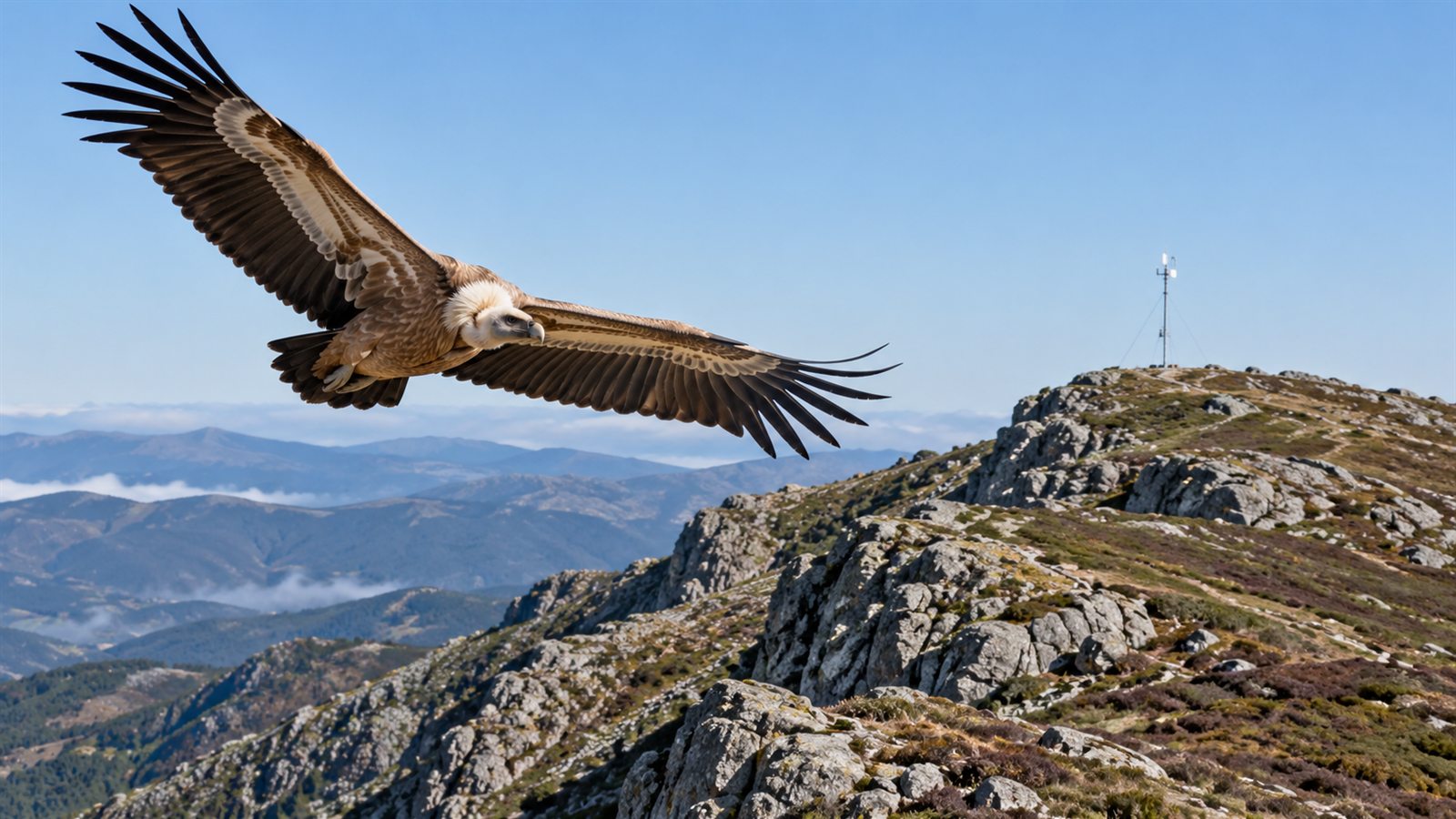
Pedro Pérez Gabriel opened his talk at RENMAD UsefulAI 2026 on 3 June by describing a chart that does no favours to anyone selling bird detection. The chief executive of Instra Ingenieros, which sells computer vision for wind turbines, started with scale: one huge bar, another very large one and, at the far end, a few tiny ones.
The published numbers bear him out comfortably. In the contiguous United States, cats kill between 1.3 and 4 billion birds a year; buildings, between 365 and 988 million; monopole wind turbines, between 140,000 and 328,000, with a mean of 234,000. The figures come from the same research team: Loss, Will and Marra in 2013, and Loss, Will, Loss and Marra in 2014. Cats are counted in billions; wind in hundreds of thousands. He drove the point home: "What I want to tell you with this is that the best thing, instead of building a system to detect birds at wind farms, you have to build a system to detect cats and follow them."
Who buys these systems, and why
So much for the biology. The market is an administrative creation, and you will see it in any live permit file.
Pérez Gabriel put a number on it. In Galicia, he said, around a hundred wind farms are still awaiting permitting, already holding administrative authorisation and a DIA, and every one of them "is required, no ifs or buts" to install a bird detection system. The DIA, or declaración de impacto ambiental, is the environmental impact statement: the environmental authority's sign-off, without which no wind farm is authorised. EGA, Galicia's wind industry association, reaches the same hundred by another route. On 31 August 2026 it wrote that "a hundred wind farms and several grid connection lines are wandering through a kind of judicial limbo, despite the favourable rulings of the Supreme Court and the Court of Justice of the European Union". The figure matches; the diagnosis does not.
Get the sequence right. No specific Spanish regulation requires you to install these systems. The only national rule in force, Royal Decree 1432/2008, covers high-voltage power lines, not wind turbines. The systems arrive one wind farm at a time, as a condition of the DIA and after it has been granted.
The missing year of data
On 6 August 2026, SEO/BirdLife, BirdLife International's Spanish partner, announced that it had lodged objections to three hybrid wind projects of 21 MW each in Guadalajara: Mimas, Titán and Dione. They lie between the Alto Tajo and the Sierra de Altomira and were put out to public consultation on 10 June. These are objections within a procedure that is still open, not a halt. But the ground they invoke is the kind that decides permit files. According to the organisation, the environmental impact study (the estudio de impacto ambiental, the assessment the developer files) "does not incorporate bird and bat monitoring campaigns carried out over a full annual cycle, limiting itself to compiling information from the literature".
The requirement goes back a long way. SEO/BirdLife's guidelines on wind farms, birds and bats, the reference manual for consultancies and public authorities, call for field studies "whose duration must in no case be less than one year". And when the Basque Government set out in June 2021 what these studies must contain, it wrote all four seasons into the text: "The duration of these studies must cover at least one annual cycle (wintering, pre-breeding migration, breeding and post-breeding migration)."
That list explains the timescale. It takes a year for a site to pass through all four periods, and a single-season survey misses them. The specification is written down and dated, and if you arrive with only a desk study, you will fall short of it.
What the draft royal decree would ask of shutdown systems
The framework could get tougher, and it pays to read it with the product catalogue open beside you. MITECO, Spain's ministry for the ecological transition, put a draft royal decree on birds, power lines and wind turbines out to public consultation from 12 March to 12 April 2025, and it has still not been approved. It would require wind farms authorised after it comes into force to include "turbine shutdown systems for situations of bird collision risk", either automated or using observers. It then adds the sentence that turns the permit conditions into a tender specification: "The proposed system must be described in detail […] together with documentation substantiating its effectiveness."
Annex II goes further. A turbine that in one year exceeds any of the estimated-mortality thresholds in its Table 2 (three collisions, in the case of non-threatened raptors) is classed as dangerous. The developer suspends its operation as a precaution and, with the machine stopped, must carry out "a detailed study over an annual cycle, including migration periods", with study radii of up to 25 km depending on the species group. If the turbine breaches a threshold again during the five years of special monitoring that follow, the draft provides that the developer proceed "to the permanent shutdown and the dismantling of the turbine", unless the authority that licenses the project grants exceptional, express permission. So the year of data comes back, this time with the turbine stopped, and you pay for it in lost output.
How far a camera can see today
Set those kilometres against the metres the supplier says his equipment can see. Pérez Gabriel tied the range to the bird's wingspan: today the systems reach "up to a kilometre" and "a little bit more", and for the short-toed snake eagle, a medium-sized raptor, "around 600-700 metres, probably". Then he went further. Of detection distances he said: "they're quite poor, we could say, ours and everyone else's. The systems right now are basically in development. And why? Because of the hardware, basically, it's what's available."
The ceiling is set by the optics. The algorithms are off the shelf: YOLOv8 decides whether there is a bird and ResNet classifies the species. What gives the systems their power, he said, is local computing: "It's not the algorithms, it's the capacity to compute locally, it's the NVIDIAs we've got mounted up there." Each turbine carries four to eight cameras and as many processors. Training is done wind farm by wind farm and, in his view, plug and play is not possible. A pole-mounted variant protects the perimeter of the wind farm and reaches, he said, "for example two or three kilometres".
The cost shows up in false positives. "One of the serious problems with these systems is false positives, that is, deciding that the bird is going to collide and stopping the turbine. It's lost production, it's an operational problem, it's ultimately something that no company normally wants to happen."
On 1 May 2026, El Periódico de la Energía reported the figures that Zefiro Partners presented for IdentiFlight at a Spanish wind farm: a 99.88% reduction in mortality, less than 1% production loss and, in its latest version, up to 1,500 metres "for birds with a large wingspan". These figures come from an interested party, as do the speaker's. Together they give you the range of what you can write into a contract: metres by wingspan and false positives per month, measured at your site. In the same piece, Julia Gómez Catasús, of the Autonomous University of Madrid, warns: "many of the automatic detection systems currently being applied at wind farms have not been validated. It is essential to apply scientifically validated protocols that contribute to mitigation in Environmental Impact Statements".
The LITE system, designed for the study phase
Pérez Gabriel also described the LITE system: "fully autonomous, battery-powered, with no mains power and with only one camera", intended for use "in the preliminary environmental study phases of wind farms" to complement observer campaigns, with recording periods of 3, 6 or 12 months and "a minimal investment". He gave no price, no customers and no installed wind farm.
A camera that counts birds for twelve months on a site that has no project yet produces the bird side of what the Guadalajara objections say is missing: an annual cycle of site-specific data covering all four phases of the year. And you pay for it while the wind farm is still on paper, with no output to lose.
Repowering brings back the year of data
Old wind farms need the baseline too. Replacing the turbines at an operating wind farm can reopen the environmental assessment, and there are already dates on the calendar. The Xunta, Galicia's regional government, gave environmental approval to repower nine Galician wind farms, taking them from 361 turbines to 75, 286 fewer machines, with 35% more production capacity. And IDAE, Spain's energy agency, published the final resolution of the second call of its Circular Repowering programme on 28 July 2026: €612 million for 173 projects, 81 wind and 92 hydro.
There, too, the same year will be asked for: the Basque document extends to repowering the requirement for "prior analysis or monitoring […] of at least one annual cycle". Taller machines and longer blades change the risk profile, so a site with twenty years of history and no systematic bird data leaves you starting from scratch.
Here is the opportunity. The environmental conditions work as a technical specification: the content is written down, the timescale is twelve months and the documentary evidence can be demanded. Read them that way and you meet them in advance. You go into the procedure with the annual cycle already measured, and the objection raised in Guadalajara has nothing left to stand on. With a hundred Galician wind farms still stuck and a repowering pipeline with dates attached, you have time to put the camera up before you need it.
Pedro Pérez Gabriel (Instra Ingenieros, chief executive) spoke at RENMAD UsefulAI 2026, Madrid, 3 June 2026.
You reached this analysis because ATA Insights puts independent energy-transition intelligence in front of 86,000+ professionals across the sector. That's exactly what we do for funded projects, events and companies — turn your work into reach.
See how we disseminate work like this →Where this analysis came from
This piece draws on RENMAD UsefulAI 2026, 3 June 2026, Madrid.
The energy transition, in your inbox
Join 86,000+ professionals reading our independent briefings across five sectors.