
Balance of Plant, Balance of Power
Cells and inverters are getting cheap. What now decides whether a battery project lands on time is the concrete, the cabling and the fire rules — and who signs for all of it.
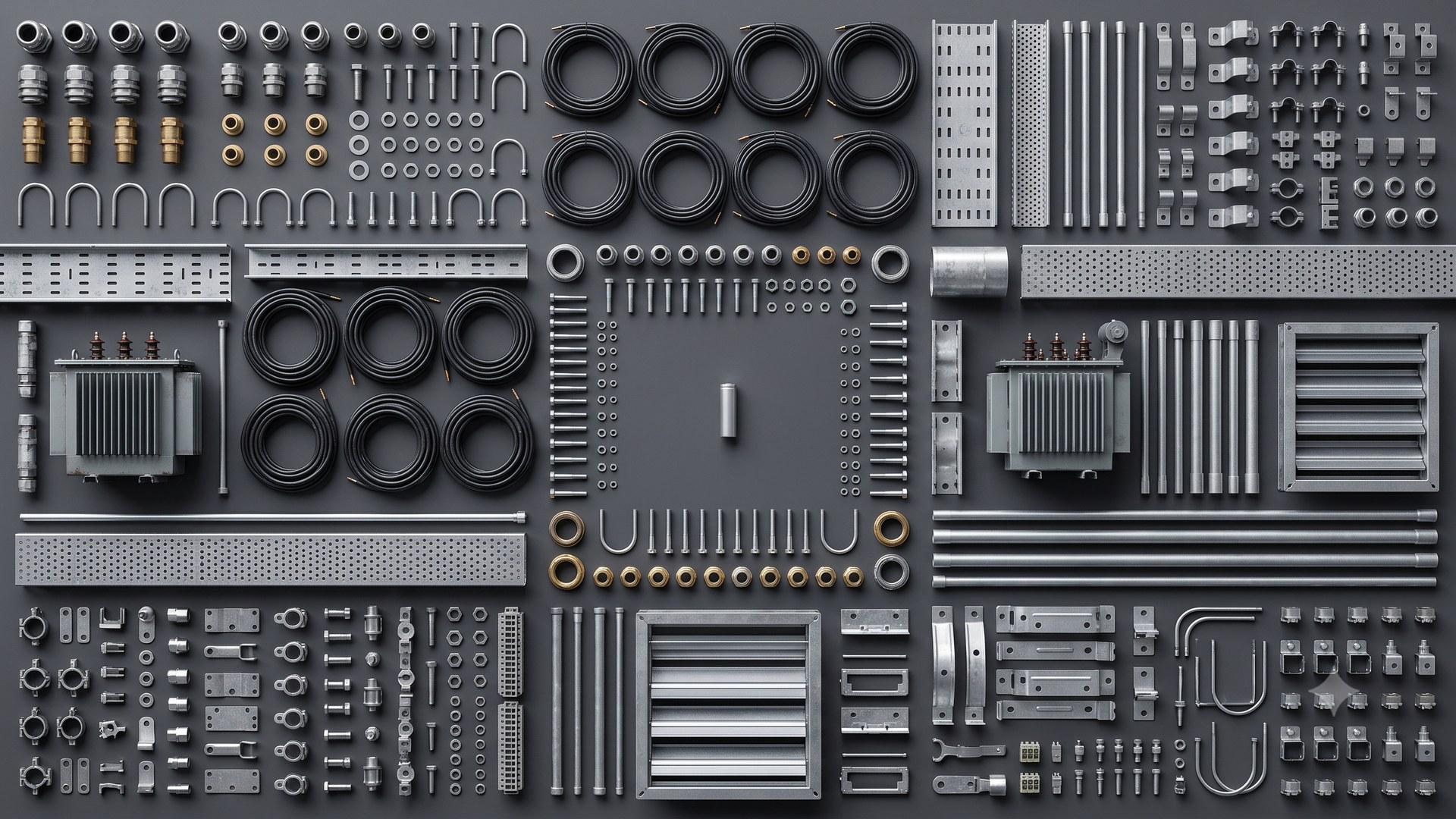
For most of the last decade, the people buying grid batteries shopped like the people buying laptops. The cells were the thing. The power electronics were the thing. Everything else — the foundations, the trenches, the fences, the substation that ties the plant to the grid — was an afterthought, a thin slice of the budget that nobody lost sleep over.
That slice has fattened. As battery cells and power-conversion systems fall in price, the unglamorous work around them is no longer a rounding error. It is where projects now run late, run over, or quietly bleed away their margin. The industry has a name for that work: balance of plant, or BoP. A RENMAD webinar in late 2025, hosted by ATA Insights and built around three views of the same problem — the technical adviser, the system integrator and the substation maker — turned into an argument about a bigger shift. Europe's battery build is moving from kit-shopping to delivery risk. And delivery risk has an address.
Everything except the batteries
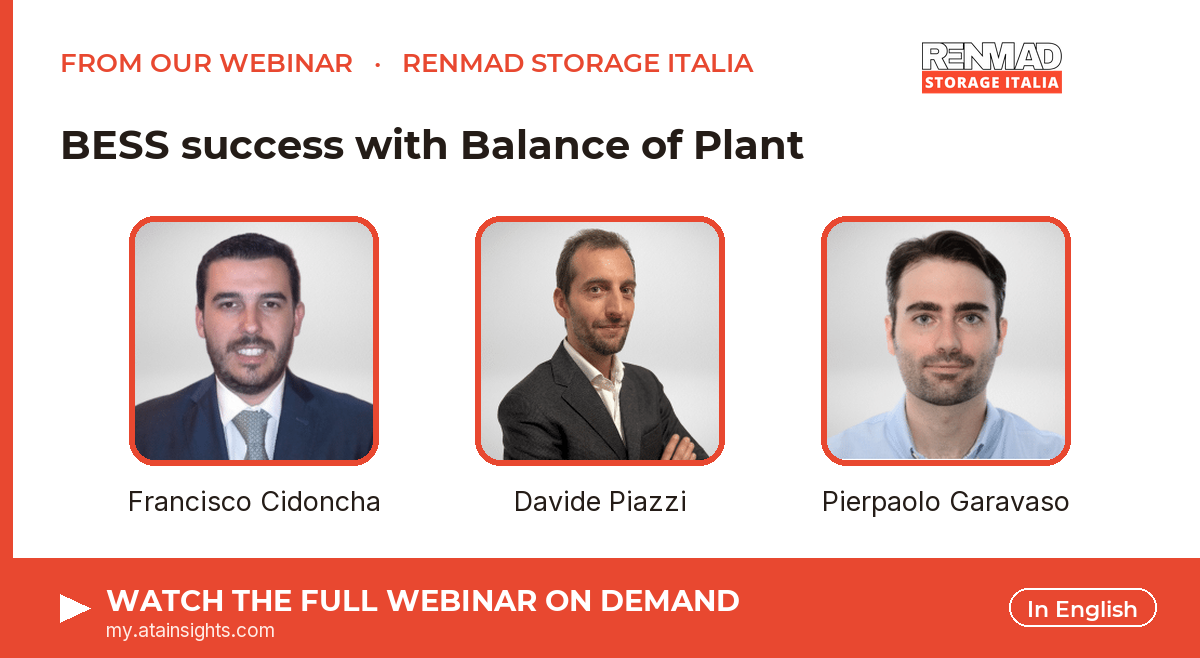
Start with what BoP actually is, because the boundary is where the money leaks. Francisco Cidoncha, a storage engineer at ATA Renewables, the technical advisory firm, drew the line plainly.
"BoP is balance of plant," he said. "It is basically everything except the batteries, the PCS, the BMS and the EMS." That "everything" is a long list: civil and structural works, electrical and mechanical works, SCADA and communications, fire systems, security. Sometimes it swallows the substation and the high-voltage line too.
The trouble is that the list is not the same in any two countries, and the differences are expensive. Cidoncha lingered on fire protection, because it is where local rules quietly rewrite a design. "Each country has their own rules, their own standards," he said. Spacing between equipment, water tanks, retention basins to catch firefighting run-off, noise barriers near housing — none of it travels. Italy's distances are larger than most. Australia has its own playbook; the United States has the NFPA codes. Get the local rulebook wrong and you either fail permitting or build a plant nobody will insure.
His prescription was less about engineering than about housekeeping before a shovel goes in. Define the project — size, functionality — before you ask anyone to price it. Hand bidders a basic engineering design and a bill of quantities so they are all costing the same plant. Run non-binding offers and Q&A rounds to "compare apples with apples." And do not, he warned, simply take the cheapest number: the right bid is "a relation between the scope, quality, price and experience of the bidders." The job of a technical adviser, in his telling, is to sit in the middle — owner's engineer, reviewer, sometimes project manager — so that the buyer is not refereeing a fight between the battery supplier and the BoP contractor alone.
The 45 percent
If BoP is climbing the budget, who carries it? Increasingly, one company for the whole job. Pierpaolo Garavaso, who heads tech sales for the EMEA region at NHOA Energy, the Italian system integrator, brought the number that anchored the whole session.
"In 2024, the overall amount of tenders requesting our support for an EPC scope of work was up to 25 percent," he said. "This year has been a significant change, bringing the overall amount of EPC requests from clients up to 45 percent." EPC — engineer, procure, construct — is the turnkey model: one contractor designs the plant, buys the kit and builds it, then hands over a working asset. In a single year, the share of buyers asking NHOA to take the lot nearly doubled.
The reason sits in the same cost story. Garavaso described two trends feeding each other. BoP used to be a marginal slice; now that supply and commissioning costs have fallen "remarkably," BoP's weight in the budget has risen to the point where it is worth fighting over. And the timeline has flipped. Projects were once paced by long-lead items — the transformer, the switchgear — while civil works sat comfortably off the critical path. No longer. "Equipment manufacturing is now improving significantly," he said, "and we found instead civil and BoP-related activities being significantly closer to the critical part of the project. So being able to manage the BoP contractor timeline is crucial for delivery."
NHOA's answer is to push engineering back upstream and standardise it. Garavaso showed the firm's "power island," a pre-engineered modular block pairing the DC side with a proprietary AC system the company calls Nexus — converter, medium-voltage transformer, switchgear and control cabinets in one. The point is not the hardware so much as the paperwork it generates. A fully pre-engineered design, he argued, can be turned into a bill of quantities that speaks the BoP contractor's own language: "If you make the effort to be talking the very same language, you can extract most of the value." Off-the-shelf documentation lets the contractor price with confidence and strip out the contingency padding they add when they are quoting against a technology they do not understand.
He offered a small, telling example of engineering that starts from BoP rather than ending there. NHOA's latest transformer carries an extra fourth winding, so the auxiliary transformer — a separate box that used to sit on site drawing housekeeping power — disappears into the main unit. "Not just reduce the number of auxiliary transformers," Garavaso said, "but also reduce cables and overall trenching on site." Fewer things to dig for, fewer things to wire, fewer things to go wrong.
His warning matched Cidoncha's, from the opposite chair. Italy's tightening fire rules, he noted, have raised "a lot of concern" from the fire brigade, and the temptation is to over-build to be safe. "Being able to understand, challenge and improve this regulation to avoid over-engineered solutions is definitely key also for the profitability of projects." A margin can be regulated away as surely as it can be spent away.
Four months into one
The third view came from the company that builds the doorway to the grid. Davide Piazzi, a business development manager at Hitachi Energy in Italy — joined by his colleague Francesco Caracci, a global application engineer for the firm's modular and mobile substations — made the case that the grid connection itself is now the bottleneck, and that the fix is to stop building substations on site.
"There is an increased request of grid connection," Piazzi said, "and the time and the resources needed for the connection are becoming always more critical." Hitachi has been making substations for more than 50 years; its pitch was that the way to speed them up is to standardise and prefabricate them — ship containerised, pre-tested modules that arrive needing only to be connected, not commissioned from scratch.
Then came the number that made the room sit up. A conventional add-on substation, Piazzi said, "might require, in our experience, something between four months, or even more, to be installed and commissioned." The modular version? "Can sort out the time to something like maximum one month." Not the manufacturing time — a transformer that takes twelve months to build still takes twelve months. But the part the developer feels on site, the install-and-commission window, more than halves.
Caracci explained how the trick works: the testing moves to the factory. "We do our pre-test in our factory, simulating the transformer," he said. "Once you are on site and connect the transformer, since the test has been already done, you just need to verify in a quicker way that everything is correct." The plant arrives pre-engineered, pre-tested, pre-commissioned. On site, crews repeat only the minimum safety checks — interlocks, emergency contacts — rather than the full battery of tests a built-from-scratch substation demands.
The knock-on effects line up with everything the other two speakers said. Light civil works mean simpler permitting, sometimes "reduced to almost nothing." Fewer trades on site mean fewer interfaces to manage and fewer people moving high-voltage equipment around — a safety gain Piazzi said is real even if it never shows up cleanly on a spreadsheet. And the same modular block can be picked up and moved: Hitachi has dropped these units everywhere from Sicily to Singapore, Saudi Arabia to Norway, often for the Italian grid operator Terna while a permanent substation is still being built.
The integrator's quiet pitch
Three speakers, three businesses, one tune. The plain reading is that as the easy savings on cells and inverters get used up, the next round of savings — and the next round of delays — lives in the parts of a battery plant that used to be ignored. The pricier reading, the one the integrators want buyers to hear, is that the way to control both is to hand fewer contracts to fewer companies.
Garavaso made that pitch openly: a single EPC contract means "a single point of accountability," predictable CapEx and timeline under "the very same entity," and a cleaner risk allocation that lenders like. "By having one clear entity managing the overall process," he said, "you have a clear risk allocation," which matters to anyone who has sat through project financing. It is, of course, the pitch of a company that sells exactly that. But the 45 percent figure suggests buyers are already voting with their tenders.
There is a tension the webinar did not fully resolve, and it is worth naming. Cidoncha's whole argument was for an independent adviser in the middle, refereeing between battery supplier and BoP contractor and protecting the buyer's interests. The integrators' argument is that the middle should disappear — one contract, one throat to choke, no referee needed. Both can be right at once. A developer with a single small plant may want the turnkey simplicity; a utility with a pipeline of large, unusual sites may want the adviser precisely because the stakes of getting the scope split wrong are higher. What neither side disputes is the underlying shift: the decisive risk has migrated out of the battery container and into the ground around it.
For the developers, investors and utilities watching Europe's storage boom, that is the practical takeaway. The battery is no longer the hard part. The hard part is the concrete poured to the right local fire code, the substation that connects in one month instead of four, and the contract that makes one company answer for all of it. The cells get cheaper every year. The balance of plant is where the balance of power now sits — and it is decided long before the first battery is switched on.
Italy is where this argument bites first. It is Europe's second-largest battery market, it is tightening its fire rules as it grows, and all four speakers will be in the same room to continue the fight at RENMAD Storage Italia, the event's third edition, in Bologna on 15–16 April. The webinar recording and slides go out to registrants by email; the session page on ATA Insights is the place to catch the replay and the questions there was no time to answer live.
You reached this analysis because ATA Insights puts independent energy-transition intelligence in front of 86,000+ professionals across the sector. That's exactly what we do for funded projects, events and companies — turn your work into reach.
See how we disseminate work like this →Where this analysis came from
This piece draws on the ATA Insights / RENMAD webinar the session. Watch the full session on demand.
The energy transition, in your inbox
Join 86,000+ professionals reading our independent briefings across five sectors.