
By Farmers, for Farmers
A giant digester rising in Lleida turns a region's manure problem into gas, fertiliser and jobs — and shows what Spain's biomethane boom could look like everywhere.
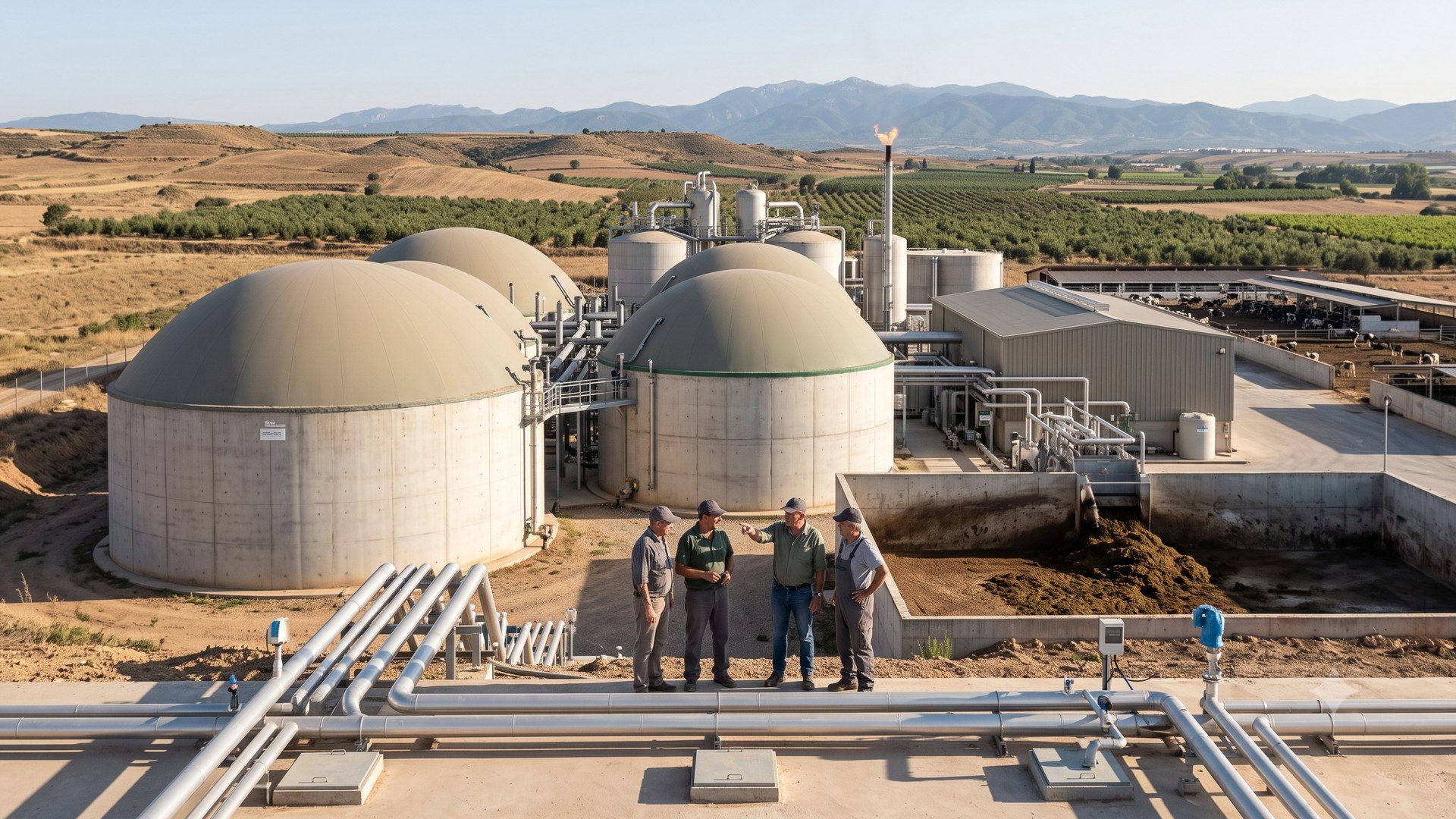
In the comarca of La Noguera, in the flat farming country west of Barcelona, the pigs and cattle produce a problem before they produce anything else. Manure — millions of tonnes of it across the surrounding fields — has to go somewhere, and for years "somewhere" has mostly meant the land next door, until the land next door has had enough. In a region this densely farmed, slurry stops being fertiliser and starts being a pollutant, leaching nitrogen into the soil and the water table.
Drop a large biomethane plant into the middle of that map and the problem inverts. The manure becomes a feedstock somebody will pay to collect; the gas it yields goes into the national grid; and what is left over comes back to the fields as a cleaner fertiliser than the slurry it replaced. That is the Cobirgy project — and on a recent RENMAD webinar hosted by ATA Insights, the people building it made the case that it is less an energy plant than a piece of rural plumbing the whole district has been waiting for.
The timing is not incidental. Spain spent years with a single biomethane plant injecting into the grid. By the end of 2025 it had 24, having doubled the fleet in a single year — and Catalonia is leading the charge. Cobirgy is the kind of project that explains how the next hundred get built.
A country sitting on its own gas
Naiara Ortiz de Mendíbil, secretary general of Sedigas, the Spanish gas association, opened with the number that frames everything. A 2022 study put Spain's total biomethane potential at 163 terawatt-hours a year — set against national gas demand of 331 terawatt-hours, that is roughly half the country's gas, sitting in its farms and food waste, waiting to be made.
The momentum is finally there to chase it. "In 2025 we doubled the plants compared with 2024," Ortiz de Mendíbil said. "We had 12, now we have 24 — so we're on the right track." The grid operator's registry, she noted, holds more than 300 applications, of which 268 are judged viable; built out, they would supply around 24 terawatt-hours a year — enough to clear the 20-terawatt-hour target Spain's national energy plan set for 2030. On the European Biogas Association's projections to 2050, Spain ranks first in the EU for potential, ahead of Germany, France and Italy, and first for planned investment, at €4.8 billion. The raw material and the money are not the problem. Building the plants, region by region, is — and Catalonia, she pointed out, is "doing its homework fastest," with a roadmap, aid schemes and a digestate strategy already in place.
The project at the centre of the map
Cobirgy is the work of Copenhagen Infrastructure Partners, the Danish fund manager, through its energy-transition vehicle. Javier Prados Mateos, who runs CIP in Spain, placed the plant in a portfolio that spans 32 markets and one global ambition: to turn waste nobody wants into energy everybody needs. CIP's funds, he noted, follow a strict "no fit, no food" rule — they do not grow crops to make energy, and they do not take feedstock that could have fed animals or people. What goes into Cobirgy is residue: livestock manure and agri-food waste that already exists and already has to be dealt with.
Luis Salgas, the project's chief executive, described a plant designed around its own catchment. Within a radius of roughly 30 kilometres sit the pig, cattle and poultry farms whose manure — on the order of four million tonnes in that ring — Cobirgy is built to absorb. Site a plant there and you are not trucking slurry across provincial borders to feed an oversized digester; you are solving the waste problem of the farms on your doorstep. The plant, Salgas said, will be the largest of its kind in southern Europe, and unusually it pairs the digester with a complete on-site digestate-treatment facility — the part most projects skip. Construction is imminent, with ground expected to break in 2026.
The phrase both men kept returning to was the one that doubles as the project's thesis. Cobirgy, Prados Mateos said, is "a project by farmers, for farmers" — built with the livestock and arable producers of the area, not imposed on them. The farmers supply the problem; the plant supplies the fix; and the value stays local, in collection fees avoided, fertiliser bought back cheaper, and jobs created both building the plant and running it.
The leftover that pays its way
The part of the story that turns a waste plant into a rural asset is the digestate — the stabilised organic matter left once the microbes have turned the manure into gas. Irene Ortiz Águila, who handles feedstock and digestate valorisation for CIP, made the case that this by-product is not a disposal headache but a product in its own right.
"It is more secure, homogeneous and stable," she said of digestate against the raw slurry it replaces. "Beyond the digestion, it undergoes pasteurisation — which means pathogens and contaminants are eliminated, and we obtain a more stable product, in our case with more concentrated nutrients." Spread on a field, it carries an NPK profile and a high load of available organic carbon; it improves soil structure, aeration and water retention, and cuts the nitrogen run-off that plagues a region like La Noguera.
And it saves the farmer money. "Digestate has a lower nitrogen unit cost than mineral fertilisers," Ortiz Águila noted — letting growers reduce, at least partly, their dependence on mineral fertilisers that are usually imported and exposed to every swing in energy prices and geopolitics. Cobirgy's full-treatment plant goes a step further, concentrating the nutrients into fractions that local fertiliser makers can use and cleaning the water stream enough to discharge. The project already has fertiliser manufacturers lined up to take those concentrated fractions.
Here Ortiz Águila flagged the one piece still catching up: the rules. Europe's fertilising-products regulation, 2019/1009, already reserves a category for biomethane-plant digestate and lets it reach "end-of-waste" status — at which point it can be sold, and even exported, as a product rather than managed as waste. Spain has the law 7/2022, a fertilisers royal decree, and in Catalonia a dedicated digestate strategy and decree. Yet, she said, "legal barriers remain that need to be tackled" before treating manure this way is as easy as it should be. The benefit is sitting there; the paperwork has not quite caught up to it.
What Cobirgy is really a template for
Strip the project to its logic and it is almost suspiciously tidy. A region has too much manure. A plant turns that manure into grid gas and a cleaner fertiliser, takes the pollution pressure off the soil and water, employs local people to build and run it, and hands farmers a cheaper input than the imported mineral bag. Nobody is asked to grow anything new or give anything up. The waste was always there; Cobirgy simply puts it to work.
That is why the people behind it talk less about megawatts than about the map filling up. Ortiz de Mendíbil's stated wish for Sedigas is that Spain's biomethane map stop being a near-empty country with a handful of dots and become one covered in them. Cobirgy — large, local, circular, by farmers and for farmers — is the dot the others can be drawn from. Spain is sitting on half its gas demand in residues it has to manage anyway. Lleida is about to show what happens when a region decides to use it.
You reached this analysis because ATA Insights puts independent energy-transition intelligence in front of 86,000+ professionals across the sector. That's exactly what we do for funded projects, events and companies — turn your work into reach.
See how we disseminate work like this →Where this analysis came from
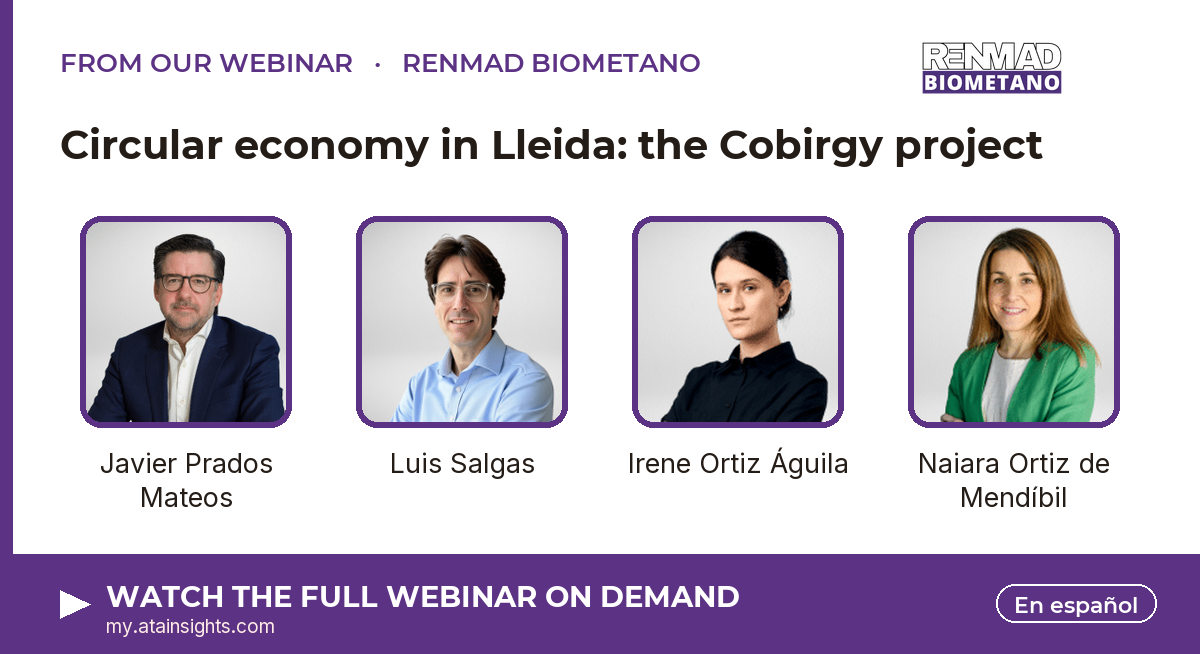
This piece draws on the ATA Insights / RENMAD webinar Circular economy in Lleida: the Cobirgy project. Watch the full session on demand.
The energy transition, in your inbox
Join 86,000+ professionals reading our independent briefings across five sectors.