
Cutting the cake: opportunities for storage in Spain's capacity market
Brussels has said yes. Now the government decides when the mechanism switches on, how much firm capacity it buys, what each megawatt is worth and who gets paid. For batteries and pumped hydro, every one of those cuts is a clue to where the money will be
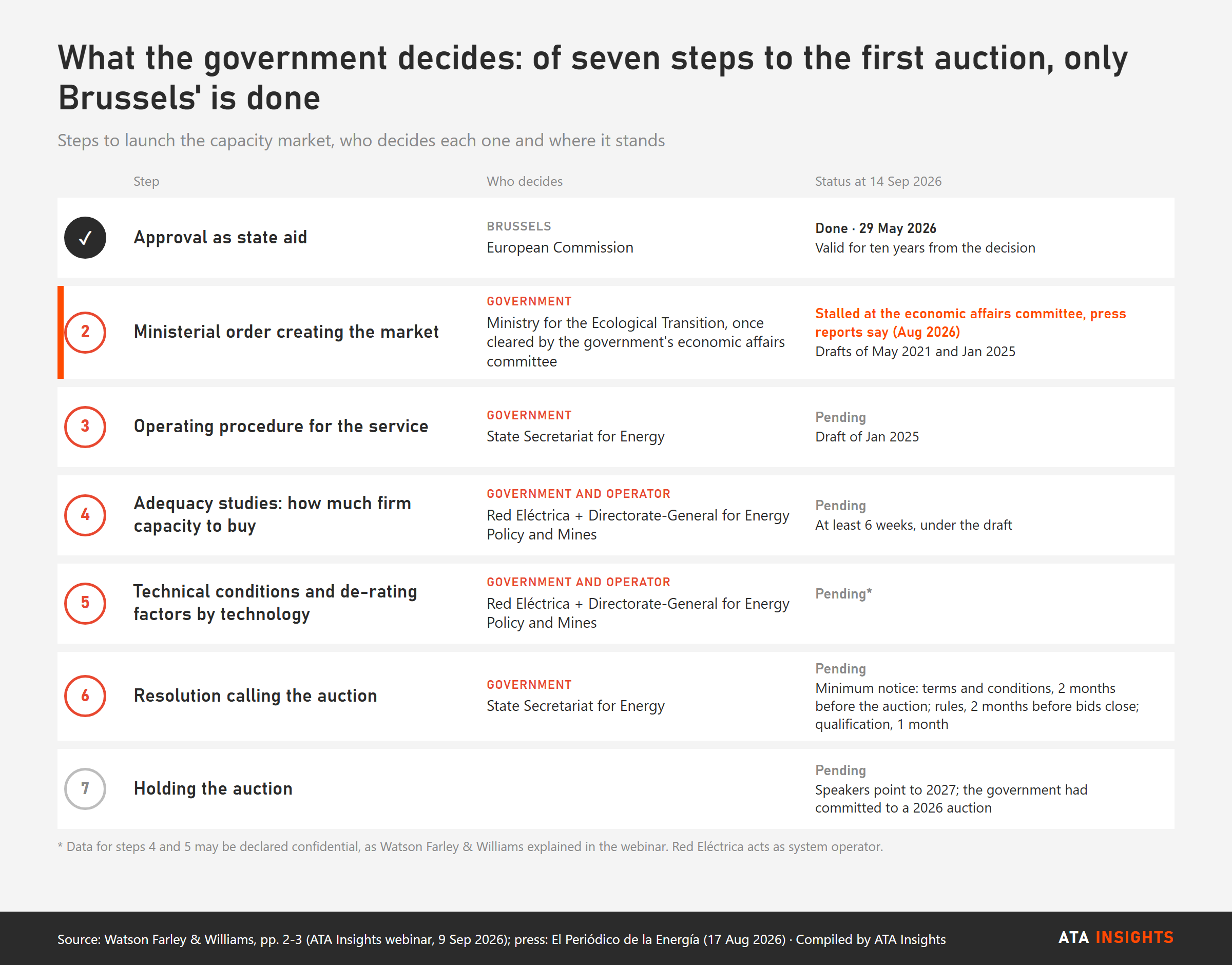
On 29 May the European Commission approved Spain's capacity market under EU state-aid rules. It was the first of seven steps that Lidia Fernández of Watson Farley & Williams walked through at the ATA Insights webinar on 9 September, and the only one that did not depend on Madrid. The other six run through the Ministry for the Ecological Transition and the government's economic affairs committee (the Comisión Delegada del Gobierno para Asuntos Económicos), with the numbers crunched by Red Eléctrica, Spain's system operator. The government holds the knife, and each cut has its reasons. Work out why it cuts where it does and you will know which slice to ask for.
All in good time, against the clock
The first decision is when to switch the mechanism on. The ministry had been promising a very quick roll-out once Brussels gave its blessing, Fernández recalled. In August the message changed. The Ecological Transition ministry approves the order, but only after the economic affairs committee has signed it off, and that is where it has stalled. El Periódico de la Energía, a Spanish energy news site, reported on 17 August that Carlos Cuerpo, First Vice-President and Minister for Economy, Trade and Business, had put this summer's planned launch on hold over the price of gas, the situation in the Middle East and the possible extra cost to electricity bills. Judging by the news, Fernández said, the Economy ministry's line is: "hang on, we need to have a think about this".
The caution makes sense: with gas expensive, any new charge on the bill gets noticed. Óscar Barrero of PwC España put it in proportion. A mechanism costing "at most €900m", he calculated, comes to "barely €3 per megawatt hour". System adjustment services, the balancing and constraint costs already on the bill, could end the year above €20/MWh on the estimates he cited.
While the Economy ministry does its sums, the clock is ticking. The approval lasts ten years from the Commission's decision, so it expires in May 2036 however late the first auction is held: every year of waiting is a year off the mechanism's life. And the terms of the approval require only one to two months' notice. Fernández and Javier Revuelta of Wood Mackenzie are looking at 2027, though Barrero points out that the government had committed to holding an auction this year. Whoever has the grid connection, the permits and the financial model ready before the auction is called will not have to wait on the Economy ministry's timetable.
Gigawatts to taste
The second decision is the size of the cake: how much firm capacity to buy. Peak demand is around 40 GW today, according to Wood Mackenzie, and the system is sized for a one-in-ten winter, about 42 GW. And for the years ahead? "Basically, for whatever we feel like," Revuelta said, answering his own question. Add plenty of data centres, electric vehicles and industry, and a conservative projection already puts it at 50 or 52 GW. The value of lost load (VoLL), the price put on each megawatt hour of demand that goes unserved, is just over €20,000/MWh, and it underpins the reliability standard: a loss of load expectation (LOLE) of 1.5 hours a year. VoLL had to survive close scrutiny, because Brussels requires it to be justified. By contrast, "there is no particular scrutiny of what capacity we are preparing for". "So there we have total discretion," he added, although the adequacy studies are public.
Barrero put it plainly: this is "also a matter of energy policy, and of how far the government wants to widen that room for demand". Seen from the ministry, that latitude is a tool: the firm capacity bought today is the demand that can be promised tomorrow to a data centre or a factory. Policy moves the supply side too. Extending the life of the Almaraz nuclear plant to 8 June 2030 means the auction parameters have to be revisited. "If you push me, the main factor is the initial size of the cake," Barrero said.
According to the Commission's decision, Spain estimates that contracting 40 to 45 GW a year at an average of about €20,000/MW would put the annual budget at €800m to €900m. The price, though, depends on how the cake is cut. If few batteries turn up and every combined-cycle gas plant is needed, it will hover around €20,000-25,000/MW a year. That, Revuelta said, is the figure the CNMC, Spain's energy regulator, has often used for the operating cost of a combined-cycle plant. If the government plans for a high peak, then "with all the combined cycles we don't get there", and it will need new capacity that only batteries and pumped hydro can supply. If that new capacity falls €50,000 or €60,000/MW a year short of covering its investment (its missing money), "the capacity payment would have to rise to that level".
That is the first opportunity. The main auction is designed "to secure demand five years out", Barrero noted, so a new project is better off running its numbers on the government's demand forecast than on today's prices. The more seriously the government takes the demand it wants to attract, the more the megawatt that does not yet exist will be worth.
Measure for measure
The third decision is how much of each megawatt counts. The de-rating factors, the share of installed capacity that can be counted on at the critical hour, will be calculated by Red Eléctrica at the request of the ministry's Directorate-General for Energy Policy and Mines. Those figures, Fernández warned, "may be declared confidential". In Spain, "the problem hours will still be winter evenings at 9pm", according to Revuelta. At that hour a battery is only as good as its duration.
In Great Britain's de-rating factors for 2029/30, which PwC España showed for illustration, a 4-hour battery counts at 44%, less than half the figure for pumped hydro, and a 2-hour battery at 21.6%.
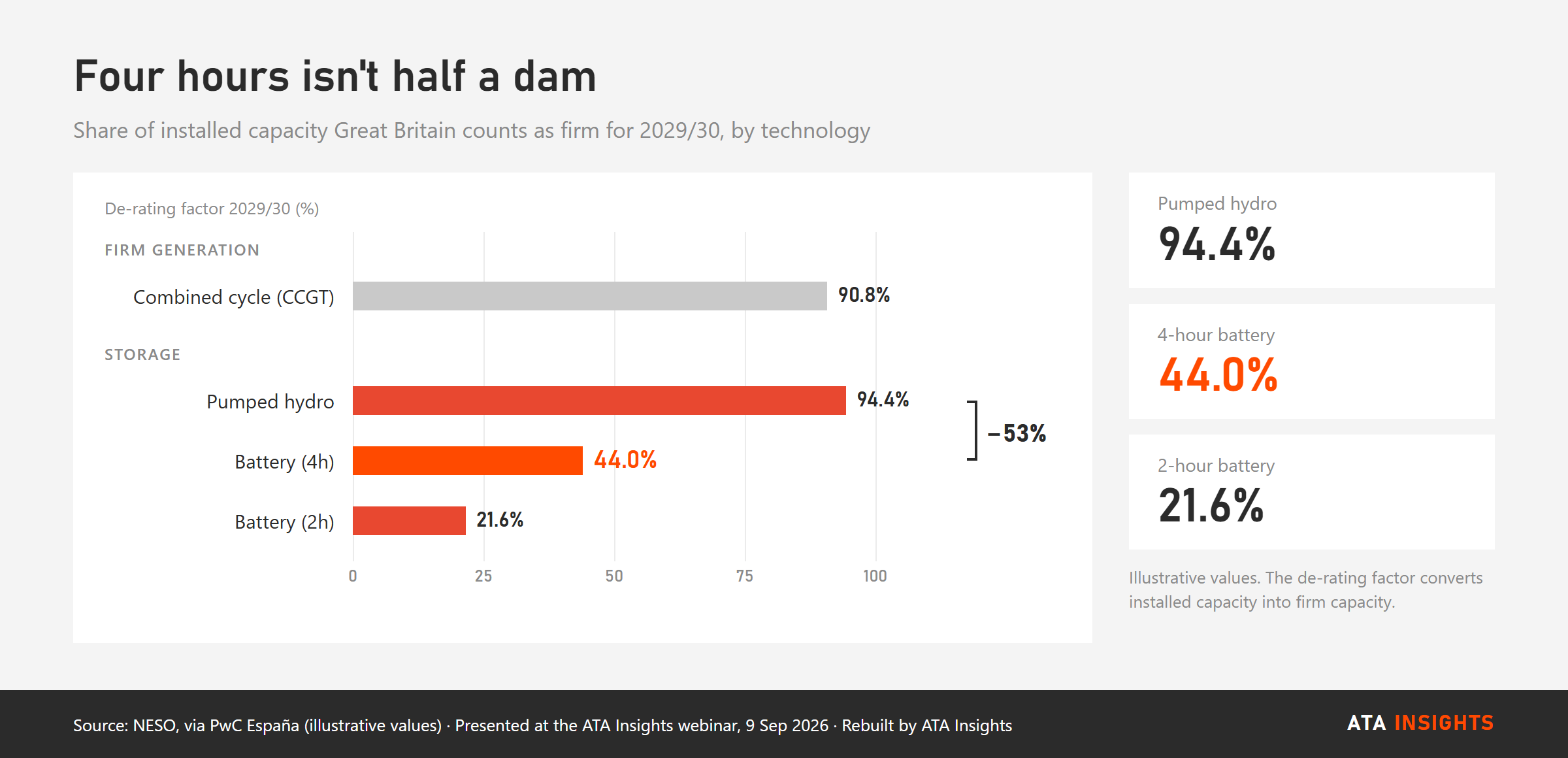
There is no official figure for Spain. Revuelta expects 60-70% for 4-hour batteries; Barrero puts it at 40%, "as optimistic values". Red Eléctrica, Revuelta predicts, will be "very conservative, as it has to be, especially at the start". And the yardstick moves with what it measures. "De-rating isn't a static factor, it's a dynamic factor," Barrero explained: the more batteries connect, the flatter the peak becomes and the less each additional megawatt contributes. In PwC España's analysis using data from Terna, Italy's system operator, the factor for 8-hour batteries falls from 90% to 22% as the fleet grows to 7,000 MW.
The operator's caution has a purpose: to stop storage becoming a victim of its own success. If 10 or 15 GW of batteries arrive and push a similar amount of combined-cycle capacity out of the system, on a windless day there is nothing to charge them with. "The battery doesn't charge and its de-rating factor is no longer 0.6. Now it's 0.2 or 0.1," said Revuelta, who sees possible downgrades in the 2028 to 2030 auctions. Barrero adds battery degradation, which the operator will also deduct.
Revuelta summed it up: "Tell me the de-rating factor and I'll tell you my bid." What matters is how a 2-hour battery, a 4-hour battery and pumped hydro stack up against each other. The opportunity lies in choosing the duration with the de-rating factor in mind, and in budgeting from day one for the module replacements that keep it there.
The management reserves the right
The fourth decision is how much to pay, and to whom. The latest draft of the ministerial order, from 2024-25, proposes a pay-as-bid auction (each winner is paid what it bid), according to published legal analyses. Even so, Barrero cautioned, "to some extent all markets end up being marginal-price markets": everyone will bid with one eye on the clearing price, set by the last megawatt to get in. Any limits would be set by the State Secretariat for Energy in the auction call: a price cap, and a lower cap for existing plants. These are the government's tools for protecting the bill. Revuelta did not rule out an existing battery facing a cap of zero when it bids for a one-year contract: "look, you're already up and running".
The same draft treats any plant with an operating authorisation granted before the call as existing. Revuelta spelt out the consequence: a plant already in operation cannot claim the new-build payment. New capacity would get contracts of up to half its useful life, capped at 15 years; Barrero puts the minimum at five, and "it may even be longer in the case of, for example, pumped hydro". Existing capacity will go on one-year contracts. If you are not investing, he reasoned, "I don't have to guarantee you anything beyond the year in which you are providing the service".
Here the opportunity is one of timing: a project that obtains its operating authorisation after the call competes as new and can go for the long contract. Pumped hydro starts with an edge: the highest de-rating factor, potentially the longest contracts and, if the call provides for it, a quota of its own in auctions held up to nine years ahead of delivery.
The best slice
Once the de-rating factors are applied, Barrero warned, capacity "isn't going to be a very significant share of plants' revenues either". But firm, multi-year income counts for more on a banker's desk than in the profit and loss account, and Spanish storage needs it: Red Eléctrica counted 260.8 MW of installed batteries in August, barely 40 MW more than in May.
Fernández reached for a classic: "I think this is the boy who cried wolf." Announce something often enough and nobody believes it, and then the wolf does come. When it does, as the Spanish saying goes, whoever cuts the cake keeps the best slice. The government has already hinted at the slice it wants: the lights kept on at the peak, at the lowest possible cost to the bill. The rest of the cake will go to whoever has worked out where the knife will cut.
Lidia Fernández, Watson Farley & Williams; Javier Revuelta, Wood Mackenzie; Óscar Barrero, PwC España. ATA Insights webinar "El mercado de capacidad en España: qué cambia para el almacenamiento (BESS y bombeo)" (Spain's capacity market: what changes for storage, batteries and pumped hydro), 9 September 2026. The debate continues at RENMAD Almacenamiento, Seville, 31 March to 1 April 2027.
You reached this analysis because ATA Insights puts independent energy-transition intelligence in front of 86,000+ professionals across the sector. That's exactly what we do for funded projects, events and companies — turn your work into reach.
See how we disseminate work like this →Where this analysis came from
This piece draws on the ATA Insights / RENMAD webinar Spain's capacity market: what changes for storage, batteries and pumped hydro. Watch the full session on demand.

The energy transition, in your inbox
Join 86,000+ professionals reading our independent briefings across five sectors.