
Factory settings: what Maxxen Day says about Europe's storage boom
More than 260 people from across Europe travelled to a factory in Türkiye's Aegean region to watch batteries being built. What they were really inspecting was a storage market on its way from pilots to portfolios, and the question of who gets to supply it.
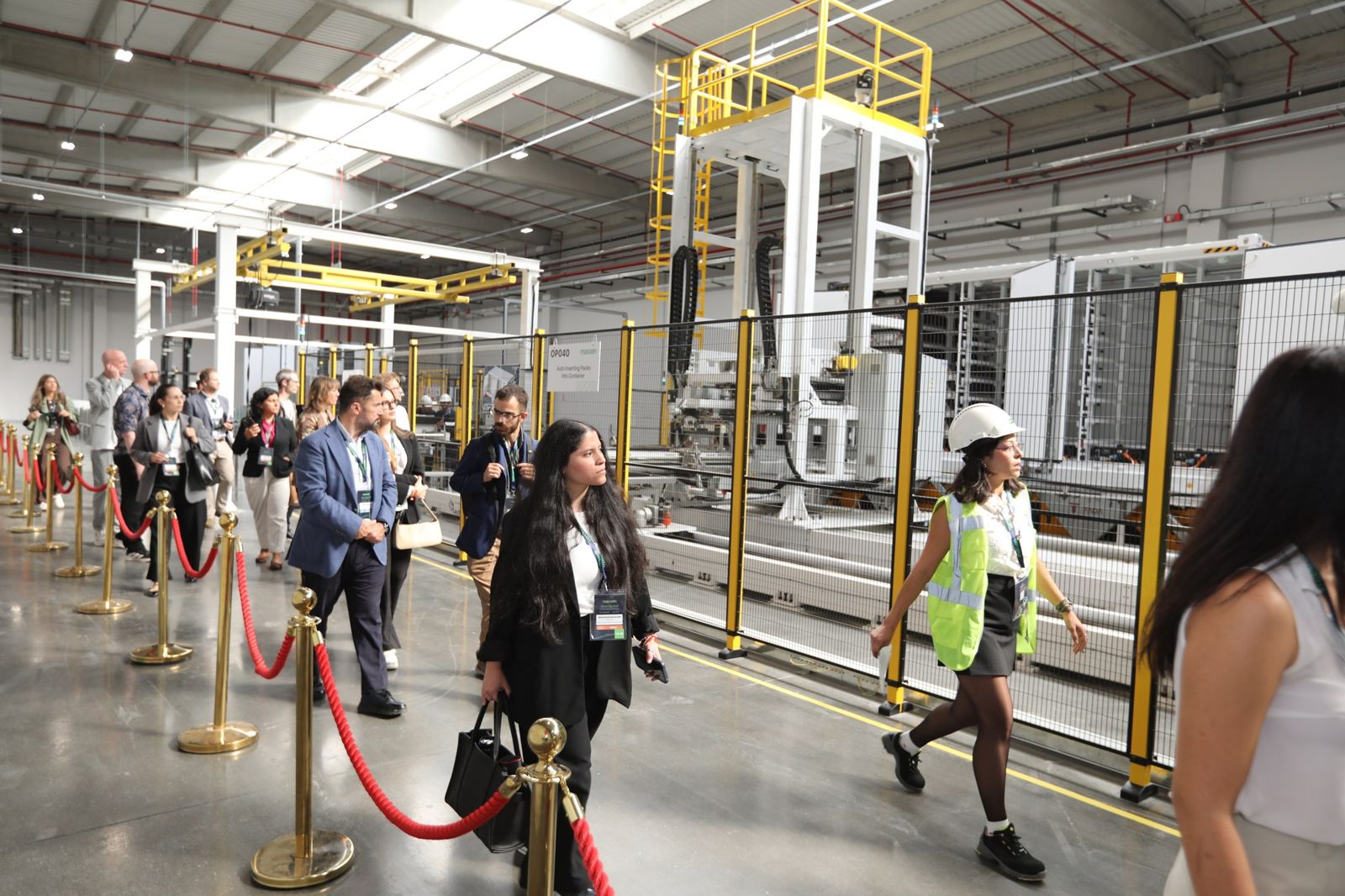
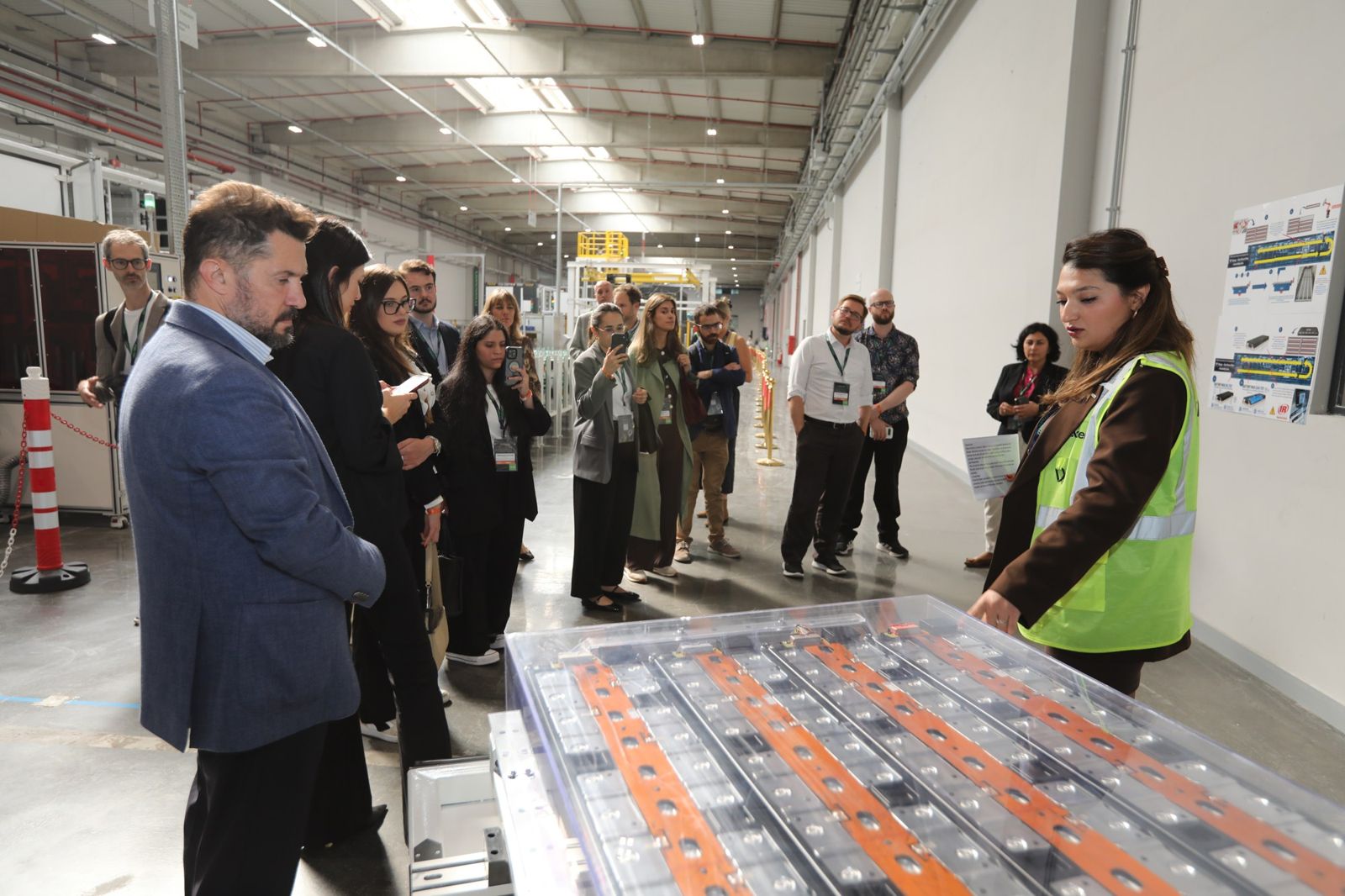
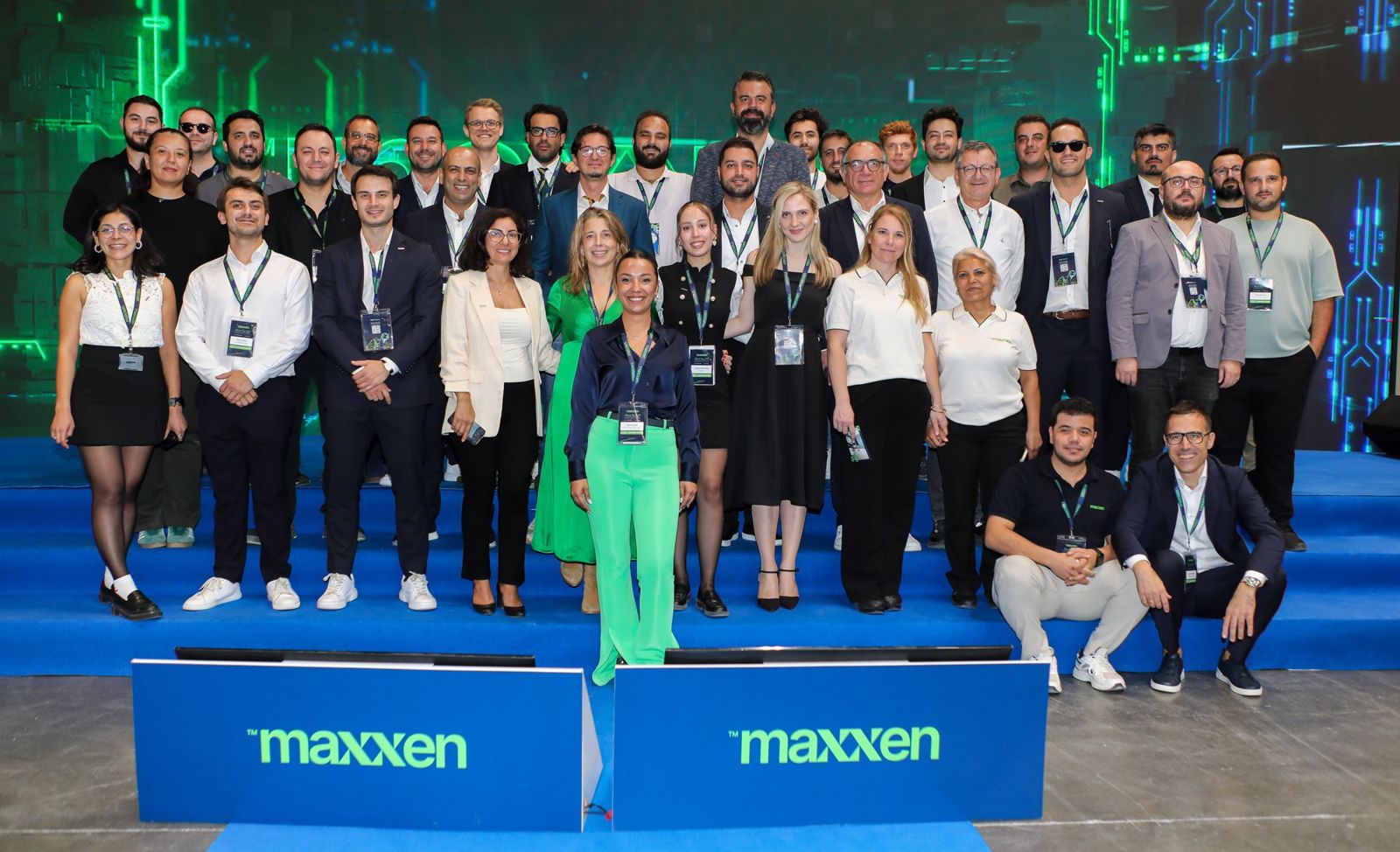
Aydın is not on the usual energy-conference circuit. On 1 and 2 October it was, briefly, the centre of it. 262 guests from 16 European countries, drawn from 118 companies across the storage value chain, came to Maxxen's plant in the Ortaklar industrial zone. They followed guides in hi-vis vests down the production line, filmed robotic arms through the glass, crowded round a battery module and asked engineers the sort of questions people ask when they are about to sign something. Then they took their seats on the factory floor and listened to Benchmark Mineral Intelligence, Wood Mackenzie, Clean Horizon, a row of investors and an insurer talk about the thing that really decides this market: money.
The host brought numbers of its own. The factory opened in December 2025. Since then, Maxxen says, it has delivered 644 MWh across 21 projects, which by its own reckoning is close to 5% of Europe's grid-scale battery market. The plant has 5 GWh of annual capacity, carries TÜV, LEED Gold and ISO 27001 certification and, the company says, runs on 100% renewable electricity. "We also believe Maxxen is the fastest-growing European BESS manufacturer ever," said Rubén Valiente, its managing director. A bold claim, but the guest list suggested the market was at least willing to come and check.
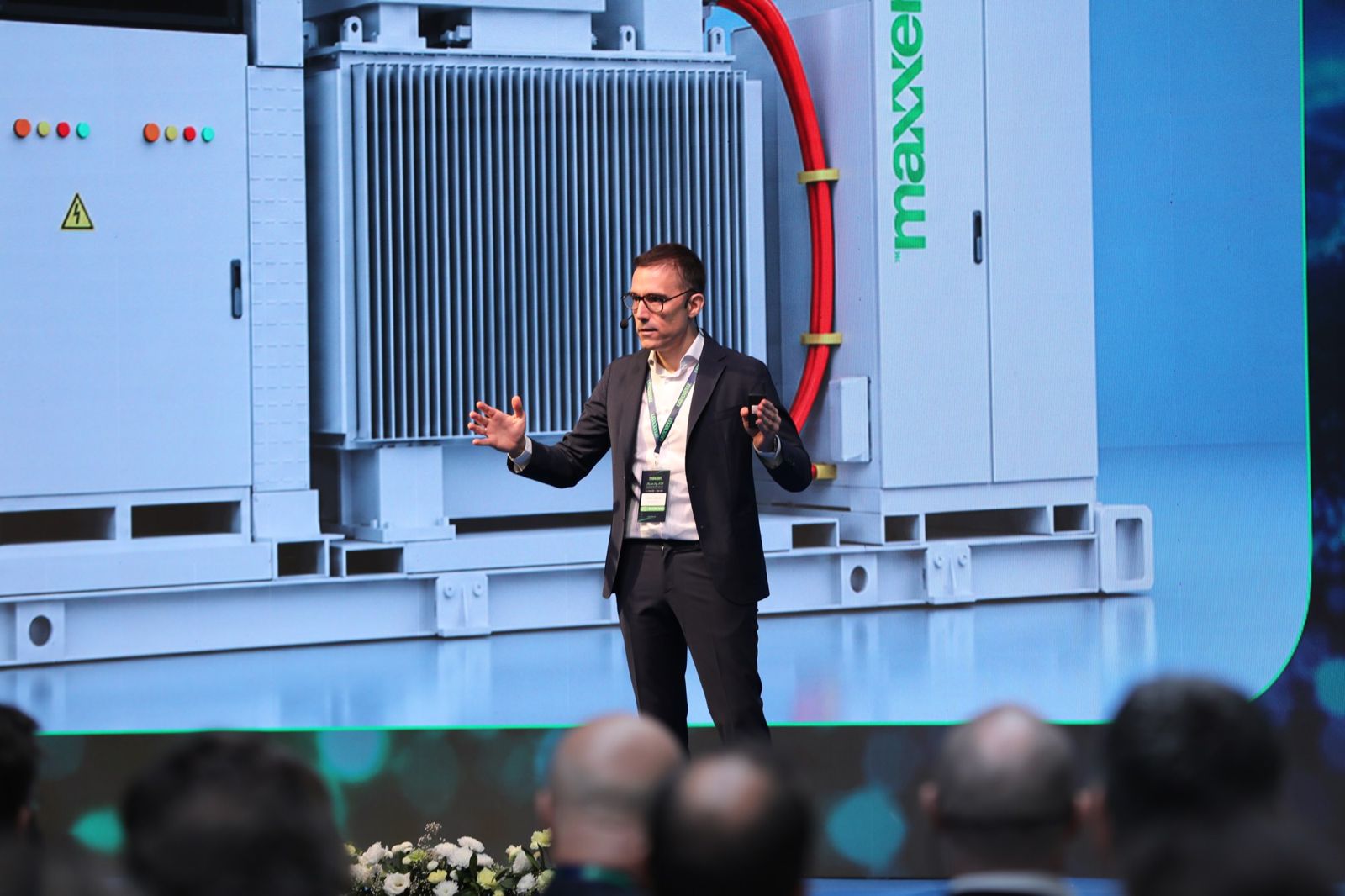
ATA Insights was among the guests Maxxen invited to Aydın, and two things stood out. The first was how wide the doors were opened. Visitors were walked through the whole process, from the robotic cells behind the glass and the module line to racking and the finished containers, and were free to stop, film and question the engineers at every station. Factories that sell on trust rarely show this much of the floor. The second was the candour of the conversation. Nobody on stage pretended the market was simple: saturating balancing markets, revenues that have fallen sharply in places, and the hard questions of finance and insurance were all put squarely on the table, and the host let them be. For a manufacturer courting buyers, that transparency may have been the most persuasive pitch of the day.
From pilots to portfolios
The analysts on stage described an industry in the middle of a growth spurt, and a change in who drives it. Until now Europe's storage boom has been led by home batteries. Wood Mackenzie expects that to change: it forecasts Europe's installed storage rising from 89 GWh at the end of 2025 to 857 GWh by 2035, with grid-scale projects supplying about two-thirds of the capacity added. Governments have stopped watching from the touchline. More than 70 GW of battery storage has been awarded through auctions in the past six years, most of it through capacity markets, and the volume awarded in 2025 alone nearly matched all previous years combined. Contracts are following. Wood Mackenzie counts some 5 GW of storage offtake deals signed in Europe, most of them in 2025: the tolls, revenue floors and similar hedges that turn a merchant gamble into something a bank will lend against.
The projects themselves are getting bigger. Benchmark's figures show the average European grid-scale project passing 100 MWh this year and topping 300 MWh in 2027. Durations are stretching too, from about 1.6 hours for projects commissioned in 2023 to more than three by 2028, with Bulgaria, Italy, Spain and Poland pulling the average up.
Demand is doing its part. Wood Mackenzie told the room that European power prices have more than doubled since the conflict that removed a fifth of global LNG supply, that renewables have tipped past half of Europe's supply mix, and that solar and wind earn ever less at the hours they produce most. That gap between when power is made and when it is wanted is exactly what a battery is paid to close. Add some 12 GW of new data-centre capacity expected in Europe by 2030, and loads that can lurch without warning (one Meta facility in Texas shed 100 MW in three minutes in May), and flexibility starts to look less like an option than a utility.
Bankability is the new chemistry
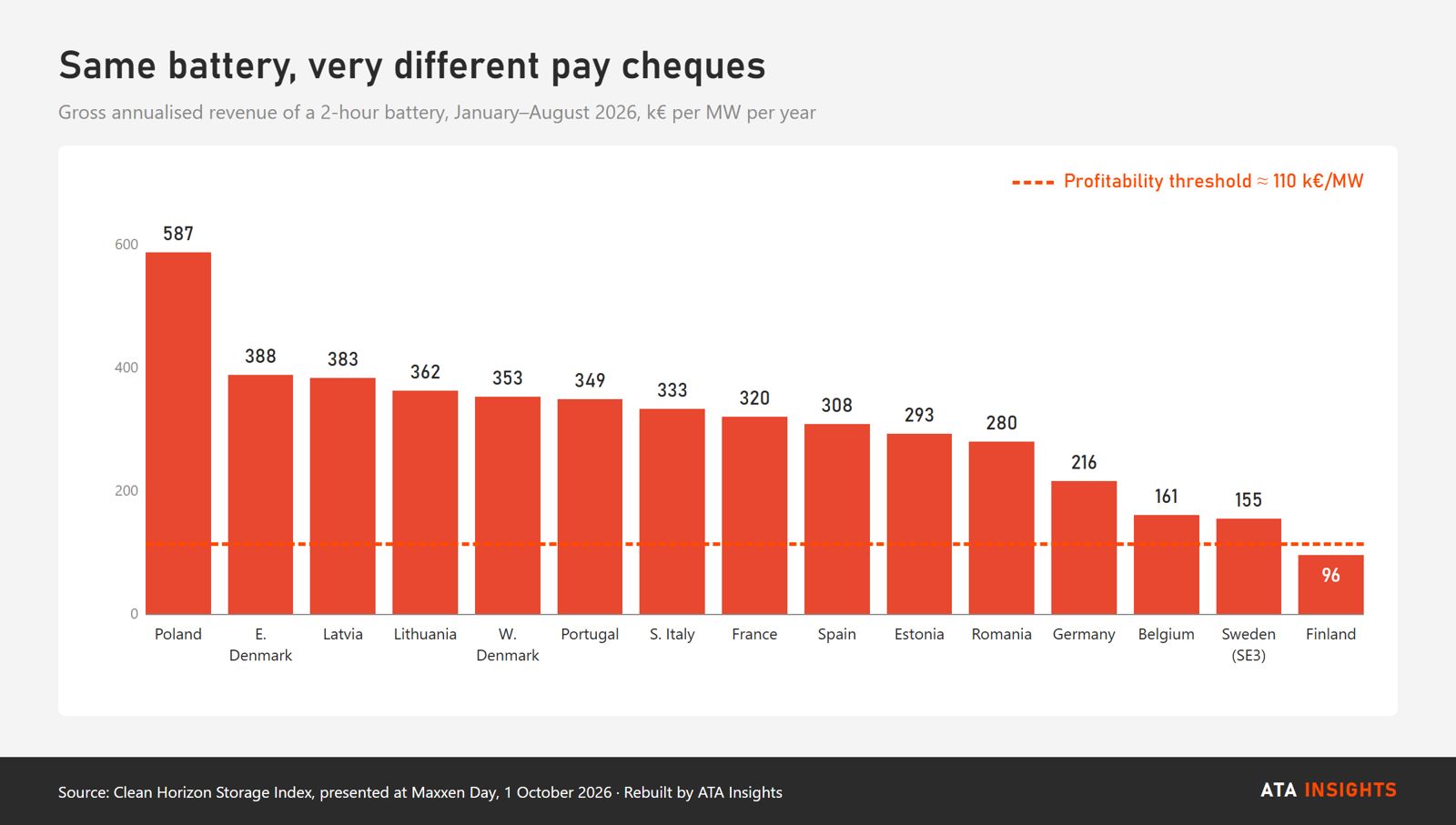
Growth brings scrutiny. Clean Horizon's Storage Index, which models what a standard two-hour battery would have earned, put annualised gross revenues between January and August anywhere from €96,000 to €587,000 per MW, depending on the country, against a profitability threshold of about €110,000. Poland sits at the top. Finland, where batteries piled into the balancing (ancillary-services) market until it saturated, sits at the bottom. For investors the message is about direction of travel: revenues are moving away from balancing services, which fill up fast, towards day-ahead and intraday trading, where liquidity is rising sharply. Wood Mackenzie summed it up as storage moving from balancing services to trading, while contracting structures develop to make projects bankable.
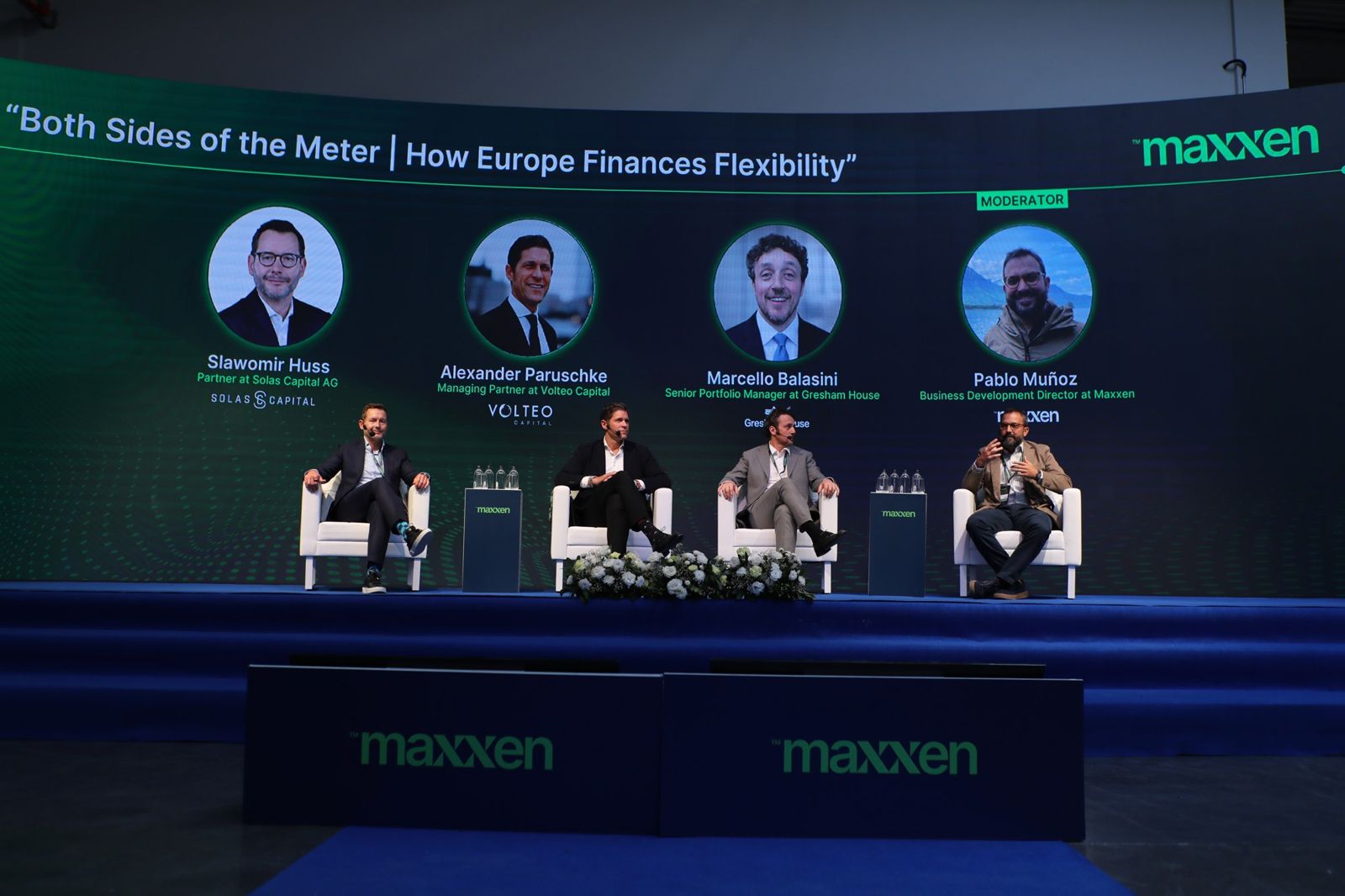
That shift changes what a buyer needs from a supplier. When an asset has to trade in fifteen-minute slots for the next decade and more, availability, round-trip efficiency (how much of the electricity stored comes back out), warranty depth and the quality of the operating data matter as much as the price per kilowatt-hour. Maxxen built its programme accordingly. One panel, moderated by Maxxen's Pablo Muñoz, put Solas Capital, Volteo Capital and Gresham House on stage to discuss how Europe finances flexibility; another, chaired by Mr Valiente, asked Zagope, Luxera and Crowmie what developers learn on the way from a first project to a full portfolio. Munich Re brought the insurer's view of risk. Outsiders have noticed. Within a year of opening, Maxxen already appears in PV Tech Research's BESS bankability pyramid, in the same band as Siemens Energy, GE Vernova and Honeywell.
Why the address on the box matters
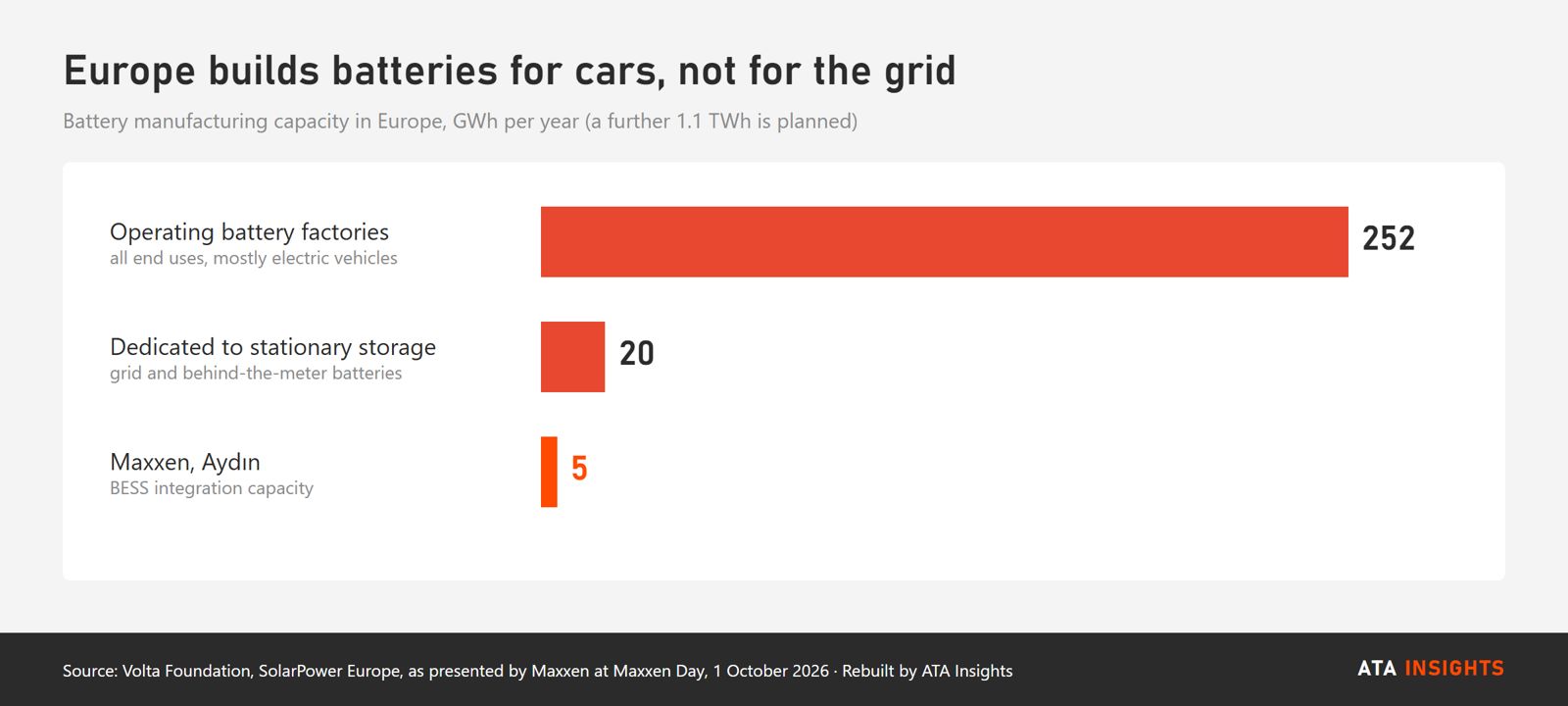
Then there is the question Europe spent a decade asking about solar panels and is now asking about batteries: where should they be made? The continent has plenty of battery factories, roughly 252 GWh of capacity in operation and more than 1 TWh planned, according to Volta Foundation and SolarPower Europe figures shown at the event. Most of it serves electric vehicles. Only about 20 GWh is dedicated to stationary storage. Maxxen set its own 5 GWh beside that figure. The comparison is not exact, since Maxxen assembles complete systems around imported cells rather than making the cells, but the point stands: Europe's stationary-storage supply chain is thin enough that a single plant of this size registers.
Policy is pushing the same way. The Industrial Accelerator Act, proposed by the European Commission in March, would attach "made in Europe" origin rules to battery storage in public procurement and public support schemes: a year after the law is passed for battery systems and their battery-management systems, and three years after it for cells and a further key component. Benchmark noted that the proposal, still being negotiated by Parliament and Council, currently treats customs-union countries as equivalent, which as drafted would place Türkiye-built systems inside the tent. Separately, the Commission has told lenders that EU funding, including from the EIB and EIF, should not go to solar, wind or storage projects using inverters and power-conversion systems from high-risk third countries, citing cybersecurity. The test covers companies owned or controlled from those countries, as well as where a factory stands. And from 18 February 2027 every industrial battery above 2 kWh placed on the EU market, grid-scale systems included, will need a digital battery passport: a record of its make-up, carbon footprint and, for stationary systems, state of health, kept by the company that places it on the market and fed by the system's own battery-management data.
Each of these points the same way. Resilience, on this reading, sits further along the chain than the mine or the cell plant: with whoever integrates the system, writes the software, holds the data, honours the warranty and can get a spare part to a site in Puglia or Brandenburg before the next auction window. Maxxen buys its cells from Hithium, its partner since 2024, and says so openly. Its value, and the control it offers buyers, lies in everything wrapped around them: modules, racks, liquid-cooled 5 MWh containers, grid-forming medium-voltage skids and its own X-Core software layer for battery management, energy management and plant control. That is the part of the system Brussels is now writing rules about, and Maxxen, headquartered in Zug, assembles it a short delivery from Europe's largest markets, to European technical and environmental standards.
Inside the tent
Türkiye is also becoming a storage market in its own right. Wood Mackenzie counts it among the newcomers, set to reach 2 GW / 5 GWh of storage by 2030. That gives Maxxen a home market to grow into while much of its output ships west, and gives Europe an industrial partner inside the customs union that already speaks the language of its tenders and its standards. The company made the point by announcing at the event that it has joined SolarPower Europe, whose chief executive, Walburga Hemetsberger, featured in the programme. "As a European company, we are proud to contribute to Europe's energy transition," Mr Valiente said, "and we look forward to doing so alongside our peers at SolarPower Europe."
One factory will not settle where Europe's batteries come from. What Aydın showed is a market grown up enough to ask for proof. Buyers now want to walk the line and quiz the engineers before they commit, and suppliers that can open their doors close to home, under Europe's own rules, are well placed to set the pace. Mr Valiente gave the credit to his team in Türkiye: "None of this happens without people and culture."
Reset a device and it goes back to its factory settings. Europe's storage market is resetting too, and one of its new defaults is plain enough: before you sign, go and see the factory.
ATA Insights attended Maxxen Day 2026 in Aydın, Türkiye, on 1–2 October 2026, at Maxxen’s invitation. Figures from Benchmark Mineral Intelligence, Wood Mackenzie and Clean Horizon were presented at the event.
You reached this analysis because ATA Insights puts independent energy-transition intelligence in front of 86,000+ professionals across the sector. That's exactly what we do for funded projects, events and companies — turn your work into reach.
See how we disseminate work like this →The energy transition, in your inbox
Join 86,000+ professionals reading our independent briefings across five sectors.