
Ghost-busting the grid queue
Short of copper, Poland is evicting the phantoms from its connection queue. For battery developers whose permits are real, the exorcism is the opportunity
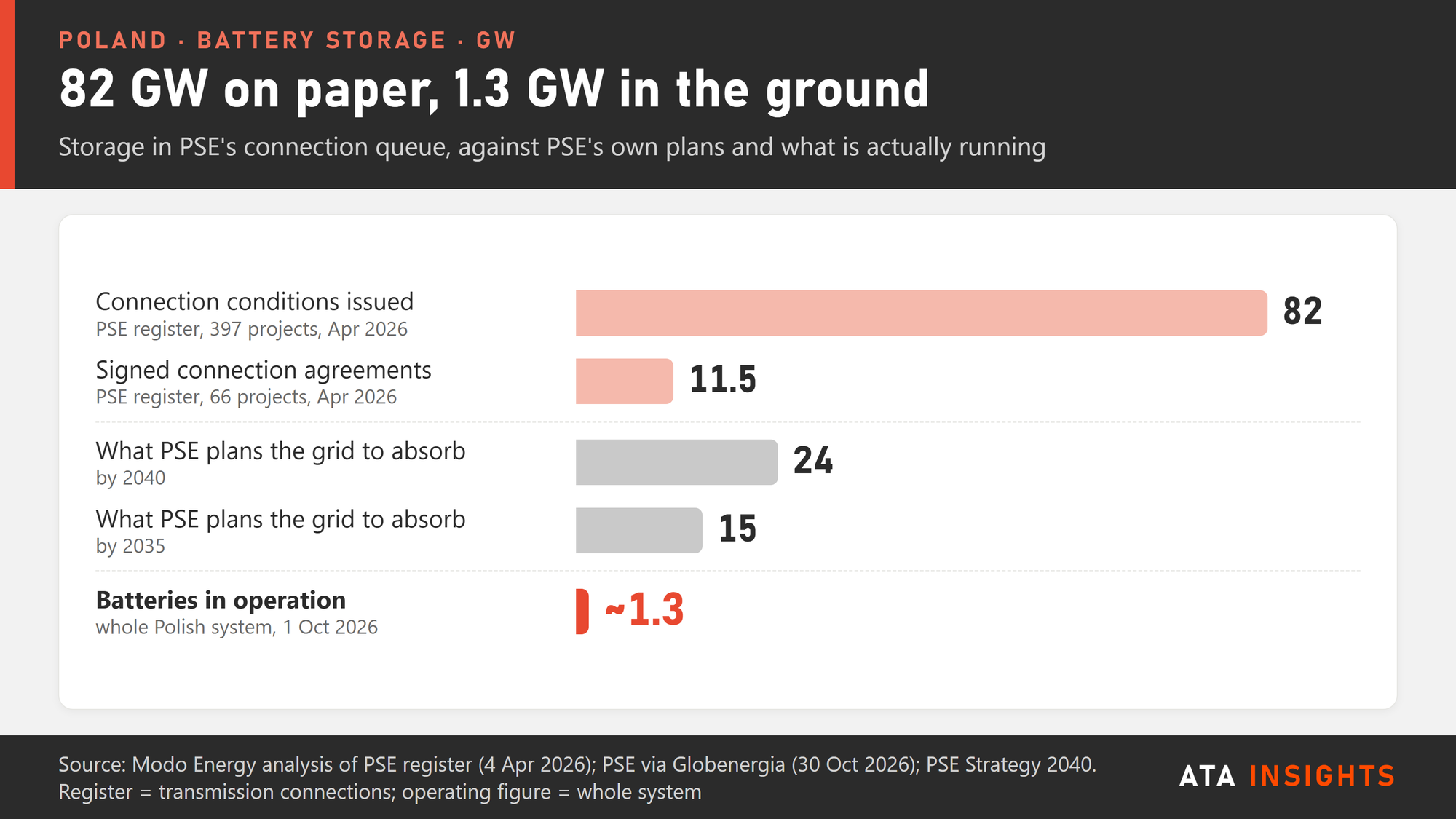
Poland's battery boom has an odd shape: enormous on paper, slender on the ground. In April, an analytics firm's reading of the register kept by PSE, the transmission system operator, found 397 battery projects holding connection conditions for a combined 82 GW. Conditions are, in effect, a reservation on grid capacity. Only 66 of those projects, worth 11.5 GW, had turned theirs into a signed connection agreement. PSE counted about 1.3 GW of batteries running across the whole system on 1 October. The paper queue, meanwhile, is more than three times the 24 GW of storage PSE wants the grid to absorb by 2040.
The grid has stopped pretending it can take everyone. Since August 2025 PSE has published a list of switchgear where it will refuse new connections outright, and the same analysis found no available connection capacity at any PSE substation for 2026 or for 2031. Network operators turned down 4,897 applications across all technologies in 2025, says the regulator, URE, down from 7,817 in 2024. But they covered 107 GW, against 73.58 GW. Fewer refusals; far bigger ones.
Speaking at a RENMAD webinar on 17 November, Jakub Dąbrowski, a partner at Addleshaw Goddard in Warsaw, gave the diagnosis plainly. The aim of the spring reform, he said, "was actually to get rid of so-called ghost projects on the market that were blocking the grid."
Bell, book and bank guarantee
The exorcism arrived as the "grid act" (ustawa sieciowa), an amendment to the Energy Law dated 13 March 2026, signed by the president at the start of April and in force since 30 April. Its tools are duller than a proton pack, and deadlier.
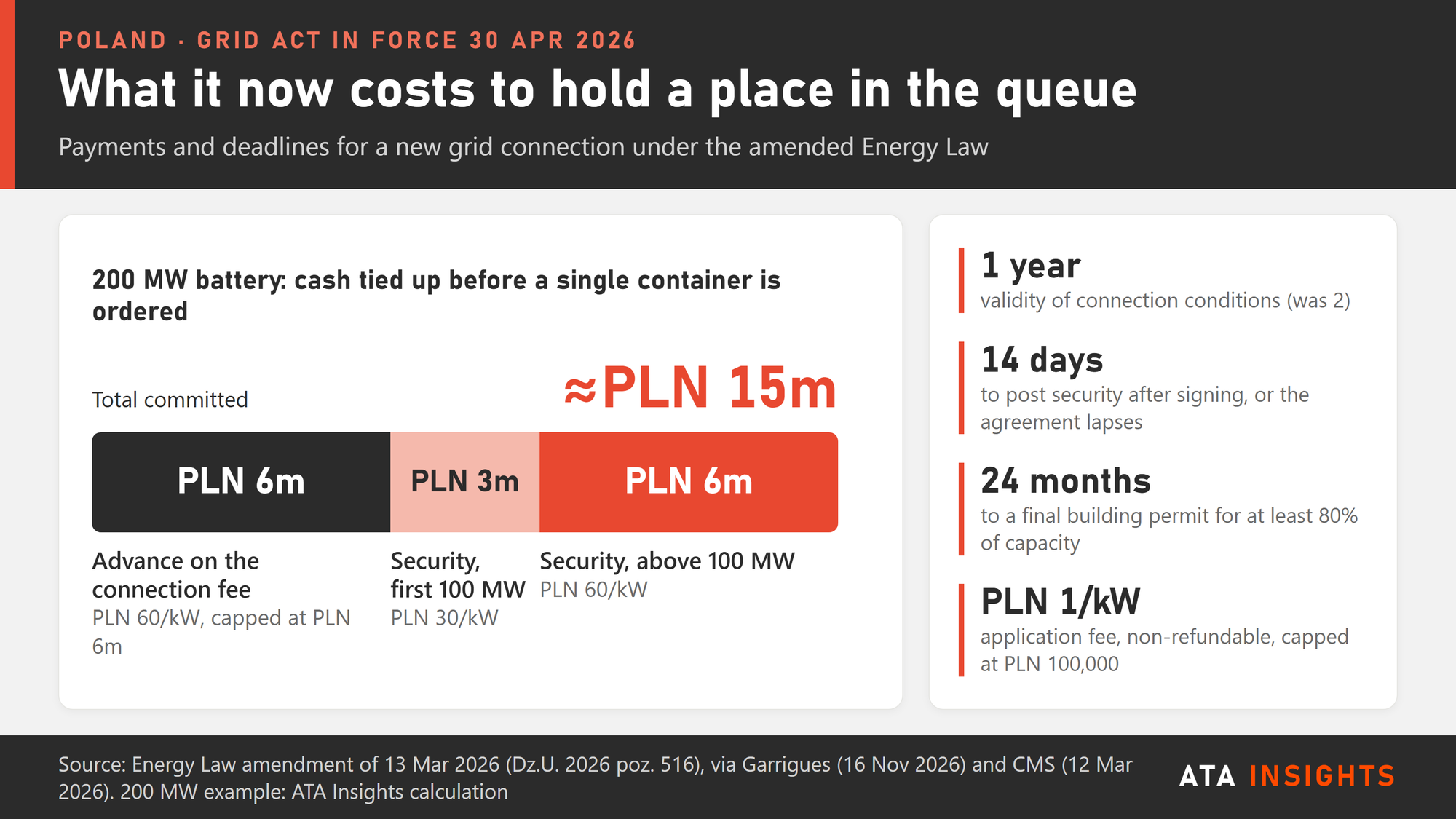
The first is time. Connection conditions now lapse after one year instead of two, so a reservation that is not quickly turned into an agreement evaporates. Conditions issued before 30 April keep their old two-year life; the first ones issued under the one-year rule start expiring next spring.
The second is money. An application now carries a non-refundable fee of PLN 1 per kW, capped at PLN 100,000. The advance on the connection fee doubles to PLN 60 per kW, capped at PLN 6m. Once an agreement is signed, the developer has 14 days to post a performance security of PLN 30 per kW for the first 100 MW and PLN 60 per kW above that, capped at PLN 12m. Miss the 14 days and the agreement expires by law. For a 200 MW battery that adds up to some PLN 15m in advances and guarantees, committed before a single container is ordered. A speculator can shrug off a filing fee. Eight-figure sums parked behind a project nobody means to build are another matter.
The third is a deadline with teeth. A storage project must now show a final building permit covering at least 80% of its contracted capacity within 24 months of signing its connection agreement. One extension of up to 24 months is available, against another PLN 60 per kW of security, and delays beyond the developer's control count as exceptions. Fail, and the agreement lapses by law, taking the place in the queue with it.
For projects that are real, the reform also widens the door. Flexible connection agreements let an operator connect a plant where capacity is tight, limiting its feed-in or offtake for up to three years. Cable pooling now lets a battery share a connection point with solar or wind owned by someone else: one of the few ways left to use a connection that already exists.
Holders of pre-reform conditions with no signed agreement had until 30 October to top up their advance or lose their place; a summer bill to push that deadline back was vetoed. The first ghosts are already being shown the door.
The paperwork is the project
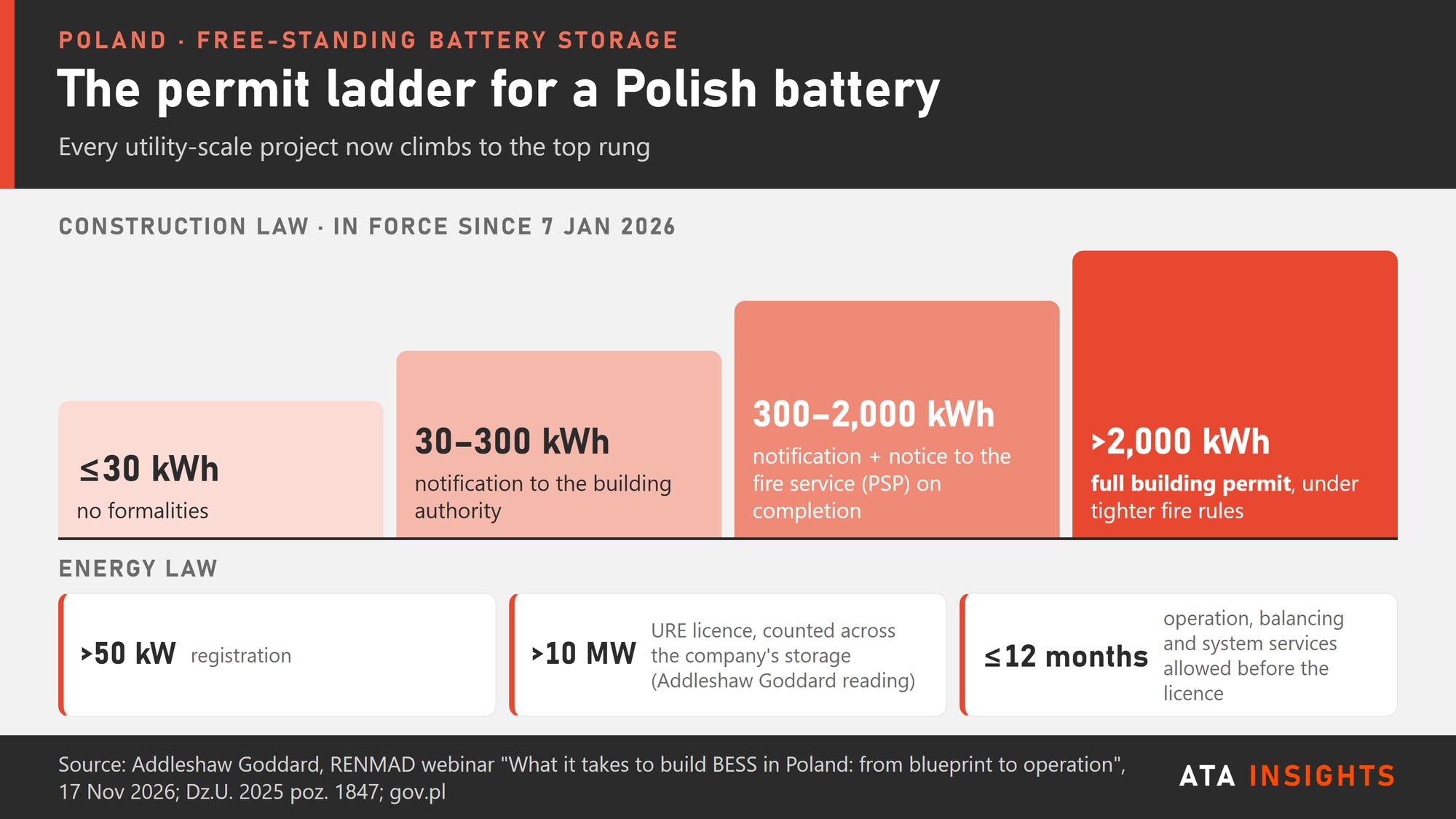
The permit stack beneath that clock has also got heavier. Under the construction law as amended from 7 January 2026, free-standing storage up to 30 kWh needs no formalities. Above 30 kWh it needs a notification, a simple notice to the building authority, and from 300 kWh the state fire service (PSP) must also be told on completion. Above 2,000 kWh a full building permit is required. Every utility-scale battery takes the full route, under tighter fire rules.
That sets a trap for anyone buying into older projects, some of which went ahead last year on a notification alone. "You need to very much look into where those projects are in terms of compliance with the fire safety regulations," Mr Dąbrowski warned. It is not unusual for a Polish battery site to carry separate permits for the battery yard, the substation and the cable route, each a separate point of failure.
The subtler danger is change. Swap the battery supplier or the container and the layout may no longer match the approved design. Changes to cable routes or technology, Mr Dąbrowski said, must be tested against the permit, "because if they don't, then an amendment to the building permit might be required." Until the milestone is met, that now eats into a statutory 24-month clock with millions of zloty at stake; after it, into capacity-market deadlines and lenders' patience.
Licensing adds a wrinkle. Storage above 50 kW must be registered, and above 10 MW it needs a URE licence. But, Mr Dąbrowski stressed, "the requirement is kicking in from 10 megawatts, but calculated for the whole company." A portfolio of tidy 9.9 MW sites gets added up, on his reading. There is some breathing room: a plant can operate, take part in the balancing market and provide system services for up to 12 months before the licence is granted, which he described as "fully, fully legal".
Hence his advice to financiers. Ask first whether the battery is really fully permitted, because "if a challenge comes after the building permit, then the construction process can be stopped halfway." His verdict: "the permitting due diligence is the most important element for any project finance." Owner-side delays, such as a third-party challenge, usually cannot be pushed onto the EPC contractor.
From slot to switch-on
A connection agreement is now a scarce asset, but it does not yet earn anything. Grzegorz Siemieniuk, a senior project manager at Electrum, an EPC contractor, explained what lies between the two. On one site, with a 133 MW connection agreement with PSE, his schedule had to cover the operator's substation, not just his own works. Progress reports can mislead: "A percentage of the completed work on its own tells us little about the readiness." He recommends a register in which each condition for energisation has an owner and a document proving it has been met. Nor do the gates swing open by themselves: "Commissioning is not the same as a commercial operation, and no one of these steps automatically follows from the previous one."
Revenue offers no shortcut either. In the capacity-market auction of 11 December 2025, for delivery in 2030, the price cleared at PLN 465.02 per kW per year, more than double the year before. But batteries' de-rating factor, the share of their nameplate capacity the market will pay for, fell to 13.39%, from about 60% a year earlier and 95% the year before that. Roughly 5.1 GW of physical storage thus won only about 685 MW of obligations, and those contracts carry milestones of their own. On 18 November URE also approved PSE's cap, effective 1 December, on how fast batteries may ramp in the secondary reserve (aFRR), the automatic service that restores the system's balance within minutes. The money will go to plants that are built properly and connected on time.
Who you gonna call?
A Polish connection agreement used to be a cheap option. It is now an expensive obligation with an expiry date, and that is exactly what makes it worth something. An agreement backed by a clean building permit, a fire-compliant design and a licence plan is a bankable, saleable asset. Conditions with no permits behind them are a liability, priced per kW.
Developers who sat on reservations will sell them or let them lapse, and buyers with balance sheets and good lawyers can pick up whatever survives due diligence. Part of the capacity the reform frees, Mr Dąbrowski noted, can go to storage, of which PSE expects 15 GW by 2035, two-thirds of it at the highest voltages. And by 30 April 2028 PSE and the larger distribution operators must run a public online system for tracking applications. A queue you can see into is one you can plan around.
The Polish grid has no more copper than it had in March, only fewer squatters on it. For developers who check their permits before they commit capital, each departing ghost leaves behind something Poland has lately been very short of: a vacancy.
You reached this analysis because ATA Insights puts independent energy-transition intelligence in front of 86,000+ professionals across the sector. That's exactly what we do for funded projects, events and companies — turn your work into reach.
See how we disseminate work like this →Where this analysis came from
This piece draws on the ATA Insights / RENMAD webinar What it takes to build BESS in Poland: from blueprint to operation. Watch the full session on demand.
The energy transition, in your inbox
Join 86,000+ professionals reading our independent briefings across five sectors.