
Inference Is the Real Prize
Everyone is transfixed by the giant AI training factories rising in Spain's empty corners. The money, three data-centre executives told an ATA Insights webinar, will be made much closer to home.
There is a rule of thumb doing the rounds in Spain's data-centre industry, and it goes like this. The gigawatt-scale "gigafactories" being planned in Extremadura, Cantabria and across the border in Sines—the vast halls where artificial-intelligence models are trained—will, in the end, account for roughly a tenth of the money the AI boom generates. The other nine-tenths sits somewhere else entirely: in the far smaller, far duller buildings that will be squeezed into the edges of Madrid, Barcelona and Valencia to run those models once they are built.
That, at least, is the case made by Miguel Ángel González of Quetta Data Centers, the edge platform launched by the Spanish fund manager Azora with Core Capital to spend more than €500m on precisely this kind of infrastructure. "We are going to deploy ten times more inference than what we consume in the models," he told a recent ATA Insights webinar on edge and colocation. "Ten times more inference, distributed near the cities."
It is a distinction worth slowing down for, because it reorders how the whole sector should be understood. Training a model—feeding it, in González's words, "a huge amount of information, all that we have available in the world"—can happen anywhere. "It is agnostic," he said. "It can be in Texas, it can be in China, it can be wherever." Inference, the moment the model is actually asked to do something, cannot. And that geographical fussiness is what turns edge and colocation from a footnote into the growth engine.
The commuter, not the cathedral
The reason inference stays home is human biology. A person reacts to sound in under a millisecond, to something seen in under 13, to touch in under 20. If an autonomous taxi is to brake before it hits someone, or a surgical robot is to move a scalpel, the model behind it cannot afford a round trip to a server farm three time zones away. "I don't want my autonomous taxi to crash into someone or run someone over in the city," González said, "which means latency is absolutely critical."
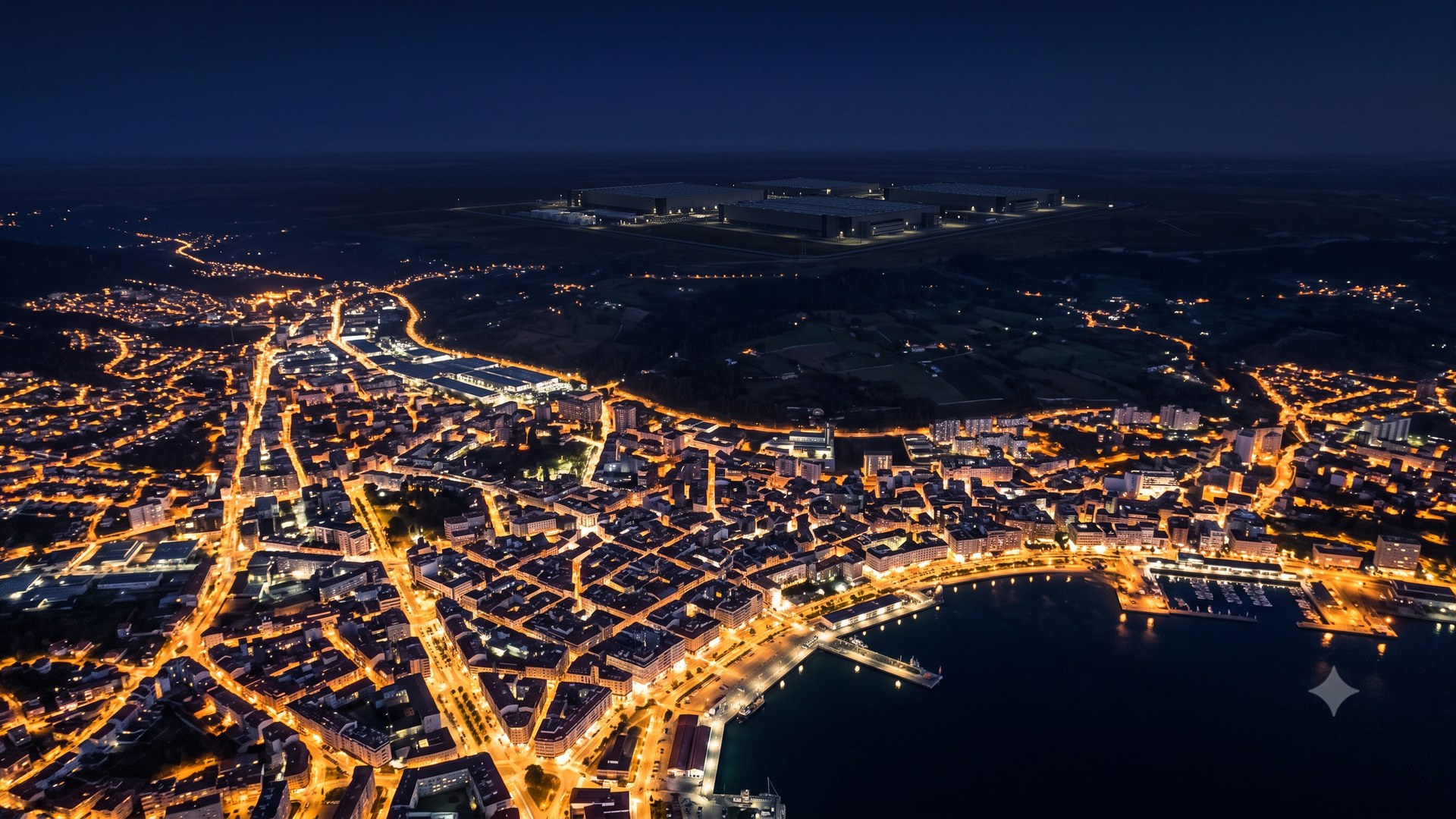
So the compute has to be near the crowd. This is why Europe's data-centre map has long clustered around what the industry calls FLAP-D—Frankfurt, London, Amsterdam, Paris and Dublin. "Look at a night-time map of Europe," González suggested. "You'll see where the population is—it's basically these big cities. That's why they build there."
The training factories are cathedrals: enormous, remote, built once and filled with the most expensive silicon on earth. Edge sites are commuters: small, numerous, close to where people live, and forgiving of latency in nothing. Xavier Domènech, who runs the data-centre division at the engineering firm PGI, framed the two as complementary rather than competitive. "We're seeing a hybrid architecture," he said—the gigafactories process the heavy loads, while the edge handles latency-critical work, distributed compute and local content. His conclusion for the engineers who have to build all this was blunt: "We work in ecosystems, not just individual buildings. Either we all come together, or it ends up not working."
Why Iberia keeps coming up
For years Spain's pitch to data-centre investors leaned on geography and cables: the submarine links landing on its coasts, a fibre network González rates as "the second-best in the world," and a strategic position between continents. What has changed, and what has investors circling, is power.
Spain has quietly become an anomaly. "We are an island in this sense," González said. "In Spain, since the year 2000, we've lost almost 5% of electricity consumption"—the result of a wave of industrial self-consumption and rooftop solar—"while generation has risen a lot, and a lot of renewable projects are entering the market." The awkward truth of the European grid is that the places where the data used to live—Britain, the Netherlands, France—increasingly cannot spare the electrons. Spain can. "We generate more than we consume," González said, and there is developable land near the big cities at a reasonable price. "These advantages don't happen to us all the time."
Ignacio Lozano, who directs capital markets for CBRE's data-centre team, put numbers to the appetite. CBRE runs an annual survey of the 95 largest infrastructure and real-estate funds in the sector. This year, he reported, 95% said they intend to keep investing; 62% are willing to take on development risk to get in; and—the figure he lingered on—"0% of the 95 funds want to liquidate their position in the sector." Deal counts tell the same story: around 146 data-centre transactions in 2023, some 186 in 2024, and more than 220 expected this year.
Spain and Portugal, Lozano noted, are treated by investors as a single market. "Investors look at Spain and Portugal as one country." Madrid, on CBRE's numbers, now attracts real-estate investment on a par with Paris.
The colocation squeeze
Here is where inference and colocation meet. Lozano groups inference workloads into the colocation bucket—facilities of roughly 10 to 100 megawatts, drawing on the national grid and sitting close to population centres, as distinct from the hyperscalers' own campuses and the training gigafactories out in the countryside. The colocation market in Iberia is heavily concentrated: 74% of it, by CBRE's count, is in Madrid, with the rest in Barcelona and Lisbon.
What AI has done to these buildings is change their physics. Domènech has watched the design brief mutate in real time. "Five years ago we were designing data centres from three, five, ten megawatts, at most, in a single building," he said. "Now we're talking about campuses that comfortably exceed 100 megawatts." Rack densities that once sat at a few kilowatts are climbing to "40, 80 or 200 kilowatts" apiece, which forces a wholesale rethink of how a room is cooled and how power is distributed inside it.
That rethink has, conveniently, solved the one liability that used to hang over Spanish projects: water. Instead of air-conditioning a hall, the new high-density racks are cooled the way a car engine is—a sealed liquid loop running coolant past the chips. "We fill that cooling circuit once, like in a car, and that's enough," González said. "We don't need more water, so we don't consume water." For a country that is, in his phrase, "water-stressed," that is not a minor footnote; it removes the objection that had made some town halls wary. Domènech went further, describing designs that harvest rainwater and recycle greywater to become "water positive—not only that it doesn't consume water, but that it returns water to the community."
The bottleneck is people and patience
None of this is easy money, and the panel was candid about where the sector jams. Lozano's value chain runs from raw greenfield land, through "powered land" with a grid reservation, to a connected and finally an operating asset—and the hardest link, he said, is the last one. "In this sector, leasing megawatts, which is fundamentally what generates you rent, is the hardest thing," he said, "above all because the clients"—the hyperscalers and the neoclouds—"are, in a certain way, opaque, and very hard to reach."
The neoclouds are the new force in the market, and their pace is punishing. "They used to plan on 18-to-24-month horizons," González said. "Now they plan on six, and they want the kit deployed in three." The commercial logic is that revenue only starts once the chips are running inference. And the kit is staggeringly valuable: the newest Nvidia gear, González noted, costs around "€40m per megawatt," against €5m-7m not long ago—which is why physical and cyber security have become non-negotiable, and why "time to money," in the American phrase, drives everything.
There is a credibility problem lurking underneath. A neocloud offering a 20-year contract is not much use to a lender if the company is six months old. "How am I going to sign anything?" González recalled the financiers asking. What has shifted is that the hyperscalers are now standing behind those contracts. Neoclouds, he said, hold more than €100bn in agreements backed by Google, Amazon and Microsoft—"they're no longer contracts between tiny companies."
The train Spain keeps missing
Asked whether the industry is ready for the scale AI demands, both remaining panellists reached, independently, for the same metaphor. "We're building the digital infrastructure of the next 30 years," González said. "You're building the roads. You're building the railways." Lozano's version came with a warning: "In five or ten years we'll regret it, and we'll say: which more important train did we let leave?"
The comparison Spaniards make quietly is with nuclear power a generation ago—an industry France embraced and Spain did not. The panel's argument is that this time the underlying advantages are genuinely Spain's to lose: abundant clean power, cheap fibre, land, and a workforce Lozano rates highly. The obstacles are self-inflicted—permitting, and a tug-of-war between central and regional governments. There are signs of movement. Catalonia, initially cool on data centres over water fears, has set up a dedicated office to shepherd projects through the paperwork; Quetta, González said, is registered with it. Merlin and Azora have committed capital; Ferrovial and ACS have built dedicated divisions; even Iberdrola is circling.
The neat thing about betting on inference is that it does not require guessing which AI application wins. Whether the growth comes from autonomous taxis, last-mile logistics, oncology models that have seen a million cases instead of a doctor's two thousand, or a promised fleet of humanoid robots, the same conclusion holds: the compute that serves any of it has to sit near a city, on a reliable grid, at the end of a fat fibre line. Spain, for once, has all three. The gigafactories will grab the headlines. The money, if the country can get out of its own way, will be made down the road.
Watch the full session on demand — "Data centers Edge y Colocation como motores de crecimiento y eficiencia digital" — at ATA Insights. The conversation continues in person at RENMAD Datacenters, 18–19 February in Zaragoza, where CBRE, PGI, Quetta and others in the value chain take the stage.
You reached this analysis because ATA Insights puts independent energy-transition intelligence in front of 86,000+ professionals across the sector. That's exactly what we do for funded projects, events and companies — turn your work into reach.
See how we disseminate work like this →Where this analysis came from
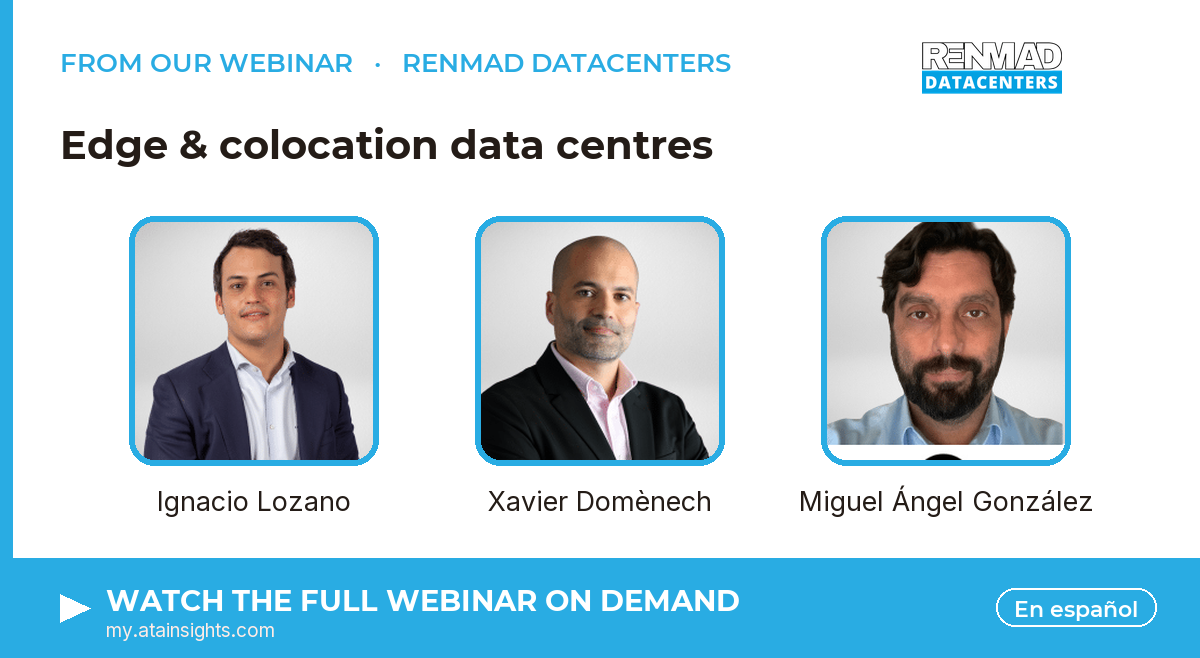
This piece draws on the ATA Insights / RENMAD webinar Edge & colocation data centres. Watch the full session on demand.
The energy transition, in your inbox
Join 86,000+ professionals reading our independent briefings across five sectors.