
Italy's Megawatts, Marked Down
A storage auction and a pricing platform have turned Italy's renewables into a buyer's market. The question is who cashes in.

When a marketplace that carries live deal data tells you a price, it is worth listening. In late 2025, nTeaser—a digital exchange with more than 15 gigawatts of projects and over 4,000 registered investors—put a number on something the market had been feeling in its bones. A ready-to-build solar plant in Italy that would have fetched around €150,000 per megawatt-peak at the start of the year was, by the fourth quarter, changing hands nearer €118,000. Batteries fared worse. After Italy's flagship storage auction cleared, valuations that had sat between €50,000 and €90,000 per megawatt in the first half of the year collapsed to a range of €19,000 to €50,000.
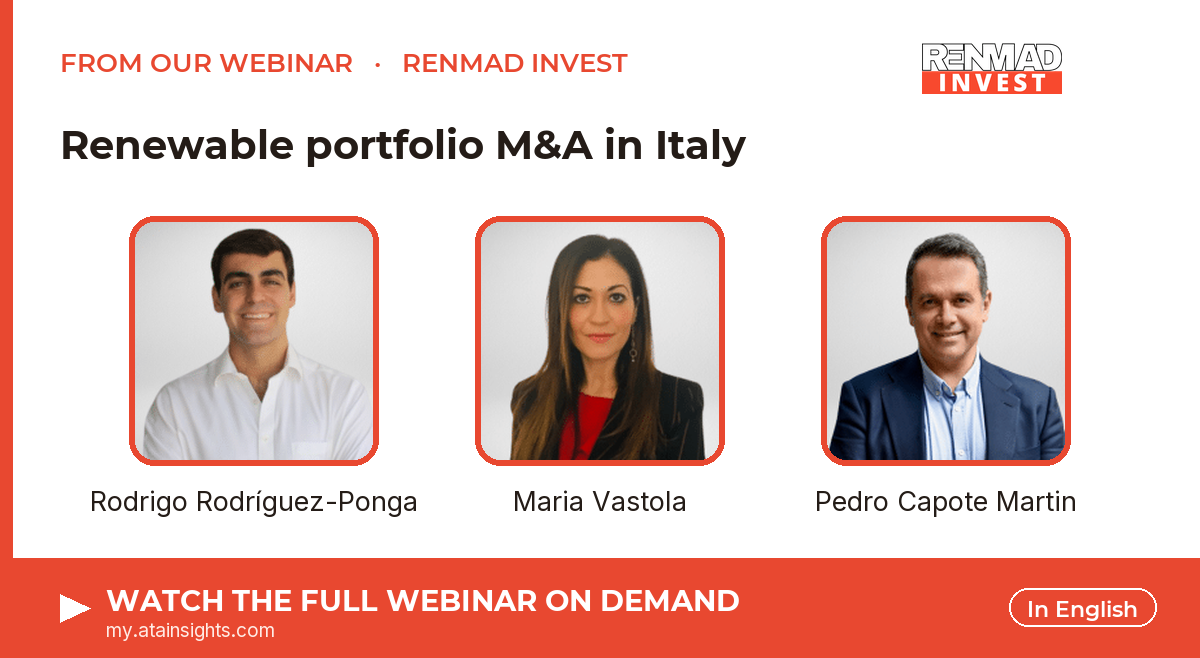
That is a lot of value to shed in twelve months. But a falling price is only bad news if you are selling. For anyone with capital to deploy, Italy has quietly become one of the more interesting places in Europe to go shopping. That was the through-line of a RENMAD Invest webinar, moderated by ATA Renewables' Manuel Bernaudo, that brought together three people who see these deals from three different seats: a marketplace, a bank and an M&A adviser.
The auction that reset the board
The single event doing the most damage to battery valuations has a name: MACSE, Italy's centralised storage capacity auction. It was meant to give storage developers a bankable revenue stream. Instead, when the results came in, two incumbents—Enel and Eni—walked away with roughly 70% of the awarded capacity, and the clearing prices were low enough to sting.
Rodrigo Rodríguez-Ponga, who runs transactions at nTeaser and watches the pricing curves in real time, did not dress it up. "The MACSE outcome was, frankly, a bit of a shock," he said. "Enel took over 70% of the capacity, which created a lot of distrust in the mechanism. And that's being reflected directly in how investors are valuing these assets." The compression he described—from as much as €90,000 per megawatt down towards €19,000—was, in his words, "a very significant compression."
Here is the counterintuitive part. The same auction that punished storage valuations also thickened the deal pipeline. Cheaper assets attract more bidders, and Rodríguez-Ponga noted that activity around these battery deals had actually gone up even as prices came down. A crushed price is not a dead market; it is a repriced one. And a repriced market is exactly where patient buyers make their money.
Solar's quiet recovery
Solar tells a gentler story. Prices slid through most of 2025 before steadying in the fourth quarter, with the average settling around €118,000 per megawatt-peak and the best assets drawing renewed competition. The floor, meanwhile, dropped to roughly €65,000—so the gap between a good project and a mediocre one is widening. Buyers are paying up for quality and walking away from the rest.
What is holding the ceiling up is a piece of policy plumbing called FER X, a fifteen-year, two-way contract-for-difference against a reference price. In plain terms, it hands a project revenue certainty that a merchant plant simply cannot promise. "That revenue certainty is what makes these projects bankable in a way that merchant assets simply aren't, at least for banks," Rodríguez-Ponga explained. When a contract like that is on the table, lenders relax, and valuations firm up. When it is not, the discount buyers demand grows fast.
The banker's version of comfort
Sitting across the table from every one of these deals is someone who has to decide whether to lend against it. Pedro Capote Martin, a senior director in structured finance at NordLB, has financed the kind of assets under discussion—including, he noted, a landmark 250-megawatt battery project in Piedmont, "the first largest BESS project," done with a partner in the north of Italy.
His appetite has limits, and he was refreshingly blunt about them. Presented with the classic dilemma—a fully merchant battery in Italy's cash-rich north versus a safer southern project locked into a fifteen-year MACSE contract—he did not blink. "As an institution, we don't have a mandate to do fully merchant long term in any technology," he said. "That project fully merchant in the north wouldn't work if I want to bring it tomorrow to our credit committee."
What Capote wants instead is a revenue mix he can size debt against: a tolling agreement covering the bulk of a battery's income for seven to ten years, topped up by a capacity payment stretching out fifteen. Get that blend right, he argued, and "the combination of a capacity market and a tolling agreement can really lead to a very good debt amount." For a buyer, the lesson is direct. The asset that finances cheaply is not the one with the highest theoretical upside; it is the one with a contract a bank can underwrite.
Where the adviser sees the money moving
If the marketplace supplies the prices and the bank supplies the discipline, the M&A adviser supplies the context—who is calling, and what they want. Maria Vastola, a managing director in UniCredit's energy team in Milan with two decades in the industry, offered the widest lens of the three. Italy, she said, sits in "a sweet spot for investors," though behind Germany in absolute scale, with smaller average tickets and a more fragmented market.
The MACSE shock, in her reading, is something the market is still working through rather than a verdict. "It's too early to assess where the valuation will go," she said, "because in case we will have different outcome for the next auction, or different route to market, the valuation will go hands on hands with the route to market and the ancillary services for BESS." Her point cuts against the panic: today's crushed price reflects one auction under one set of rules. Change the rules, or run a better auction, and the number moves.
What has not moved, she stressed, is appetite. "All days I receive calls from different investors, strategic and financial ones, that are looking for assets, renewable and BESS across Europe," Vastola said. "Renewables still remain at the top of the investment agenda." When headline valuations fall but demand holds, the gap gets bridged with structure—earn-outs, co-development agreements, milestone payments tied to auction results—rather than a simple cheque. That is the machinery through which a repriced market keeps transacting.
The overhang nobody has priced yet
Two clouds sit over all of this, and the panel was candid that neither has fully shown up in deal terms. The first is geopolitics feeding through to gas: Italy still draws more than half its electricity from gas, so a Middle East wobble that pushed Italian gas towards €45 per megawatt-hour, up from €35 earlier in the year, matters more here than almost anywhere in Europe. Yet Rodríguez-Ponga reported that transaction prices had not actually budged. "The price itself hasn't moved, and the big players—the major developers and IPPs—their strategies remain for the moment the same."
The second is the Decreto Bollette, an Italian measure aimed at cooling consumer power bills that could, by decoupling certain carbon costs, drag down the capture prices renewables earn. Early estimates floated a 20-30% hit. The panel's collective shrug was telling. Vastola said most of her clients are "not factoring it into valuation," treating it as probably outdated already. Capote, who lived through Spain's retroactive regulatory shocks of 2010-13, was more wary, warning it could take up to eighteen months for Brussels to rule on whether the measure amounts to state aid—an uncertainty that "creates tension" in every PPA being negotiated. Buyers are scrutinising it in due diligence; none is yet writing it into the price. That, for a certain kind of investor, is precisely the window—the moment before a risk is fully priced is the moment to negotiate it in your favour.
Who wins when a megawatt gets cheaper
Step back and the picture is not one of decline but of a handover. Repricing transfers value from the developers who built at yesterday's costs to the buyers assembling portfolios at today's. Consolidation favours the platforms and infrastructure funds with the balance sheets to absorb fragmented Italian assets that never quite reached scale. And the discipline the panel described—banks insisting on contracted revenue, advisers structuring around uncertainty—quietly weeds out the projects that should not have been financed at the top of the cycle anyway.
Rodríguez-Ponga's parting bet captured the mood of people who buy for a living rather than sell. Asked where he would put his own money, he ignored the safe southern option and went the other way: "Go north, merchant, and hopefully close to industrial load or a data centre cluster that will give you real optionality." Not the asset with the guaranteed contract, but the one sitting next to the demand that is coming. Italy's megawatts have been marked down. The buyers who understand why are already at the till.
The full panel—covering pricing data, deal structuring, project finance and the regulatory overhang—is available on demand. Watch the recording via ATA Insights, and keep an eye on RENMAD Invest, the platform behind this conversation, for where Italy's next repricing gets debated.
You reached this analysis because ATA Insights puts independent energy-transition intelligence in front of 86,000+ professionals across the sector. That's exactly what we do for funded projects, events and companies — turn your work into reach.
See how we disseminate work like this →Where this analysis came from
This piece draws on the ATA Insights / RENMAD webinar Renewable portfolio M&A in Italy. Watch the full session on demand.
The energy transition, in your inbox
Join 86,000+ professionals reading our independent briefings across five sectors.