
Lego for Data Centres
Artificial intelligence has turned the data centre into a moving target. The industry's answer is to stop pouring concrete and start clicking bricks together.
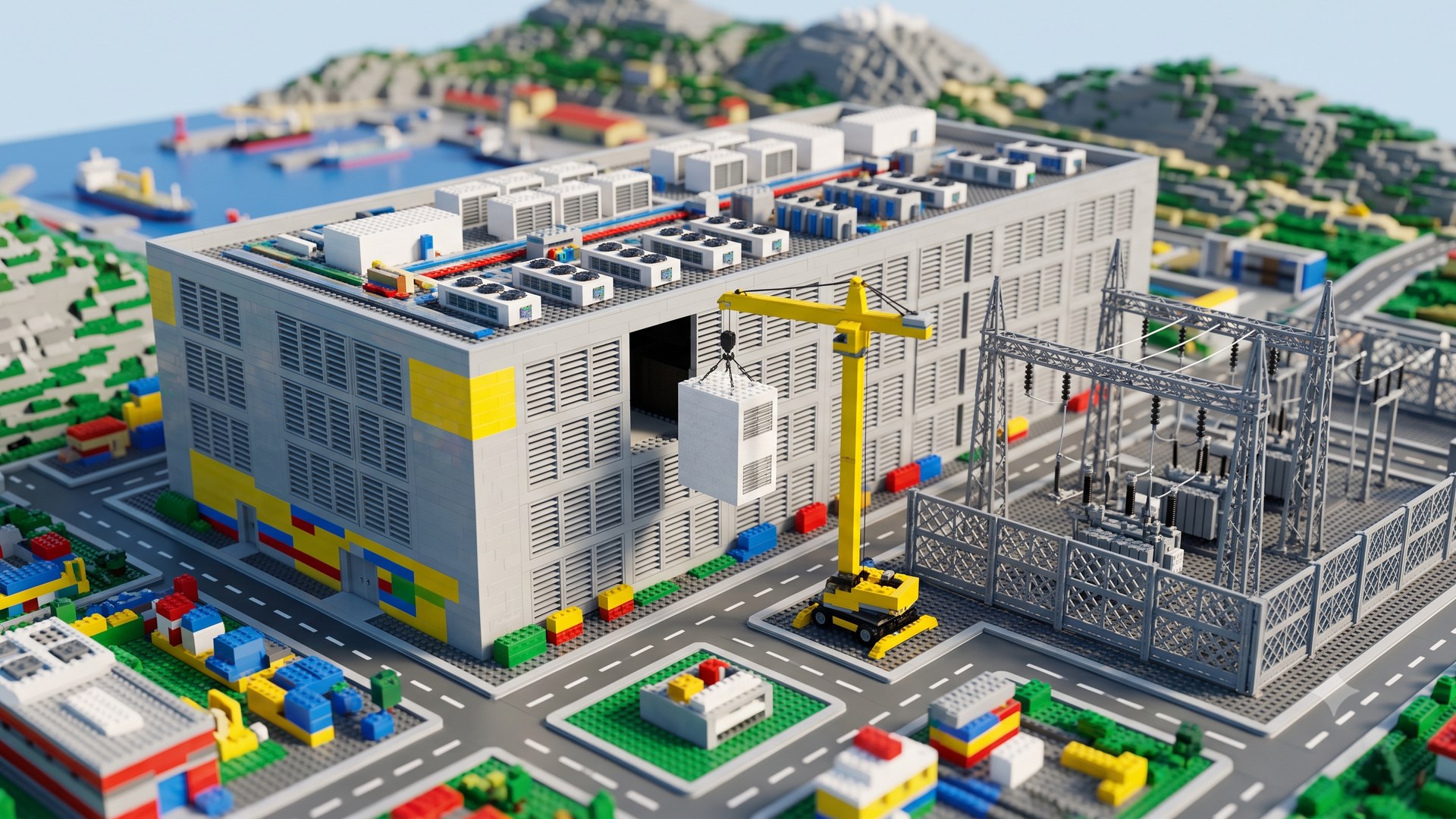
A data centre is one of the longest-lived things a company will ever build. Sink a few hundred million euros into a hall of servers and you expect it to earn its keep for fifteen or twenty years. The awkward part is what happens inside during those two decades. The building must stand still while the technology it houses reinvents itself roughly every three years. By the time the roof needs its first serious repair, the machines it was designed around are five generations obsolete.
For most of the industry's history this was a manageable tension. Server racks crept up in power the way most things creep up, slowly enough to plan around. That era is over. Artificial intelligence has taken the steady climb of computing density and turned it into a vertical line, and it is now the single hardest variable in data-centre design. This was the uncomfortable consensus of a recent ATA Insights webinar, "Optimisation in data-centre design", staged ahead of RENMAD Datacenters in Zaragoza, where an operator, a manufacturer and an engineering firm took turns describing a problem none of them can fully solve and a strategy all three are converging on: build the thing out of interchangeable parts, like a set of very expensive Lego.
The moving target
Start with the numbers, because they are the whole story. Rafael García, director of operations at NXN Data Centers, has spent since 2004 in hosting and colocation, long enough to remember when a rack drawing five to seven kilowatts was normal and ten was ambitious. He put the current trajectory on a single slide. A conventional air-cooled rack: ten kilowatts. An NVIDIA-specified AI rack in 2024: forty. In 2025, ninety, then a hundred and twenty. And beyond that, densities that no longer fit inside any category the industry grew up with.
"Practically speaking, you now design a data centre for each new GPU," García said, "because the requirements change so radically that keeping all these parameters in mind is no longer simple." That is the crux. A facility used to be built for a purpose, a telecoms centre, a banking centre, a hosting centre, and it would serve that purpose for years. Now the hardware itself dictates the design, and the hardware is a different beast every eighteen months.
The economics sharpen the point to something close to painful. Those AI servers are not cheap tenants. An NVIDIA H100 system runs to roughly $300,000; the newer generation closer to half a million. Pack four into a single rack and you are guarding one to two million euros of equipment inside one cabinet. "The value of that infrastructure is absolutely critical for those clients," García noted, which is another way of saying the room around it can no longer be an afterthought. When the contents of a rack cost more than the rack, the walls, the wiring and the cooling that keep it alive stop being plumbing and start being the product.
The independent figures bear him out. A single NVIDIA GB200 NVL72 rack draws 120 to 132 kilowatts, well past the point where air alone can carry the heat away. The next platform, Vera Rubin, is expected to push racks toward 190 to 230 kilowatts, and the 2027 "Kyber" configuration is specified at roughly 600 kilowatts, with megawatt-class racks visibly on the horizon. The whole industry is now bracing for direct-current distribution at 800 volts simply to force that much power down the same copper.
Design for the unknown
The obvious response, sizing a building for the biggest rack imaginable, is a trap. David Fernández, who leads business development for Huawei's Digital Power unit, laid out the bind with unusual candour. "You cannot size for a 300-kilowatt rack today," he said, "because that technology hasn't arrived yet. It would be throwing money away. But what happens if you size for what exists today, and in three, four or five years a client turns up with a technology that needs a completely different power density and cooling?"
This is the design-for-obsolescence problem in its purest form, and Fernández gave it the tidiest framing of the session. A data centre lives fifteen to twenty years. At the current pace of chip development, he reckons a conservative estimate is at least five generational leaps across that lifespan. "The building has to be able to adapt to those technological cycles that are yet to come." You are, in effect, designing a home today for tenants who have not been born, whose habits you cannot predict, and who will nonetheless expect the plumbing to fit.
Faced with an unknowable future, the panel agreed the only sane posture is flexibility, expressed in three words that recurred all afternoon: modularity, scalability, elasticity. García was refreshingly honest that these are easier to invoke than to deliver. "This is quick to say but harder to translate the moment you put it inside a building," he said. Leaving room to grow, keeping the power halls able to expand, holding space to swap out cooling systems mid-life, all of it competes with the equally strong instinct to build tight and cheap. The wish list, he admitted, was long. He hoped, drily, that it might shrink over time.
Unbundling the box
Fernández's proposed escape is conceptually simple and quietly radical. Stop treating the data centre as one monolithic object and break it into functional blocks, five of them, roughly: the IT halls themselves; the low-voltage room with its switchgear, UPS and batteries; the cooling; the medium-voltage supply; and the generators. Modularise each block and you can grow the facility piece by piece rather than wrestling the whole thing at once.
The clever move is what he calls decoupling. The one thing an operator can predict with reasonable confidence is how much floor space the servers will need over the building's life. What it cannot predict is the electrical and cooling load, precisely the parts that AI keeps upending. So separate them. Fix the data hall; let everything volatile live outside it, in modules that can be swapped for bigger ones without touching the racks. "If I have a first data hall at 40 kilowatts per footprint," Fernández explained, "and tomorrow I have to build a second at 120, those decoupled systems stay decoupled, but with a different capacity."
Then comes the factory. Huawei's term is "engineering productisation": the decoupled blocks are prefabricated, standardised and shipped rather than poured on site. The company's PowerPOD is the poster child, a 40-foot container holding an entire low-voltage room, switchgear, UPS, batteries, fire suppression and all, rated at up to 2.4 megawatts, with a 3.2-megawatt version due this year. Because it arrives pre-commissioned and tested from the factory, on-site installation collapses from over two months to a matter of weeks. The point, Fernández said, is to stop designing "a bespoke, one-off building for every deployment" and instead adopt "a campus model, a modular model where the pieces and the designs are reusable, and I play as if this were Lego, putting standard bricks together to build my own data centre."
The clock is the competitor
That metaphor is not just tidy branding. In this market, speed is the whole game. "Having the space very often means having the business," Fernández said, and the maths of AI makes every inefficiency expensive: the bigger the facility and the more megawatt-hours it burns, the more any saving compounds. Prefabrication attacks the one resource nobody can buy more of, time.
Rafael Madrid, project director at Cap Ingelec, a French engineering and general-contracting firm with offices in Madrid, Milan and Athens, comes at the same target from the construction side. His firm works in "design and build", overlapping the three phases of a project, design, permitting and construction, that the traditional model runs one after another. Stacking them saves, by his estimate, around two months per project year. But the deeper benefit is not calendar time; it is keeping the design alive.
"If you started a design and closed it a year ago," Madrid said, "the client's needs may have changed and you'd have to reopen it." In a world where the target moves every eighteen months, a frozen design is a liability. Keeping it open through permitting and construction buys the client time to make final decisions late, when they know more. Madrid sees prefabrication as the inevitable destination for the whole sub-sector. Chilled-water piping already arrives pre-built from the workshop; buildings increasingly go up in prefabricated structural elements; the electrical rooms are next, brought in as isolated modules. Curiously, he was candid that this rarely saves money, factory-built and site-built come out roughly level on cost. What it saves is on-site execution time, and time is the currency that matters.
The parts that don't come in a box
For all the talk of standardised bricks, the panel was clear about the limits. Ask how many square metres a megawatt needs and you get the most honest answer in the business: it depends. At the newest 300-kilowatt densities, García only half-joked, "you'll need a broom cupboard for a megawatt." At conventional densities you need several hundred square metres for the same power. And the electrical and generator space, the "grey space", does not scale in a straight line; it balloons as density climbs. Even the modular saving resists a formula. The prefabricated share of a build, Madrid noted, is typically around 30% of the works, but he has seen it swing between 15% and 40%. "It isn't easy to copy and paste, because it isn't as standardised as ordinary construction."
And there is one component no factory can extrude. García, asked what will separate the winners among operators in five years' time, did not mention hardware at all. "It comes down to managing talent," he said, "the technical capability and degree of specialisation of the human team." Spain's advantage in attracting these projects, he argued, rests on its depth of infrastructure and IT talent, even if the cross-disciplinary skill the sector needs, a bit of power, a bit of cooling, a bit of communications, all at once, is still being built. He pointed to the recent nationwide blackout as proof: data centres were among the few sectors that did not collapse, and not only because their designs were robust. "It's the capability of the technical teams when it comes to operating the centres."
Bricks for a building that never finishes
There is a pleasing irony in all this. The most dynamic, fast-mutating industry on the planet is arriving at a design philosophy borrowed from a children's toy invented in 1949: standard bricks, snapped together, pulled apart and rebuilt as needs change. The AI boom did not make data centres bigger so much as it made them impermanent, machines that must be perpetually half-rebuilt while running. The Lego approach is less a clever optimisation than a survival strategy for a building that can never quite finish being built. As García put it, this is a complex moment and a thrilling challenge for the whole sector. The bricks, at least, are ready.
The full session is available to watch on demand. For more on where all this is heading, RENMAD Datacenters gathers operators, engineers and manufacturers in Zaragoza.
You reached this analysis because ATA Insights puts independent energy-transition intelligence in front of 86,000+ professionals across the sector. That's exactly what we do for funded projects, events and companies — turn your work into reach.
See how we disseminate work like this →Where this analysis came from
This piece draws on the ATA Insights / RENMAD webinar Optimising data-centre design. Watch the full session on demand.

The energy transition, in your inbox
Join 86,000+ professionals reading our independent briefings across five sectors.