
Mind the Gap
Europe is building a cross-border market for green gas on top of a registry that still isn't switched on. The companies that get the plumbing right will own the trade.
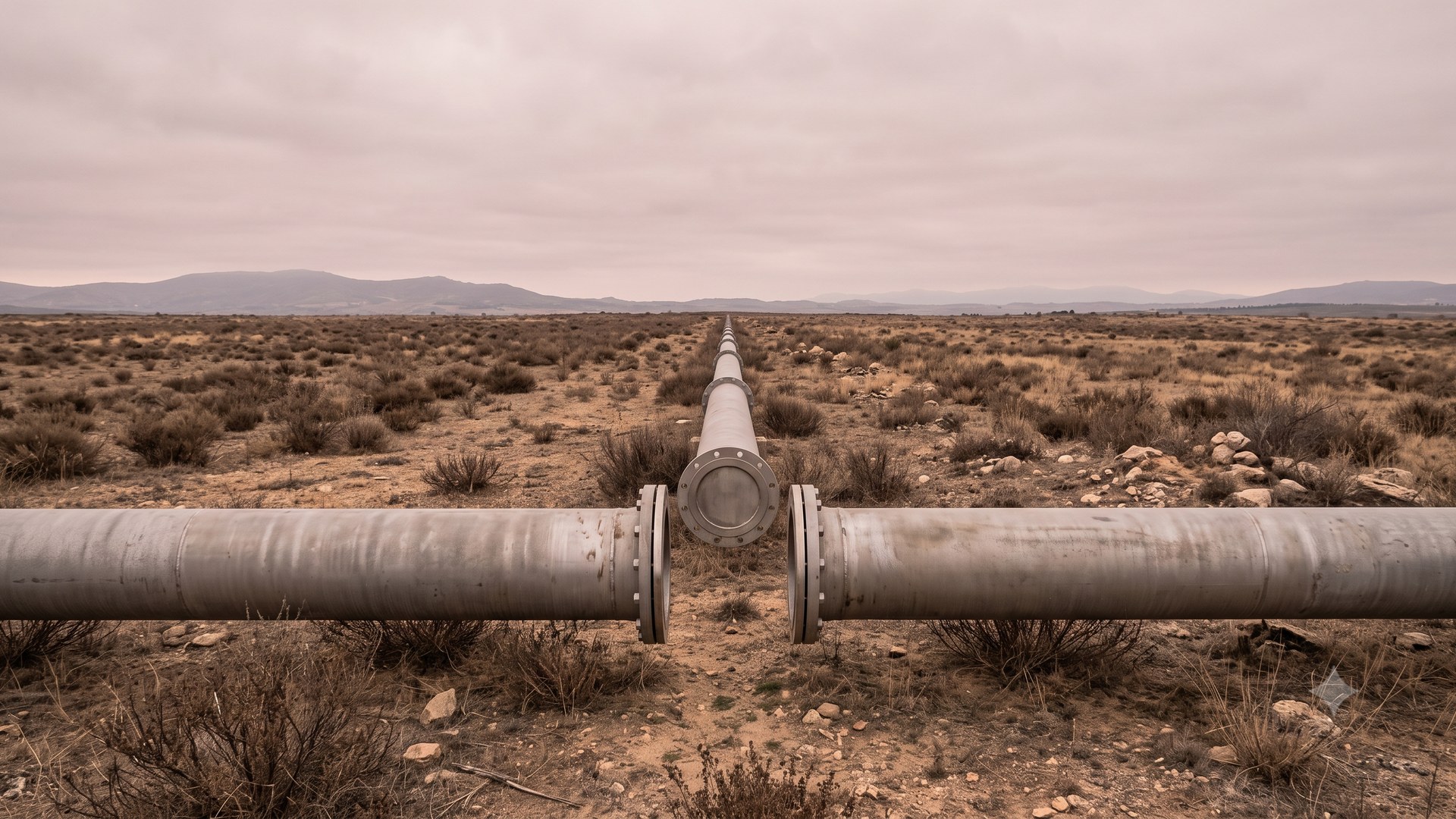
In Brussels there is a database that is supposed to know where every clean molecule of gas in Europe came from. It can tell you the feedstock, the carbon score, the producer, the journey from farm to burner tip. There is only one problem. For gas, it does not yet have to be used.
The Union Database, or UDB, is the European Union's answer to a question the biomethane industry has been asking for years: how do you prove a green molecule is green, and prove it only once? For biofuels and bioliquids the system is already considered functional. For gas, the date when it becomes mandatory keeps sliding. The Commission's own timeline now points to the end of 2026 for the launch, with the rest of the rulebook — a delegated act on tracing raw materials and a revised implementing regulation covering the rest of the chain — expected around the same time. The hard deadline for when companies must use it has not even been fixed; it is still being coordinated with member states.
So the industry finds itself in an odd position. It is wiring up its plants, its certificates and its trading desks to a system that is not yet live, on the strength of rules that are not yet written. That sounds like a recipe for wasted effort. It is the opposite. The firms doing the wiring now are the ones that will move first when the switch is finally flipped — and a continent-wide market in trusted green-gas certificates is the prize on the other side.
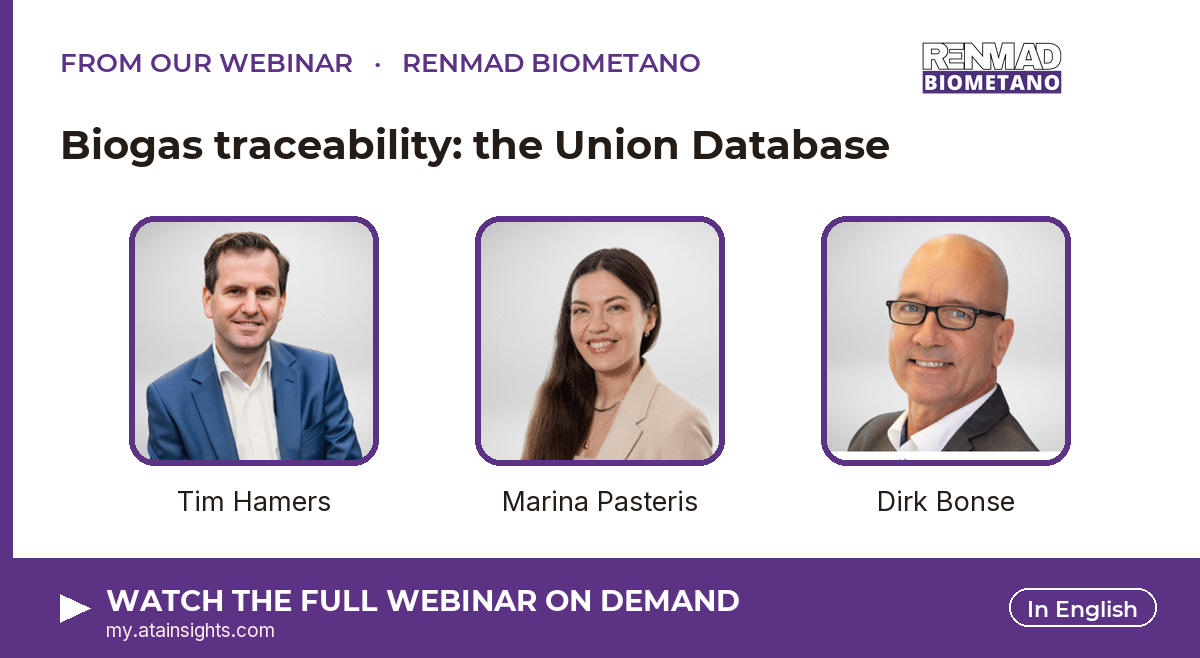
That was the throughline of a RENMAD webinar hosted by ATA Insights, where three people who spend their days inside this machinery laid out what works, what does not, and where the holes are.
What the database is, and what it is not
Start with what the UDB replaces. Until now, the proof that a batch of biomethane is sustainable — the "proof of sustainability", or POS in the trade — has often travelled as a PDF attached to an email. Audited once a year, trusted the rest of the time.
"Up to now, this was traced by just sending in an email with a PDF," said Tim Hamers, Secretary General of ERGaR, the association that links national biomethane registries across borders. The UDB swaps that for a single EU-wide ledger. A producer injects gas, asks for a guarantee of origin and a proof of sustainability, and the grid operator confirms the volume. After that the certificate sits in an account "just like money at a bank account", as Hamers put it, ready to be transferred to a trader or an end user.
What it is not, Hamers stressed, is a trading platform or a crystal ball. "We don't have a lot of new answers. We still have a lot of open questions." Who is allowed to trade on it. Whether a certificate must always move with physical gas. How subsidised gas is counted. The basics are clear; the detail, as he said more than once, is where the devil lives.
The referee, not the player
If Hamers described the field, Marina Pasteris described the rules of play. She works for ISCC, the certification scheme that audits whether a producer's sustainability claims hold up — one of the bodies the whole system leans on.
She offered a useful way to think about it. The European Commission writes the rulebook. Certification schemes translate it into something operators can actually use, and then act as referees. "We will be playing as referees, to make the rules apply," she said, with the economic operators — farms, biogas plants, upgraders, traders — as the players on the pitch.
The referees are already on the field. ISCC has onboarded almost all of its EU-certified gas operators into the database and built a tool, called TTC Connect, to sync a company's certificate and mass-balance data straight into the UDB and back again. The Commission, she noted, is lining up a second testing phase for gas. The point is that the readiness work is happening now, ahead of the rules being final — which is exactly why early movers will not be caught flat-footed.
The hole in the fence: imports
Here is the first gap, and it matters more by the month. Europe's appetite for imported biomethane is rising. But the database, as built, mostly cannot see gas that was injected into a grid outside the EU.
The reason is structural. A certificate only becomes valid in the UDB once a transmission or distribution operator verifies the injection — and the Commission cannot ask a grid operator in Malaysia or the United States to do that. "The Commission is not accepting biomethane that was injected in non-EU grids," Pasteris said. Today only Ukraine, physically wired into the European grid, has a recognised path; the United Kingdom sits in a similar grey zone. Everywhere else, the door is effectively shut.
That is awkward timing. The American trade authorities have already flagged that the UDB disrupts US biogas exports to Europe. As long as the import question stays unsolved, a growing slice of global supply is left knocking on a locked gate — and a transition period in which imports simply cannot flow is, as Hamers warned, a real possibility.
But notice the shape of the problem. It is not that imports are unwelcome. It is that the plumbing to admit them honestly does not yet exist. Build that plumbing — a recognised way to verify a foreign molecule and let it in without fraud — and the same database that looks like a wall becomes a gateway to a far bigger market.
Germany's cautionary tale
The second gap is subtler, and Germany is the place to watch as Spain and others transpose the latest Renewable Energy Directive, RED III, into national law.
Dirk Bonse, who heads the renewable-gases department at the German Biogas Association, walked through it. Germany runs a busy GHG-quota system in its fuel sector, and because manure-based biomethane carries a negative carbon value, "this is going 100% to the fuel sector. Also imported biomethane, for that matter."
The trouble is what happens to gas that was already supported once. "Imported biomethane at the moment is not controlled, let's say whether it was already supported," Bonse said — "and then goes to Germany, is being here put on the GHG quota. This is a typical example of double counting." A molecule subsidised in its home country can be counted again against a German target. Multiply that across borders without a single ledger to catch it, and the climate accounts stop adding up.
This is precisely the leak the UDB is built to plug. One registry, one certificate, cancelled once. The German experience is the argument for getting the database right before national quota systems harden around the old, leaky way of counting — a warning worth heeding wherever RED III is now being written into law.
The prize on the other side
It would be easy to read all this as a story of delay and doubt. The speakers did not. Every one of them, asked to close, landed on the same note.
"The Union Database has a lot of potential to really make it easier to create a harmonised European market, to create more clarity, reduce double counting," said Hamers. Pasteris framed it as shared homework: "This is work that we all have to do and collaborate and inform the Commission. We can make the UDB as user-friendly as possible and aligned to the market — this is a tool that we are all waiting and hoping for." Bonse, blunt as ever, put it simplest: "Let's get it done."
The upside is concrete. Today a guarantee of origin cannot always be moved between EU countries, because they sit on different hubs. Link the guarantee of origin to the proof of sustainability inside one database, Hamers explained, "and all of a sudden you can transfer this GO plus POS all over Europe." That is the unlock — not a registry for its own sake, but a single trusted passport that lets a green molecule trade from Spain to Germany to the grid next door without a stack of PDFs and a leap of faith.
A market like that does not appear the day the database goes live. It appears for the companies that spent the slow years learning the system, feeding back to the Commission, and onboarding their operators while everyone else waited for certainty. The plumbing is unglamorous. Whoever lays it first gets to sell the water.
The gap, in other words, is not a reason to stand still. It is the opening.
You reached this analysis because ATA Insights puts independent energy-transition intelligence in front of 86,000+ professionals across the sector. That's exactly what we do for funded projects, events and companies — turn your work into reach.
See how we disseminate work like this →Where this analysis came from
This piece draws on the ATA Insights / RENMAD webinar Biogas traceability: the Union Database. Watch the full session on demand.
The energy transition, in your inbox
Join 86,000+ professionals reading our independent briefings across five sectors.