
Neighbours with Benefits
Spain is turning the people who once fought wind and solar farms into the people who help pay for them. A quiet financing tool is making local resistance profitable for everyone.
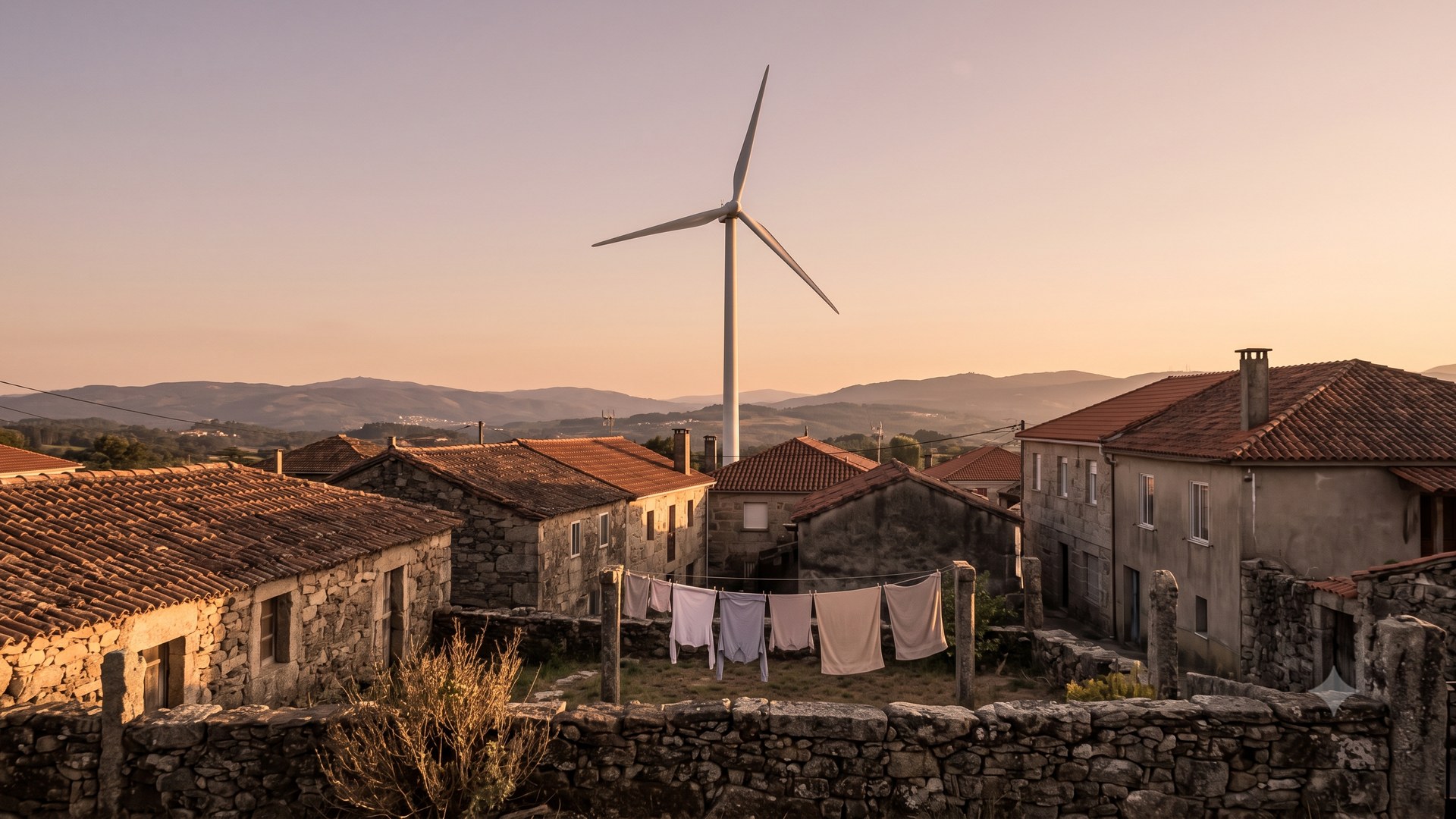
The wall, and the way round it
Santiago Abaitua spent four years pushing a small solar project through the planning system on Gran Canaria and, by his own account, mostly ran into a wall. The town hall and the island council were, he says, "fundamentally" the obstacle. In the end the only route left was an exceptional one — a declaration of general interest that let the regional government issue the building licence over local heads. That is the version of the Spanish energy transition few brochures show: a developer with a signed grid connection, a leased plot and 30 years of solar experience, stuck for years a few kilometres from the substation.
His project, the Baalus solar park in the sunny south of Gran Canaria, eventually got built. Part of the reason it did is a financing tool that, five years ago, most Spanish developers would not have taken seriously. It is called crowdfunding, and it has quietly grown up.
The peg is a shift in the rules. A growing list of Spanish regions now require large renewable projects to offer a slice of the financing — usually around 20 to 25 percent — to residents living within roughly 60 kilometres of the site. What began as a way to buy off local opposition is turning into a genuine line on the capital stack. The people who used to sign petitions against the wind farm are being invited to lend to it, or own a piece of it, and collect the returns.
From nuisance to funding line
Adrián Bautista runs Fundeen, which he and his brother launched in 2017 and got licensed in 2019 as the first renewables crowdfunding platform in Spain. He tells the origin story plainly. The tool was born to fill a gap the banks left open. "In conversations years ago with people from banks' financing teams, they told us that below 20 million euros they wouldn't look at deals," he says, "because in the end they had to deploy three billion euros a year in renewables and couldn't do it if they looked at smaller deals."
That gap — projects too small for a bank's attention but too big for a founder's pocket — was the first market. The second arrived by regulation. As opposition to renewables hardened across the countryside, Spanish authorities began writing rules that push developers to share the upside with the places that host them. One of the cleanest ways to share it is to let locals invest.
Bautista lists the regions that have moved: Catalonia, the Balearics, Navarra, the Basque Country and the Canaries oblige it; Galicia offers it as an incentive. Above a certain size — typically 5 or 10 megawatts — projects "are obliged to offer, generally, 20 percent of the capital, whether equity or debt, to the citizens of the area." Suddenly a new financier appears at the table: the neighbour.
The logic is almost embarrassingly simple, and Bautista makes it. "If I'm going to be looking at a wind farm for the next 25 years on my land," he says, "let me benefit directly and voluntarily from that wind too, by investing the same way the developer does." A person who owns a sliver of the turbine is a person who has stopped writing letters to the council.
Anywhere in the stack
What makes crowdfunding useful rather than merely charming is where it can sit. Fundeen is licensed to do both debt and equity, which lets it slot into whatever gap a project has. "I like to say we're the most flexible capital in the sector," Bautista says. "We can take any position in the payment waterfall."
In practice that means several things. It can be senior debt — the only lender, running a proper project-finance loan with external due diligence, pledges over bank accounts and a promise of mortgage over the asset. It can be junior debt stacked on top of a bank loan: picture a 50-million-euro project that has taken 35 million from a bank, where Fundeen adds a further ticket of up to 5 million to squeeze out a better return on the developer's equity. That five-million ceiling is not a preference but a rule — platforms may raise up to 5 million euros per project company per year. It can also be equity, either level with the developer euro for euro, or a preferred structure that behaves like subordinated debt, with an agreed exit yield and a buy-back mechanism.
The number that matters to a bank is the one Bautista keeps returning to: banks will not look below roughly 20-million-euro tickets. A citizen tranche de-risks the last, awkward slice that neither the bank nor the founder wants to carry. It is senior to equity, junior to the bank, and — crucially — it comes with hundreds of goodwill ambassadors attached. The platform's job, in his words, is to make hundreds of small investors "function as one" so the developer sees a single counterparty and makes a single payment.
Six years in, the tally is real enough to argue with: 24 million euros channelled, more than 18,000 registered users, over 2.5 million euros returned to them, 32 completed operations. Fundeen reckons it has handled something like 80 percent of Spain's citizen-participation offers and 95 percent of the capital raised through them.
The case: San Frutos, oversubscribed
The clearest illustration is a project Bautista did not have to build. San Frutos, a small solar farm in a municipality next to Manresa in Catalonia, had won a 2022 renewables auction slot reserved for projects with local participation — under 5 megawatts, with 25 percent of the financing coming from people within 60 kilometres.
It started, as these do, with friction. So Fundeen and the developer held an in-person event. Forty or fifty neighbours turned up. And then the thing that permitting officials rarely see happened: the mayor asked to take part. "The mayor himself wanted to get involved in this offer," Bautista says. "He took part in that presentation event, and told the story of how the project had been developed in the area." The fifty neighbours told their families and friends. Word of mouth did the rest.
"From a project with a lack of local support," Bautista says, "it ended up being a very well-supported project." The money came in from people across 58 municipalities. A scheme that had arrived with local grievances left oversubscribed. Participation, it turns out, is the antidote to the backlash — not a communications campaign about participation, but the actual chance to put in 500 euros and collect a return.
The developer's ledger
Abaitua's Baalus project shows the other face of the tool: not opposition management, but survival. His park is 2.1 megawatts-peak of bifacial solar on Gran Canaria, hybridised with a five-megawatt-hour battery, for a total spend of about 2.1 million euros.
The battery is not a luxury. The Canaries run isolated island grids, still roughly three-quarters fossil-fuelled, and the grid operator can curtail solar farms above 500 kilowatts when the midday sun overwhelms the network. "These limitations can mean economic losses of more than 30 percent a year," Abaitua says, speaking from experience with another plant he owns. Storage lets him hold the midday surplus and release it in the afternoon when the curtailment lifts. On its own, he admits, "hybridisation makes no financial sense — the numbers don't add up." It only works because a Next Generation grant for the islands covered a large share of the cost.
But grants pay late. "You have to do the works with your own capital," Abaitua says. "Only once the works are finished do you get the aid, which compensates part — not all — of the capital originally invested." That is the trap crowdfunding sprang. The grant required at least half a million euros of the investment to come from participatory funds. Fundeen ran the campaign in 2025, after passing its technical and legal due diligence, and the money — half a million euros of senior debt at a fixed 9 percent over five years — was raised in a single week from 151 investors. The platform was willing to lend more. The partners chose to take only the minimum the grant demanded.
Read the ledger and the pattern holds. The asset ends up financed roughly 40 percent equity, 60 percent debt, with the citizen tranche doing the work a bank would not touch on a project this size. "Without your own money, the project doesn't happen," Abaitua says. The crowd is what closed the gap.
The catch, and the shift
None of this makes crowdfunding a magic wand, and Bautista is candid about the limits. It finances "any proven technology a bank would also finance" — no free-energy machines — with a floor around 600,000 euros in Spain and more abroad, because due-diligence costs eat small deals alive. And the market has turned harder: with Spanish solar capturing prices near 35 euros a megawatt-hour, projects going merchant without a power-purchase agreement or some certainty of income "become very hard to model," he says, "and don't work for us." Fundeen sizes its money against believable cash flows, not a share of the capex. Where the income is uncertain, the money it can put in shrinks toward zero.
That is the honest frame. Citizen finance is not free money and it is not everywhere. But the direction is unmistakable. A decade ago, local residents were a cost line — the source of delay, the reason a substation sat idle while a licence stalled. The regulation now spreading across Spain rewrites them as a funding line. The wind and the sun that neighbours will watch for the next 25 years become something they can, if they choose, own a piece of.
The prize is bigger than any single round. Spain's permitting backlog is, at heart, a trust problem. A tool that turns the affected public into paying stakeholders addresses the trust problem directly, and gets a de-risked tranche of financing as a bonus. San Frutos went from grievance to oversubscribed because the neighbours were offered a stake rather than a leaflet. That is the whole idea in one sentence: the fastest way to stop people fighting your project is to let them profit from it.
You reached this analysis because ATA Insights puts independent energy-transition intelligence in front of 86,000+ professionals across the sector. That's exactly what we do for funded projects, events and companies — turn your work into reach.
See how we disseminate work like this →Where this analysis came from
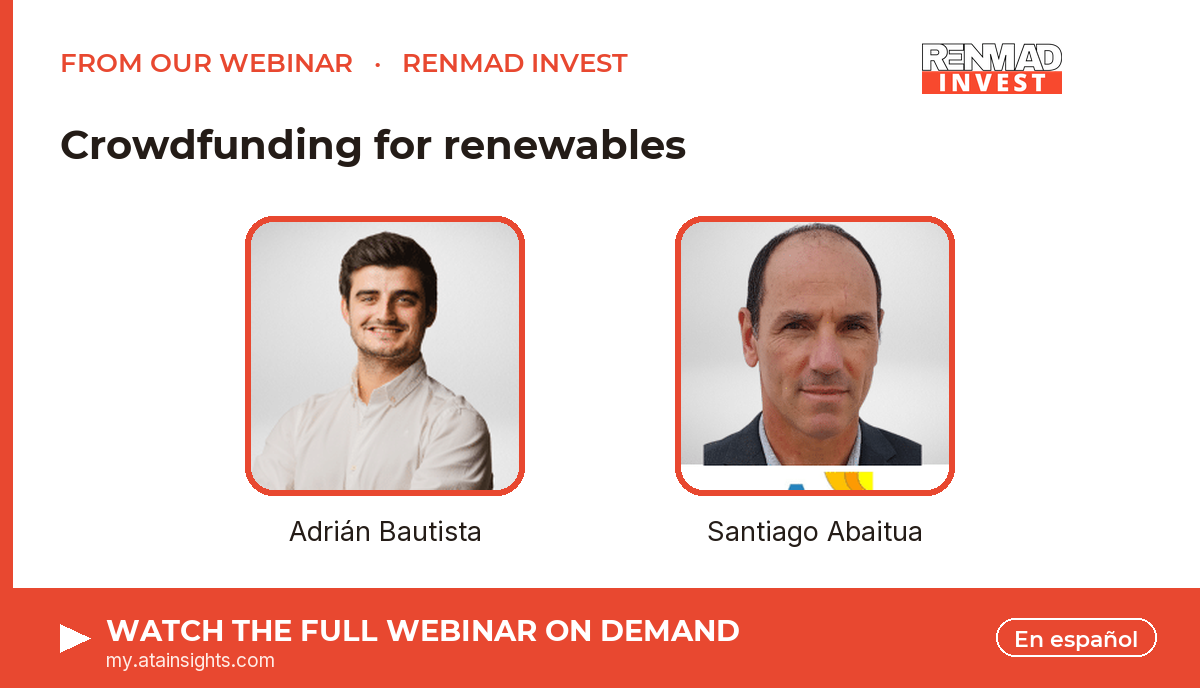
This piece draws on the ATA Insights / RENMAD webinar Crowdfunding for renewables. Watch the full session on demand.
The energy transition, in your inbox
Join 86,000+ professionals reading our independent briefings across five sectors.