No one to hand over to: the digital twin is arriving not out of ambition but because the people who know how to run the plant are retiring
At RENMAD UsefulAI 2026, Manuel Járrega, who introduced himself as the person who runs advanced process control for Schneider Electric across the whole of EMEA, gave you the real reason simulation is making its way into your plant: the people who know how to run it are retiring, and very few are coming up behind them. First the digital twin trains the newcomers, and then advanced control saves you from needing them. He said it in so many words: "it's the substitute for the operator".
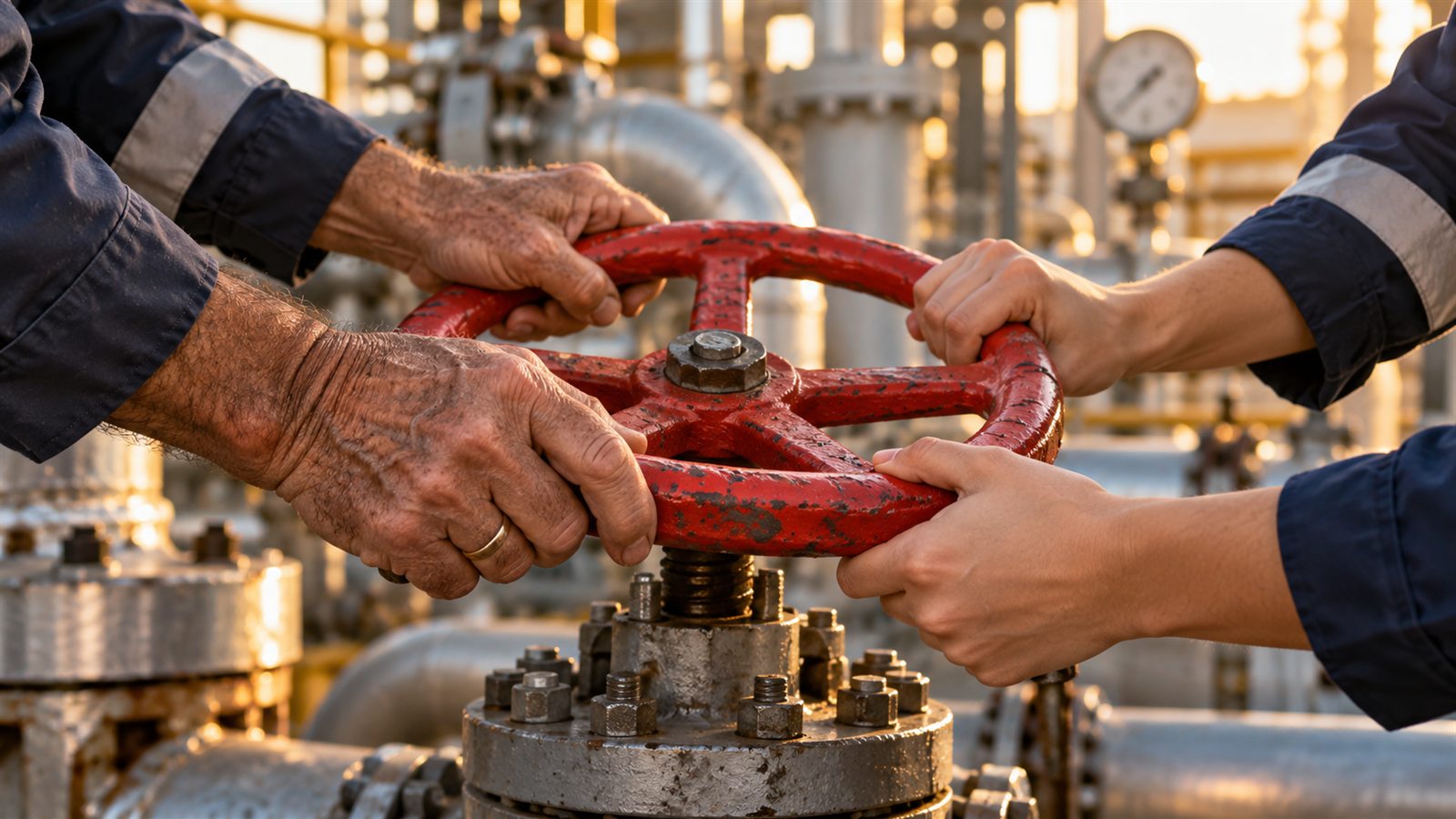
The plant you run works, in large part, because someone there can tell without looking at the screen that a pump sounds different, knows the order in which to restart things when a start-up goes wrong, and has spent years building up that judgement without ever writing it down. That person has a leaving date. Járrega did not dress it up in his talk on 3 June 2026: "Many of the operators, and I'm not talking about Europe, I'm talking about almost the whole world, are going to retire and they're going to disappear with all their knowledge. And there's no talent that wants to go into operating control centres, very little."
His whole argument follows from that. He said that "first we need to train the new people who come in, that's why we need simulators". Then came the second half, "and we're also going to need to automate the plants because we're going to have fewer and fewer operators who want to operate the plants". The twin is a model of your plant that responds the way the real facility does. Two decisions, in that order, with the same reason behind both.
How many are leaving, and how many are coming in
The International Energy Agency has already put numbers on it. Its World Energy Employment 2025 finds the energy workforce older than the economy-wide average. In grid roles there are 1.4 workers nearing retirement for every young worker coming in, and in nuclear 1.7, against an economy-wide average of 1.2. Narrow it to advanced economies and the sector as a whole, where the agency measures against employees under 25 instead, and the ratio rises to 2.4 workers close to retirement for each of them. The same edition adds that two in every three new hires between now and 2035 will be needed just to replace people who retire. Count companies rather than people, and around 60% of those in the sector report labour shortages.
Spain is heading the same way, and its arithmetic is harsher still. EY's Brújula del talento sénior 2026 looks at a different pool: people across the whole Spanish labour market, energy included. It puts retirements over the next decade at about 5.2 million, against barely 1.8 million expected new entrants, which is almost three people leaving for every young person coming in. Translate that into your shift rota and the queue of candidates with plant judgement is painfully short, whoever you ring.
First, the simulator: training the people coming in
What Járrega describes as an operator training simulator has three parts: a first-principles simulation, which calculates how the plant behaves from the physics up, starting with thermodynamics and electricity; a copy of the control system, with its interlocks and its start-up and shutdown sequences; and the same operator screen the newcomer will see on their first day in your control room. An instructor sets exercises, and the trainee works through them against a plant that does not exist. On top of that sits the physical twin in XR, the plant in virtual reality, for whoever will have to go out into the field to close a valve or start a motor. "This technology exists and it works," he said.
His example was Arizona Public Service, the largest electric utility in Arizona, with facilities spread over more than 90,000 square kilometres and half of its 6,000 employees within five years of retirement. According to the case study published by AVEVA, a Schneider Electric company since January 2023, APS built its operator training on generic power plant models hosted in the cloud. The saving was measured in travel days: up to three fewer days away from the plant per person, per session. Its training manager sums it up as hours on the road traded for time in front of the screen.
Járrega adds an anecdote of his own. In Rotterdam, he recalls, a newly arrived operator, already trained, averted a shutdown that would have cost €2 million. It is a vendor's figure, with no client named and no way to verify it, so read it for what it is: an attributed anecdote. The mechanism, though, is the one at work in any job learnt on a simulator. Someone who has already watched a sequence fail recognises it when it starts to fail for real.
Which twin, exactly?
Before you sign anything, take the term apart. His first warning was that "there are many digital twins. There isn't one digital twin. That's the first thing we have to be clear about". There is an electrical twin, which runs arc-flash, harmonic and transient calculations and works out what happens to the rest of the network if you take a line out for maintenance. There is a process twin, a data construction twin and a physical twin in XR. Two of them matter for the succession problem: the process twin underpins the training simulator, and the physical twin trains the people who go out into the field. The process twin also does double duty, because the same model is useful before start-up, in what they call virtual commissioning: testing your control system against the twin while the plant is still being built.
To exist at all, that model needs data your plant is probably throwing away today. Járrega insists that a plant "should be born digitally native". He keeps seeing projects, he says, where engineering generates all the data and it reaches operations so incomplete that the equipment list for the CMMS, the maintenance software, has to be rebuilt almost from scratch. It is the same loss of knowledge as a retirement, brought forward to handover day. And it explains why some European plants are still run from memory. "I've seen a lot of plants, I've seen hydro plants that are run almost by hand and where, for example, the maintenance side is run on an Excel spreadsheet. I've seen that in Europe."
Then advanced control, which he calls "the substitute for the operator"
The second step is advanced process control: software that plugs into any control system over OPC, yours included and whoever made it, and that can stabilise the process and then optimise it. In his words, it acts "as the operator, it's the substitute for the operator so that the operator can devote their time to value-added tasks".
He described what that changes on shift. "At a biomass plant where we've applied this, the operator told us, thanks, now I can go to the toilet. Before, the setpoints used to be changed 900 times a day. And that's a real figure." If the plant runs round the clock, nine hundred setpoint changes a day works out at roughly one every minute and a half. That is a job that ties up an entire person with repetitive moves, and it is exactly the one left unfilled the moment your veteran retires.
That step is already being taken in Spain. On 22 September 2026 Sener and Almirall unveiled the digital twin of the pharmaceutical plant at Sant Andreu de la Barca, a real-time replica of its energy behaviour that acts directly on the equipment and automatically adjusts how the facilities run. Almirall reports gas consumption more than 60% lower than in 2019, with the twin in service only since the third quarter of 2025. On output rather than consumption, it reports 20 million more units of product than in that year. These are Almirall's own figures, and the period since 2019 covers more than the twin alone. It is the architecture Járrega described, simulation underneath and autonomous control on top, in a Spanish plant with home-grown engineering.
Simulator, control, then recruitment
A control room about to lose its veterans has an advantage that will not come round again: it can be redesigned from top to bottom, because it is changing hands anyway. The simulator turns years of judgement into something that can be taught and that stays with the plant. Advanced control takes over those nine hundred repetitive decisions a day. And the operator you do manage to hire walks into a job where the working day goes on the decisions that need a person, which is also why they might want to stay.
A public authority has also confirmed that this is a workforce problem. On the same day, 22 September 2026, the Basque Government approved its Plan de Relevo Generacional y Transmisión del Conocimiento, a generational succession and knowledge-transfer plan linked to early retirement. It covers some 7,000 public employees, more than 700 of whom are already 63 or older and eligible to take it up, and it sets one concrete requirement for anyone leaving: fill in the knowledge-transfer form. That form does on paper what a simulator does on screen. When a government makes early retirement conditional on a person's know-how not walking out of the door with them, the digital twin becomes a workforce decision. The deadline is set by the age of your control room.
Manuel Járrega, of Schneider Electric, gave a talk on digital twins at RENMAD UsefulAI 2026, Madrid, 3 June 2026.
You reached this analysis because ATA Insights puts independent energy-transition intelligence in front of 86,000+ professionals across the sector. That's exactly what we do for funded projects, events and companies — turn your work into reach.
See how we disseminate work like this →Where this analysis came from
This piece draws on RENMAD UsefulAI 2026, 3 June 2026, Madrid.
The energy transition, in your inbox
Join 86,000+ professionals reading our independent briefings across five sectors.