
Phantom Gigawatts
Data centres have asked Spain's grid for 19 gigawatts of power. Much of that demand does not really exist — and a wonkish new rulebook is quietly trying to tell the real from the imagined.
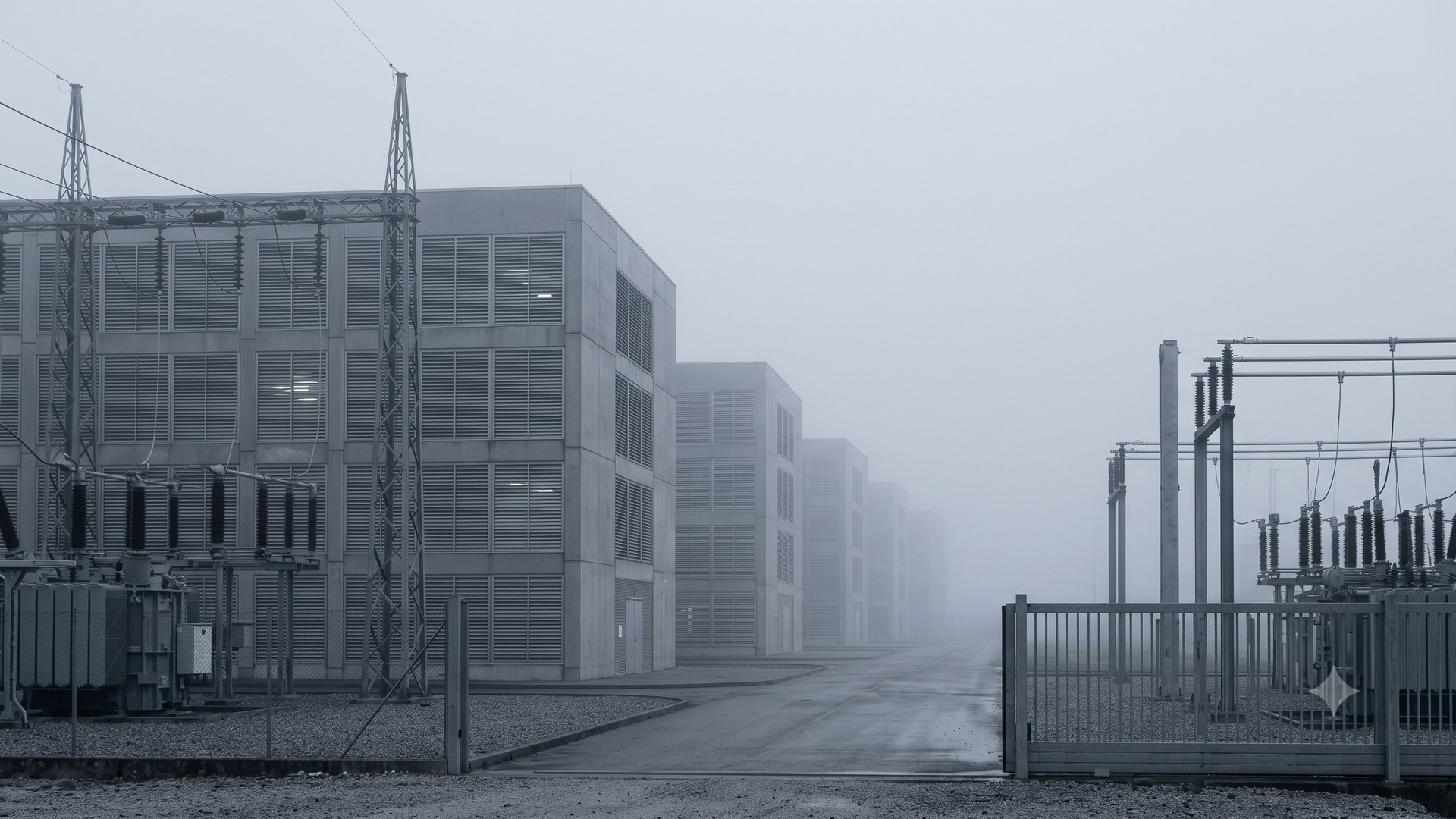
There is a number that has been startling Spanish regulators, utilities and mayors alike: nineteen. As in nineteen gigawatts of grid capacity requested by data centres — roughly the peak summer demand of the entire country on a quiet afternoon, and very nearly what Spain's famously power-hungry heavy industry asks for in total. On paper, an armada of server halls is steaming toward the Iberian coast, cooling fans spinning, ready to feed Europe's insatiable appetite for cloud storage and artificial intelligence.
The trouble is that the paper lies. Not maliciously — but systematically. A large share of those nineteen gigawatts is the same project counted several times over, the same developer knocking on the doors of five substations in three provinces at once, hoping one of them opens. Call them phantom gigawatts: demand that shows up in the queue, clogs the analysis, spooks the planners, and then, quite often, vanishes.
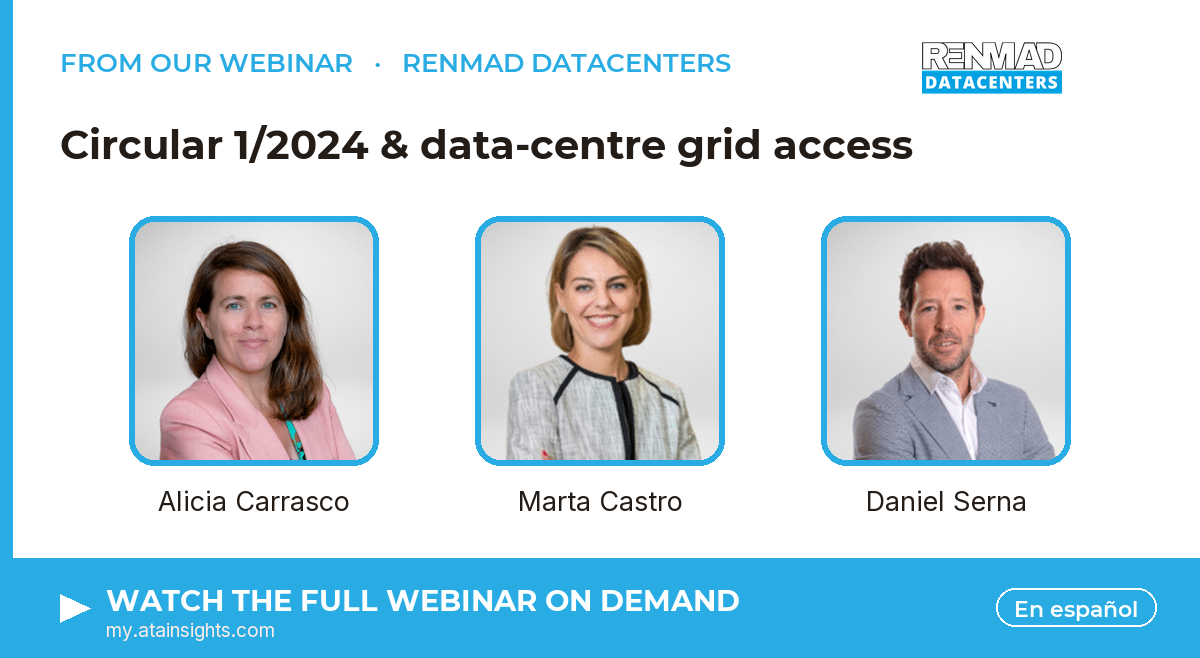
This was the uncomfortable subject of a recent ATA Insights webinar, "Energy for the future: navigating the impact of Circular 1/2024 on data centres," moderated by Andrea Renieblas and staged in the run-up to RENMAD Datacenters in Zaragoza. Three people who spend their days inside the machinery of grid connection — an aggregator, a network regulator and a lawyer — sat down to explain why Spain's data-centre boom is both real and, in large part, an illusion, and how a dense piece of regulation with an unglamorous name is meant to separate the two.
The queue that cries wolf
Start with the anatomy of the nineteen. Marta Castro, director of regulation at aelēc, the association whose members run more than 80% of Spain's electricity distribution, laid out the ledger with the flat precision of someone who has stared at it too long. Of the roughly 19 GW of grid access that data centres have requested, barely 0.4 GW has actually been granted. Somewhere above 10 GW is still winding through the pipes of assessment. And around 8 GW has been refused outright — partly because the network simply has no room, and partly because the developer walked away.
That last category is the tell. Developers do not abandon projects they have fought to build; they abandon the extra tickets they bought as insurance. "It is very probable that the developer has found the zone where it can best locate itself," Castro explained, "and so, if it has made twelve applications, it obviously keeps the one that responds first." Twelve applications. One data centre.
She was blunt about what this does to everyone downstream. "This is generating a bottleneck," she said, "because for any access and connection request, the distributor obviously has to do the analysis, answer the requirement, look at the technical and economic conditions." Every phantom filing consumes a real engineer's real afternoon. And because each speculative request reserves a slice of capacity while it sits in the queue, the phantoms crowd out projects that are ready to break ground.
Her plea, repeated like a refrain, was not to believe the headline figure. "It is so important that we do not believe those 19 GW that are pending connection," she said — while conceding, with disarming honesty, that nobody yet knows the true number underneath. That is the maddening thing about phantom demand: you cannot subtract it until you can see it.
A map that turns off the lights
Why were developers spraying applications across the country like a gambler covering the roulette table? Because, for years, they were playing blind. There was no public map showing where the grid actually had room. If you cannot see which door is unlocked, you rattle all of them.
Enter Circular 1/2024, the Spanish energy regulator's rewrite of how demand — not generation, demand — gets access to the grid. It is the sort of document that empties rooms at parties, and it is also, on Castro's account, quietly transformative. Its central innovation is transparency: it obliges distributors and the transmission operator to publish maps of available demand capacity, node by node. "This publication of this demand capacity map," Castro said, is "a fundamental tool for data centres."
The logic is elegant. Give developers a map, and the incentive to file twelve blind bets collapses; they can aim at the substations that can actually take them. The circular also, for the first time, sets homogeneous criteria across every distributor and the whole national territory — Ceuta, Melilla and the islands included — for judging how much capacity a network can bear. No more twenty different rulebooks for twenty different companies.
The maps have since arrived, and their message is sobering. When the first demand-capacity maps appeared under the circular in late 2025, they showed a distribution network already roughly 83% saturated, with nearly two dozen provinces above 90%. Since April 2026 the regulator has published a single interactive map, refreshed monthly, so anyone can watch the remaining headroom shrink in near-real time. The maps do the phantom-hunting almost by themselves: once everyone can see which nodes are already spoken for, it becomes obvious how much of the requested capacity was the same project hedging across the country.
The circular does more than draw maps. It defines, at last, what a demand connection application must actually contain — "one of the pending subjects we had in the sector," as Castro put it. And it formally distinguishes firm connection from flexible connection, the latter being the idea that a consumer accepts curtailment at peak moments in exchange for getting connected sooner. For a queue drowning in requests, flexibility is the pressure valve.
The flexible server hall
Here the aggregator's voice mattered. Alicia Carrasco, co-founder and executive director of ENTRA — the Spanish association for demand aggregation and flexibility — and chief executive of Olivo Energy, argued that data centres should not be seen only as a colossal, immovable load. They can, in principle, bend.
"We see that data centres are key for the industrialisation and digitalisation of industry," Carrasco said, "but we have to bear in mind that planning is needed so that these installations optimise their energy resources — and also optimise the network capacity that exists." Her association is studying how flexible a server hall can really be: computing and cooling, in particular, offer some room to shift or shave load. Castro agreed that although data centres consume "practically at base-load," those two functions "could offer a certain flexibility," which "opens the door" to connecting on flexible rather than purely firm terms.
Carrasco pointed abroad for cautionary and instructive tales alike. In Ireland, the grid operator around Dublin has stopped accepting new connection requests until 2028 because it has run out of electrical capacity, pushing the government to consider gas connections and on-site generation instead. Irish regulation now demands that new data centres bring a net positive impact — oversized renewables and storage of their own, so they add "non-fossil flexibility to the grid and to the electricity market," in Carrasco's phrase, rather than merely draining it. Germany and France, Castro added, are trying to plan the other way round: identify where the data centres will sit, then size the network to meet them, the way one plans for any electro-intensive industry.
That is the opportunity buried inside the phantom problem. A data centre that can flex, generate and store is not a threat to the grid but a resource for it. The task is to design a regime that rewards the flexible ones and filters out the ghosts.
The lawyer's warning
If Castro supplied the numbers and Carrasco the vision, Daniel Serna, managing partner for public and regulatory law at Lacasa Abogados, supplied the friction. His account of Aragón — the region hosting RENMAD Datacenters, and now a magnet for the hyperscalers, with Amazon Web Services and Microsoft among the names circling — was a reminder that grid capacity is only the first of many gates.
Serna's terrain is the tangle beneath the transformer: land classification, environmental impact, the patchwork of regional and municipal permitting that decides whether a data centre can be built at all. His central point was that even a project which clears the electrical queue can founder on the question of where, legally, it is allowed to sit — and that streamlining connection means little unless the permitting maze is untangled in step. Simplification of applications, clearer definitions, rational development of the network alongside a hard look at territorial and environmental impact: the regulatory scaffolding, he argued, has to be built well, not just built fast. A green light on the grid map is not a green light to pour concrete.
Telling the real from the imagined
The through-line of the hour was refreshingly honest for an industry given to breathless capacity announcements. Spain has genuine advantages — abundant renewables (on a good recent day, more than 60% of demand met from clean sources), power prices 20-30% below the EU average, a reliable grid — and those advantages have made it a real destination for real data centres. But the queue that measures the boom is corrupted by duplication, and until the maps clear the fog, nobody can say how big the boom truly is.
The panellists did not pretend the fix is complete. The detailed specifications for firm demand capacity are only now going to public consultation; the rules for flexible connection, Castro said, are the harder problem still being hammered out with the regulator, with the ambitious goal of having the whole framework in place by year's end. Carrasco used the webinar, only half in jest, to lobby whoever from the regulator might be listening to let demand aggregators into the working groups. The plumbing, in other words, is still being fitted.
But the direction is set, and it is the right one. For years Spain counted phantom gigawatts because it had no way to see through them. Now it is building the instruments — public maps, homogeneous criteria, flexible connection — that turn a speculative free-for-all into something a planner can actually plan around. The nineteen will shrink. The question worth watching is what number is left standing when the ghosts finally clear the room.
The full webinar — "Energía para el futuro: navegando el impacto de la circular 1/2024 en datacenters" — is available to watch on demand from ATA Insights, and the conversation continues in person at RENMAD Datacenters in Zaragoza.
You reached this analysis because ATA Insights puts independent energy-transition intelligence in front of 86,000+ professionals across the sector. That's exactly what we do for funded projects, events and companies — turn your work into reach.
See how we disseminate work like this →Where this analysis came from
This piece draws on the ATA Insights / RENMAD webinar Circular 1/2024 & data-centre grid access. Watch the full session on demand.
The energy transition, in your inbox
Join 86,000+ professionals reading our independent briefings across five sectors.