
Same Truck, Cleaner Tank
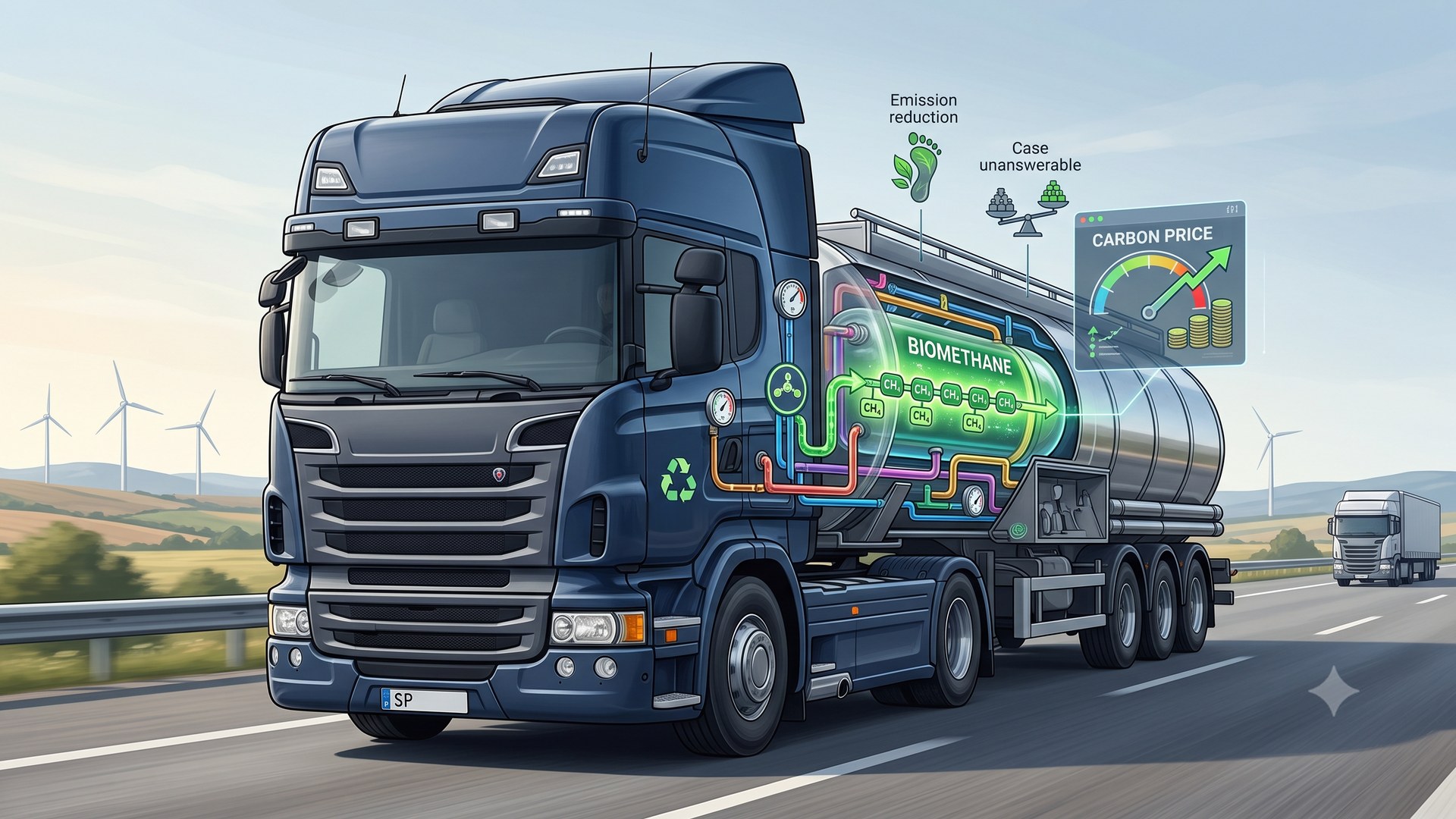
Spain's heavy lorries can decarbonise today without changing the engine — biomethane is already in the tank, and a carbon price is coming to make the case unanswerable.
In Zaragoza, more than two dozen city buses pull out of the depot each morning running on gas made from rubbish. They look like any other bus. They sound like any other bus. The drivers do nothing differently. The only thing that has changed is what is in the tank: not diesel, not fossil gas, but biomethane — and with it, about 1,500 tonnes of carbon dioxide a year that no longer go up the exhaust.
That fleet, run by Alsa and fuelled through Redexis stations, is the kind of unglamorous fact that tends to get lost under the louder argument about how to clean up transport. Electrify everything, runs the slogan. And for a city car, fair enough. But a 40-tonne lorry hauling strawberries from Huelva to Germany is a different problem, and the people who move freight for a living have noticed that one of the answers is already parked in the yard.
That was the through-line of a recent RENMAD webinar, run by ATA Insights, on biomethane in mobility. Three people who actually build, sell and fuel this stuff — a strategist, a project developer and a station operator — spent an hour making a case that is less about the future than about the present.
The drop-in nobody talks about
The technical trick at the heart of biomethane is that there is no trick. Strip the carbon dioxide and impurities out of biogas — itself made by digesting manure, food waste or sewage — and what is left is chemically near-identical to fossil natural gas. It moves through the same pipes, burns in the same engines, refuels at the same nozzle.
"Biomethane is a renewable gas produced from waste, completely compatible — what we call a drop-in fuel — with natural gas," said Isabel León Pita, Director of Strategy at PwC España, who has spent the better part of six years advising clients across the industry. "Any motor or downstream system using natural gas today is completely compatible with using biomethane."
That compatibility is the whole argument. There is no new engine to design, no charging network to build from scratch, no waiting for a battery heavy enough to haul sixteen tonnes a thousand kilometres. Spain already has more than 37,000 gas vehicles on its roads and over 150 refuelling stations open. The hardware exists. The fuel exists. What has been missing is the will to point the two at each other.
León Pita's map of where this matters is precise. Light vehicles and last-mile delivery? Leave those to the electric grid, which already wins on cost. The opening for renewable gas is in the parts of transport that electricity struggles to reach — long-haul road freight, buses, coaches, and shipping. Heavy road transport alone burns 82 terawatt-hours of final energy a year in Spain, and the maritime sector another 108. These are big, stubborn, hard-to-electrify numbers, and they are exactly where a drop-in fuel earns its keep.
A laggard with room to run
Here is the awkward part. Spain makes very little of this gas. As of late September 2025, the country had 22 biomethane plants in operation — against more than 100 in Italy and close to 700 in France.
León Pita is blunt about it: "Spain is an under-performer in biomethane development compared with European countries that share our characteristics." But she frames the gap as an opportunity rather than an indictment, and the reason is the speed at which the leaders moved. Italy went from 18 plants in 2020 to 133 in 2024. France's fleet is barely older. This is not a twenty-year head start that Spain can never close; it is a four-year sprint that Spain has not yet started running.
The raw material is there. A PwC España study puts Spain's biomethane production potential at 163 terawatt-hours — enough, in principle, to decarbonise a meaningful slice of road and maritime transport several times over. The official roadmap targets 20 terawatt-hours of production by 2030; León Pita reckons 15 to 20 is realistic given the project pipeline, and that even the lower figure could cover around a tenth of the energy used by long-haul and maritime transport today.
Built without a cheque from the state
The way Spain got its first 22 plants is the detail that sets it apart from France and Italy, and the one investors should pay attention to.
In most of Europe the model is regulatory: the state offers contracts-for-difference, guarantees a price for fifteen years, and effectively becomes the off-taker. It works, and it is fast. Spain did it differently — or rather, did not do it at all.
"The 22 projects have already been developed without this kind of regulatory framework," León Pita said. The plants stand on private, bilateral, long-term supply contracts — biomethane purchase agreements that behave much like the power-purchase agreements that financed renewable electricity, offering producers and buyers a stable price over ten or fifteen years. "There is willingness on all sides, and a price signal that justifies and makes the projects profitable, such that we don't need that kind of scheme in Spain for the market to take off."
That is a quietly remarkable claim: a renewable industry getting off the ground on commercial logic rather than subsidy. It also tells investors something useful — the demand and the price stability are real enough that private money is already closing deals.
What a good plant smells like
If the economics are there, the obstacle is closer to the ground. Biomethane plants treat waste, and waste has a reputation. The fight is increasingly local, fought parish by parish over the question of whether a digester belongs next door.
Cecilia López Miranda, who originates biomethane projects for the trading and developer firm Axpo, has clearly had this conversation many times, and her answer is disarming. "A well-designed plant should not smell," she said — and repeated it, because it is the line that wins or loses a planning meeting. What people smell, she added, is usually the lorry traffic bringing waste in, which is why a plant sized sensibly for its own region — not one trucking manure forty kilometres across a provincial border to pump up its output — is the only kind worth building.
Her remedy is not spin but plumbing and candour: seal the digestate so it does not smell, size the plant to the local waste it can solve, and be straight with the town hall and the neighbours from the start. A biomethane plant, she argues, is fundamentally a waste-treatment plant that happens to produce energy — its first job is to make a manure or rubbish problem disappear. Sold that way, it is a solution arriving in the village, not a nuisance.
Axpo has the receipts. It signed Spain's first long-term biomethane purchase agreement back in 2019, for the plant at Madrid's Valdemingómez waste park — the gas from which now helps move part of the capital's bus fleet. And López Miranda points to a more recent milestone that quietly proves the supply chain works end to end: the first bio-LNG bunkering operations at Enagás terminals, where biomethane has been delivered by tanker truck at the Barcelona, Huelva and Cartagena terminals to fuel ships. "None of this is possible," she said, "without a commitment to creating demand and agreements between the different players."
The carbon price changes the maths
So why now, if the fuel and the trucks have been around for years? Because the cost of doing nothing is about to go up.
Two pieces of European policy are landing on diesel at once. The RED III renewables directive is being written into Spanish law with binding transport sub-targets — a renewable share rising toward 29% of final transport energy by 2030, with a specific advanced-biofuels obligation stacking to roughly 8% over the decade. And the EU's second emissions trading system, ETS2, will put a carbon price directly on road-transport fuels. Brussels pushed the start back during last year's haggling over the 2040 climate goal — fuel suppliers are already monitoring emissions, with the price beginning to bite later this decade rather than, as once planned, in 2027 — but the direction is fixed. When it arrives, every litre of fossil diesel carries a charge that biomethane, as a renewable fuel, does not.
José Luis Vidal, who runs mobility for Redexis, framed it as the moment the spreadsheet flips. He pointed to the coming carbon cost on fossil fuels — on the order of tens of euros a tonne — and to the certificates that biomethane accumulates instead. A haulier, he noted, watches every cent: fuel is about 30% of the cost of moving freight, and the industry will not jump to anything that makes the lorry or the refuelling dearer. Biomethane, crucially, does neither — gas trucks cost about the same as their diesel equivalents to buy and run, and the fuel has spent most of the past seven or eight years competitive with diesel at the pump.
Vidal's frustration is with the all-or-nothing framing of the energy transition. "We're talking about an energy transition that doesn't happen in a quantum leap," he said. "It has to be done step by step, meeting milestones — and among all the available technologies, biomethane, of course, helps to decarbonise now." His point about hardware is the same as León Pita's: the same engines, the same refuelling infrastructure, plus the long range a lorry crossing a continent actually needs. Redexis has already opened more than 40 gas stations compatible with biomethane and bio-LNG, fuelling buses in Zaragoza, Madrid and Pamplona and freight fleets across the country.
The case rests
Strip away the policy acronyms and the argument is almost embarrassingly simple. The trucks exist. The stations exist. The gas exists, made from waste that someone has to deal with anyway. The plants are being financed without asking taxpayers for a cheque. And a carbon price is coming that will make the diesel alternative more expensive than the renewable one.
Asked at the end of the session to sum up biomethane's future in a single line, each speaker landed in the same place. For León Pita it was "a reality, with use cases that prove this is a viable and very promising technology." For López Miranda, "a solution to the waste problem and a fully viable product for decarbonising transport — we just need to grow demand." Vidal was the most compact of all.
"Biomethane," he said. "Now. And at a competitive price."
The future, as he put it, borrowing from Back to the Future, was meant to bring vehicles that run on rubbish. It is a year or two late. But it is already on the road.
You reached this analysis because ATA Insights puts independent energy-transition intelligence in front of 86,000+ professionals across the sector. That's exactly what we do for funded projects, events and companies — turn your work into reach.
See how we disseminate work like this →Where this analysis came from
This piece draws on the ATA Insights / RENMAD webinar Biomethane in mobility. Watch the full session on demand.

The energy transition, in your inbox
Join 86,000+ professionals reading our independent briefings across five sectors.