
Signed, sealed and stranded
A biomethane plant can have every paper signed and still fail to start up. The risk lives in the gap between what is authorised, contracted and built and what the financial model takes for granted, and it tends to surface in three places: contracted feedstock the authorisation does not cover, a 60-working-day deadline and the digestate.
Picture a spotless file: confirmation of planning compatibility, an environmental impact statement, an integrated environmental authorisation (the AAI, Spain's permit under the EU Industrial Emissions Directive) and feedstock contracts with half the livestock farms in the district. That is precisely what should put anyone reviewing it for a buyer or a bank on their guard. At the RENMAD webinar on biomethane project due diligence on 5 November 2026, Sofía Cabedo Usó, partner in Public and Environmental Law at Broseta, ended her talk on this note: "The permit is not the end of the analysis but the starting point."
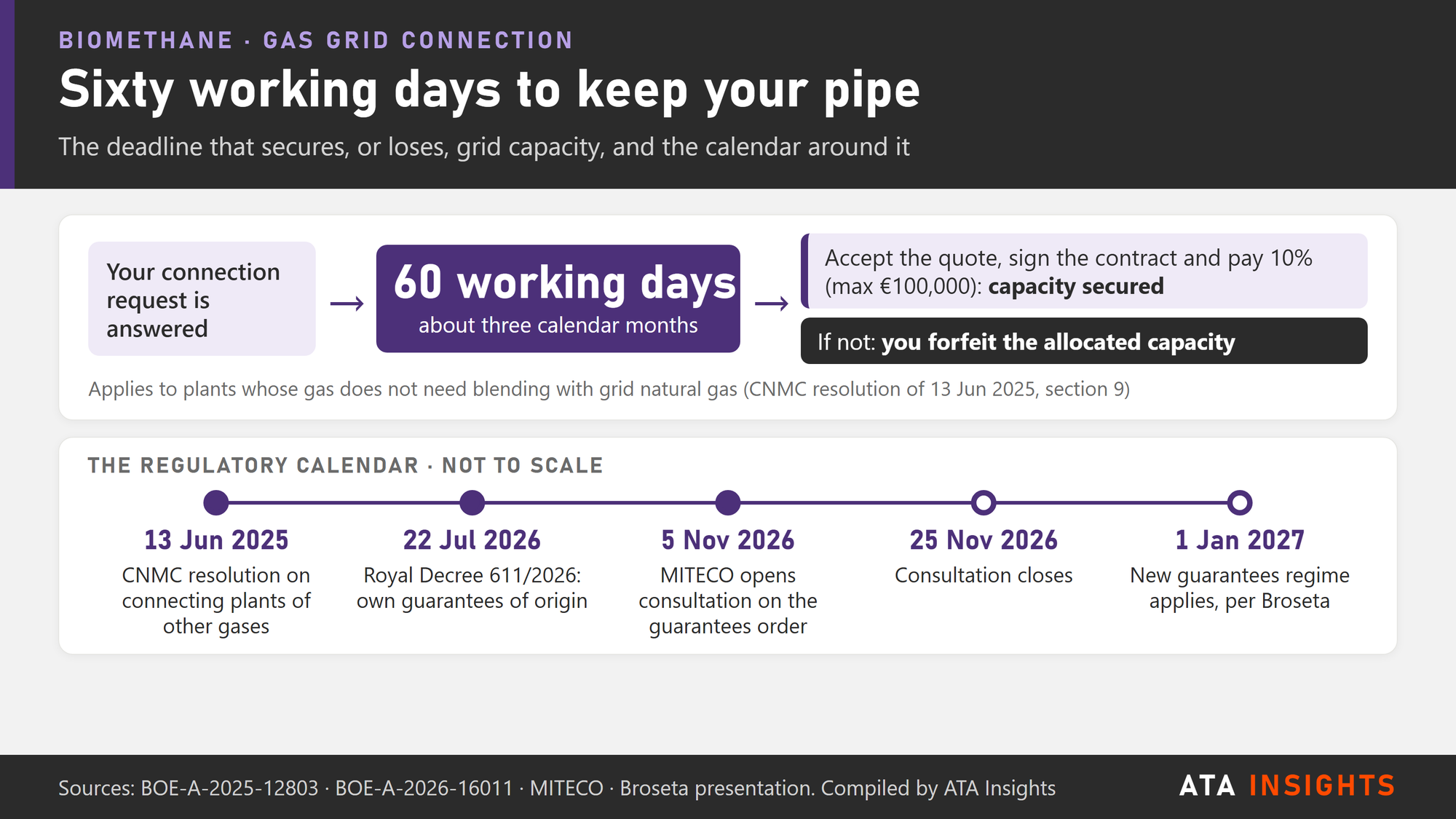
And the timetable is tight. Royal Decree 611/2026 of 22 July repeals the part of Royal Decree 376/2022 that governed guarantees of origin and, in its own Title VI, creates a dedicated system for renewable and low-carbon gases. The decree has been in force since 24 July, and Broseta's presentation puts the start of the new regime at 1 January 2027. On the very day of the webinar, MITECO, Spain's Ministry for the Ecological Transition, opened a public consultation on the ministerial order that will set out how the system is run; submissions close on 25 November.
Four activities, one asset
Talking about "a biomethane plant", in the singular, is a convenient simplification. In law, Cabedo explained, four activities with different requirements share the site. If waste comes in, producing biogas is a waste treatment operation. The gas then has to be upgraded to grid quality, and injecting it puts you under Spain's hydrocarbons regime and the rules of the CNMC, the country's energy regulator. Meanwhile digestion produces digestate, which has to leave the plant by a legally permitted route.
The upshot is blunt: a perfectly authorised production plant "is not much use if it is not legally entitled to inject the gas or has no legal outlet for that digestate". Plant, connection and digestate run on three parallel tracks that depend on one another, and it takes only one to fail, Cabedo warned, for commissioning of the whole project to slip.
Lorenzo Chacón, head of biomethane projects at ATA Renewables, reached the same conclusion from the engineering side. Technical due diligence checks that the permits applied for or granted, the injection capacity and the electricity grid access all fit the design of the facility. Put another way, the paperwork and the drawings have to describe the same plant.
The four-column test
What really adds value in legal due diligence, Cabedo said, "is the correspondence between these four elements": what is authorised, what is contracted, what is built or planned, and the assumptions in the financial model. When the pieces do not match, in come "the delays, the cost overruns, the operating limitations or the valuation adjustments".
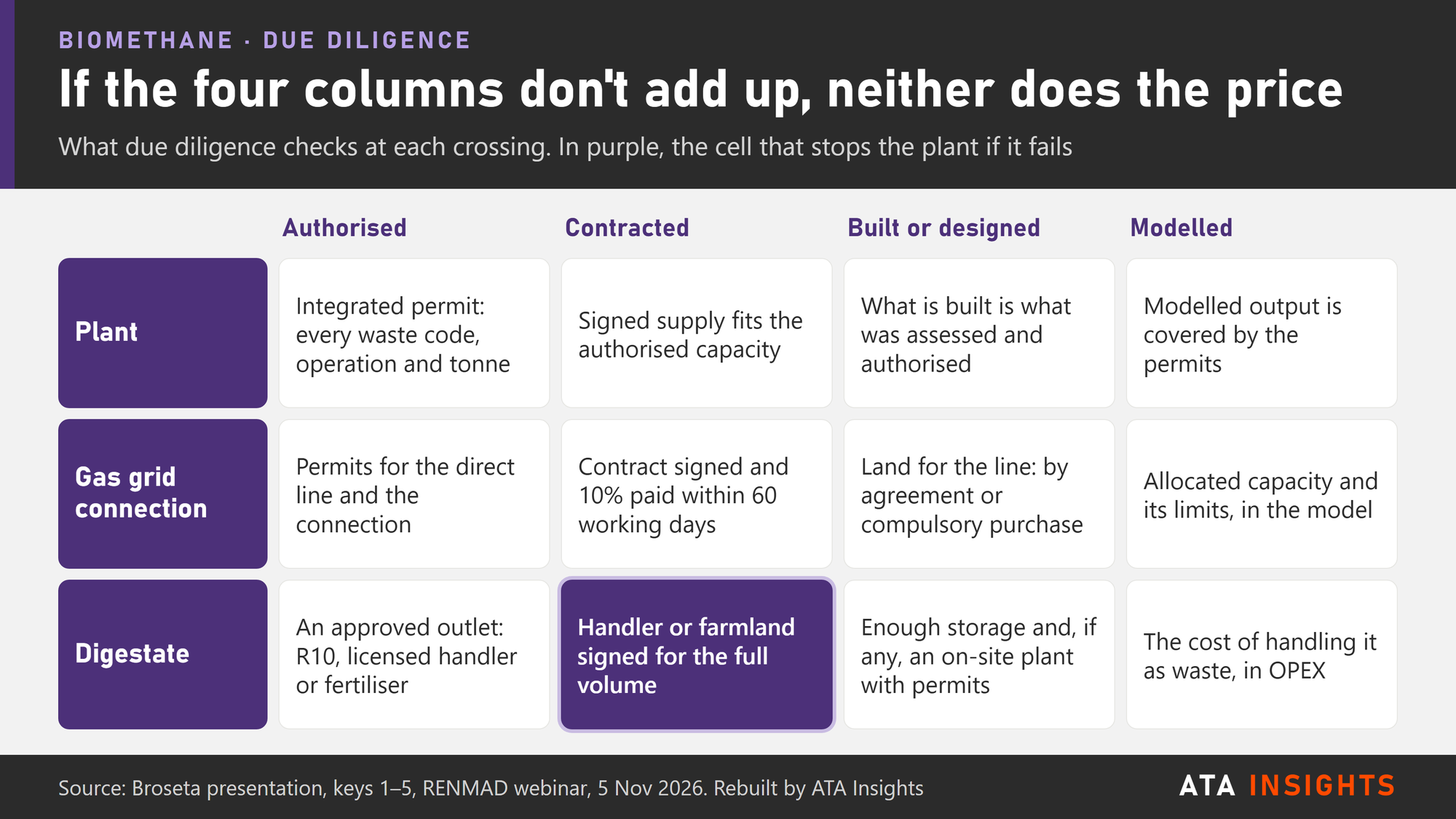
The first crack usually opens between what is authorised and what is contracted. The typical risk, according to Cabedo, is contracted feedstock that the authorisation does not cover: waste whose LER codes (the Spanish acronym for the European List of Waste, known in English as EWC codes) do not appear in the permit, tonnages above authorised capacity, or manure arriving without SANDACH approval, the clearance Spain requires before a plant can take in animal by-products.
Thresholds turn any growth into a permitting exercise. An AAI is mandatory above 75 tonnes a day of non-hazardous waste recovery, or 100 tonnes if anaerobic digestion is the only treatment activity (Annex 1 of Royal Legislative Decree 1/2016, Spain's consolidated law on integrated pollution prevention and control). A plant that grows past that line needs an authorisation it did not have before. And for one that already holds an AAI, Cabedo pointed out, an expansion that reaches the thresholds for a substantial modification cannot go ahead until the AAI itself has been amended.
Cabedo flagged a subtler flaw: projects assessed piecemeal, with the plant, the pipeline and the digestate each taken separately. That salami-slicing leaves every one of the permits open to future legal challenge.
Sixty working days, or no pipe
The second crack is the connection, and here the risk has a date on it. The CNMC Resolution of 13 June 2025 governs grid connection for plants producing other gases, biomethane among them. For a plant whose gas does not need blending with network gas, it gives the developer no more than 60 working days from the reply to its application. (Working days, in Spanish administrative law, exclude weekends and public holidays.) Within that window the developer must accept the quote, sign the connection contract and pay 10% of the quoted cost, capped at €100,000. Fail to sign or pay in time and the resolution treats it as a waiver of the conditional capacity allocated. Roughly three calendar months separate a connection right from a dead letter.
Besides, having capacity is not the same as having a pipe. Cabedo distinguished between two pieces of infrastructure. The direct line belongs to the producer and needs its own authorisations, its own land and, if no deal can be struck with the landowners, a specific declaration of public utility, the step that opens the way to compulsory purchase. The connection facilities, by contrast, form part of the network: the network owner builds them, although the producer usually pays for them. "Nor does a connection right on its own mean that the infrastructure is authorised and ready to inject the biomethane," she warned.
The electricity connection can stall too. A plant that upgrades and compresses gas draws power, and in some areas supply capacity is proving hard to secure. In the Q&A, two of the speakers agreed on the remedy: work out from the earliest stages how much power the plant will need, and check with the distribution network operator that the capacity is there.
Digestate: the exit the spreadsheet forgot
The third crack lies in the area that, in Cabedo's words, "tends to receive less attention but is just as decisive". "Digestate does not become fertiliser merely by being treated." If the plant treats waste, its digestate is, as a rule, waste as well, and the producer must guarantee that the entire volume is managed, either directly or through an authorised waste manager, with every shipment documented. Spreading it on land as waste is a recovery operation, R10 (the EU code for land treatment that benefits agriculture). Royal Decree 1051/2022 on sustainable soil nutrition allows it only for the wastes listed in its Annex VIII, and always within agronomic limits and the rules for nitrate vulnerable zones. Selling it as a product means complying with the EU Fertilising Products Regulation (EU) 2019/1009 or with Spain's fertiliser decree, Royal Decree 506/2013.
Chacón confirmed that, where a project plans to use the R10 route, his team checks the digestate's specifications against Royal Decree 1051/2022. Broseta's presentation puts a price on every failure. If digestate meant to be sold as fertiliser is still waste in law, it brings management costs that nobody had budgeted for. If there is not enough farmland, or the waste manager cannot keep up, intake has to be cut, and revenue with it. The slide puts it bluntly: without a digestate route that is authorised, contracted and sufficient, there is no operation.
From red flag to price tag
Useful due diligence ends in a number or a clause. Broseta's method has four steps: identify the contingencies, assess their impact on timing and cost, mitigate them or allocate them in the contract, and make the call with enough information. In Chacón's technical version, each risk is graded on a five-level scale from low to high, each with its own mitigation measure. "Is it possible to take on a project with contingencies?" Cabedo asked as she wrapped up. "Of course, provided it comes with a legal measure to try to minimise them."
Inés Monroy, sustainability consultant and mediator at Licencia Social Energy, added the risk that amplifies all the others: a project can be "technically feasible, economically profitable and administratively authorisable, but not necessarily socially viable". Moratoriums, local referendums and politicians (local ones above all) who withdraw their support under social pressure all end up as delays and cost overruns. Which is why she often asks her clients a question that holds for the whole exercise: if these risks translate into money, are they already in your model?
That is where the opportunity lies. In Spain, Chacón noted, a great many projects are stuck in permitting. The buyer or bank that applies the four-column test can tell the well-documented assets apart from the ones that will actually run. A project whose permits match its contracts, with its connection firmed up and paid for on time and a signed outlet for its digestate, is not free of risk, but its risks come priced. When almost every file arrives spotless, that coherence is what makes it bankable. For the developer the lesson is the mirror image: any gap it leaves open, the buyer will close for it, by marking down the price. And with the new guarantee-of-origin system about to start, in which each guarantee stands for 1 MWh, whatever the plant fails to produce does not get certified either.
All of this will be back on the table at RENMAD Biometano in Toledo on 10 and 11 February 2027.
In biomethane, the permit gets you in. The money is in finding a way out.
You reached this analysis because ATA Insights puts independent energy-transition intelligence in front of 86,000+ professionals across the sector. That's exactly what we do for funded projects, events and companies — turn your work into reach.
See how we disseminate work like this →Where this analysis came from
This piece draws on the ATA Insights / RENMAD webinar Biomethane project due diligence: what to analyse. Watch the full session on demand.
The energy transition, in your inbox
Join 86,000+ professionals reading our independent briefings across five sectors.