
Sludge or gold? Digestate's identity crisis
Spain is ordering biomethane to scale. But every plant leaves behind a substance whose legal identity — decided by law, not chemistry — will make or break the business case. A regulatory thaw is now tilting it from waste towards resource.
Spain's biomethane sector has never had more political wind in its sails. A draft royal decree now working its way through consultation would set, for the first time, mandatory blending quotas for renewable gas in the grid — starting at 0.5% in 2028 and climbing to 6% by the mid-2030s. The instruction to developers is unambiguous: build, and build fast.
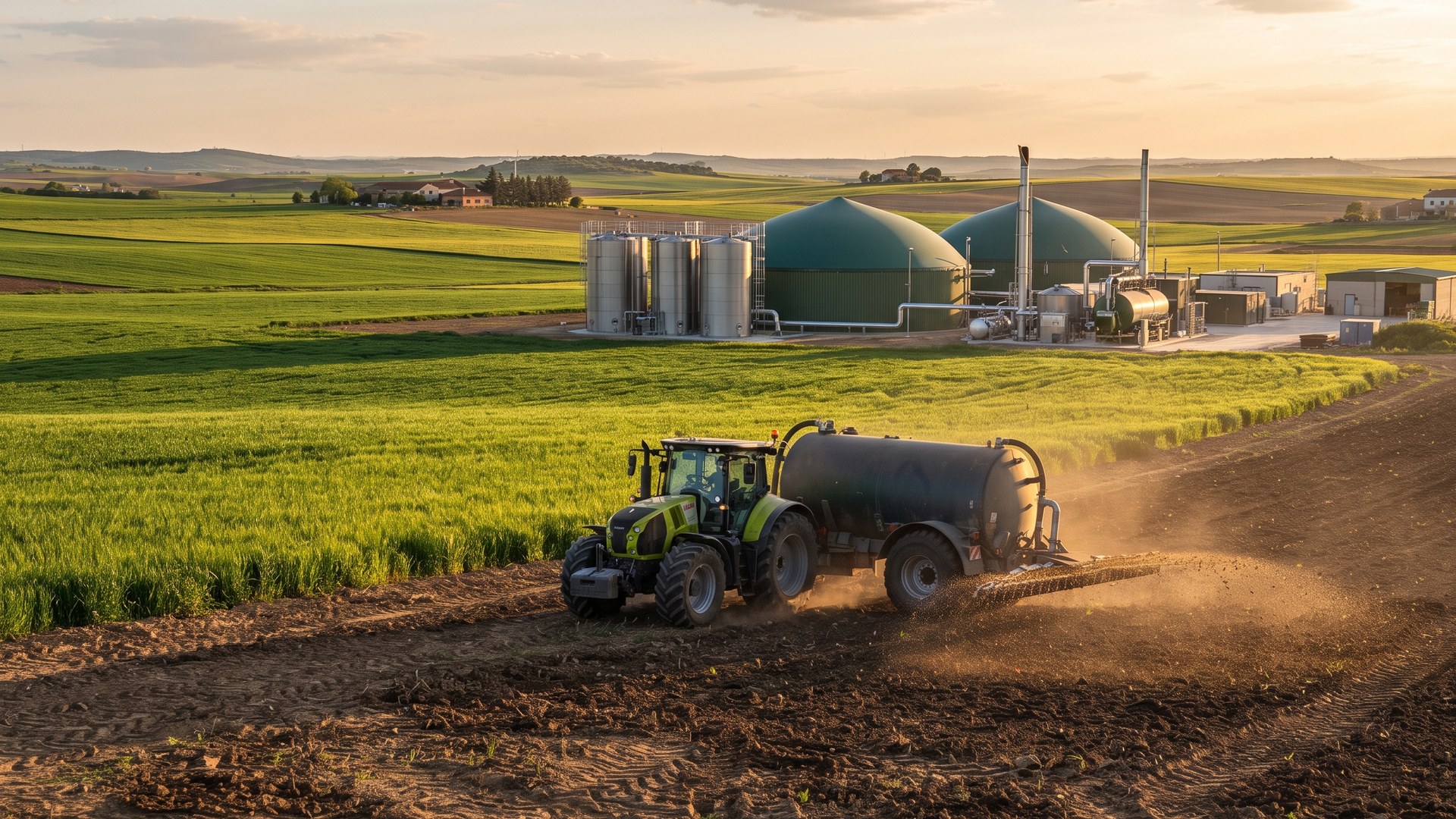
Yet for every cubic metre of green gas that reaches the grid, something is left behind that rarely makes it into the investor pitch: digestate, the effluent that remains once anaerobic digestion has squeezed out the biogas. And across a recent RENMAD Biometano webinar, three specialists kept returning to the same uncomfortable point — the gas is the easy part. What decides whether a project lives or dies is what you do with the leftover.
A substance defined by law, not chemistry
The trouble with digestate is that it suffers an identity crisis. The very same tonne of organic matter can be, depending on who holds it and why, a waste to be disposed of at a cost, a by-product to be reused, or a fertiliser to be sold with an EU certificate.
Its status "doesn't depend on the physical and chemical characteristics of the materials, but on the will or the legal obligation of the holder," explained Lorenzo Chacón, senior biomethane expert at ATA Renewables. In other words, digestate is not what it is; it is what the law says it is. Two identical plants — same feedstock, same process — can end up with a legally different product depending on where they sit and who manages the output.
And the balance usually tips the wrong way. "In 99% of cases," Chacón noted, "a plant producing biogas will be a waste-management plant, in which the digestate is considered a waste." To shed that label — to reach the coveted "end-of-waste" status — a project has to navigate a maze of overlapping rules that he declined even to summarise in full: "this would take a dedicated master's degree, not a webinar."
The starting point is stark. According to the European Biogas Association, around three-quarters of the digestate produced in Europe is spread directly on fields, with a further fifth applied after some treatment — so more than 90% ends up, one way or another, on farmland. The dominant strategy, in short, is not to valorise digestate as a high-value fertiliser but to dispose of it as an agricultural residue. A model that works until it doesn't.
Why the label decides everything
Change the label and you change the business. If digestate is waste, spreading it is a recovery operation hemmed in by regional limits and the unforgiving arithmetic of land. If it is fertiliser, it enters another league: certified, registered, sold with a brand. The difference is not semantic; it is the line between a liability and an asset.
José María Soria Domínguez, who heads the water, environment and waste division at Fluidmecánica Sur, put the cost of getting it wrong bluntly. Rules change from one Spanish region to the next, he said, "and sometimes regulations appear retroactively," so a launched project stops being viable overnight. His verdict: "very often the project dies before it is born." He recalled recent sector forums where more than eighty plants, permits in hand, were said to be going up within eighteen months. Eighteen months on, he believes, not a single one has been built.
The new referee, meanwhile, is the bank. "Lenders are looking very closely at what the digestate solution is," warned Buenaventura Gómez, energy transition director at ID Energy Group, whose company has 110 projects in the Spanish pipeline. His central lesson was a warning against wishful accounting: digestate cannot be an afterthought. "You have to think about it from the conception of the project. If not, the most likely outcome is that the project won't go ahead."
The thaw has begun
Here is the opportunity. The ground beneath that label is shifting — and it is moving from waste towards resource.
The first thaw is already adopted. On 9 February 2026 the European Commission adopted Directive (EU) 2026/288, amending the Nitrates Directive to accommodate RENURE fertilisers, nitrogen recovered from processed manure. In member states that opt in, farmers will be able to apply up to 80 kg of nitrogen per hectare a year above the traditional manure ceiling, precisely so recovered nutrients can replace mineral fertiliser. Transposition is expected by 2028, so it is not yet on the fields; but it is exactly the door Chacón anticipated.
The second is domestic: a draft royal decree on fertilising products, circulated in 2026, would replace Spain's decade-old regime and finally align it with EU rules — potentially letting more digestate reach end-of-waste status without forcing every case through by hand.
The third is direction of travel. The Commission's Fertilisers Action Plan floats simplifying by-product management and even excluding certain materials from the waste directive, while a February 2026 package aims to cut Europe's dependence on imported fertiliser. The political vector is clear: Europe wants nutrients recovered from its own organic waste to replace imported sacks — and digestate is, by volume, the obvious candidate.
Designing for the resource
None of this turns digestate into gold automatically. Even a company that tries to certify "all of it" as fertiliser, Gómez admitted, never manages the whole stream; a fertiliser fraction will always coexist with a residual one. "There is no optimal solution — digestate is solved case by case."
But the reclassification is possible, and geography proves it. Just across the border in Portugal, Gómez noted, digestate from a plant handling animal and plant waste "is directly a fertiliser — there's no need for any specific treatment." Same peninsula, same substrate, opposite legal identities. If the problem is the framework, frameworks can change.
The lever for developers is to design for the thaw from day one: choosing the digestate route before the first tonne of earth is moved, building fertiliser certification and farmer agreements into the project rather than bolting them on, and presenting lenders a credible, costed outlet. Spain's biomethane will not be won in the digester. It will be won in the fine print — and whoever reads it best turns what's left over into what holds the project up.
Lorenzo Chacón (ATA Renewables), José María Soria Domínguez (Fluidmecánica Sur) and Buenaventura Gómez (ID Energy Group) spoke at the RENMAD Biometano webinar "Digestato: claves regulatorias y tecnológicas para su gestión", moderated by Jesús Rodríguez (ATA Insights).
You reached this analysis because ATA Insights puts independent energy-transition intelligence in front of 86,000+ professionals across the sector. That's exactly what we do for funded projects, events and companies — turn your work into reach.
See how we disseminate work like this →Where this analysis came from
This piece draws on the ATA Insights / RENMAD webinar Digestate: regulatory and technological keys to its management. Watch the full session on demand.
The energy transition, in your inbox
Join 86,000+ professionals reading our independent briefings across five sectors.