
Southern comfort: why Italy's cheapest electrons are looking for a data center
Italy's South has power it cannot sell; its North has data centers it cannot plug in. Batteries, newly bankable, could make the introduction
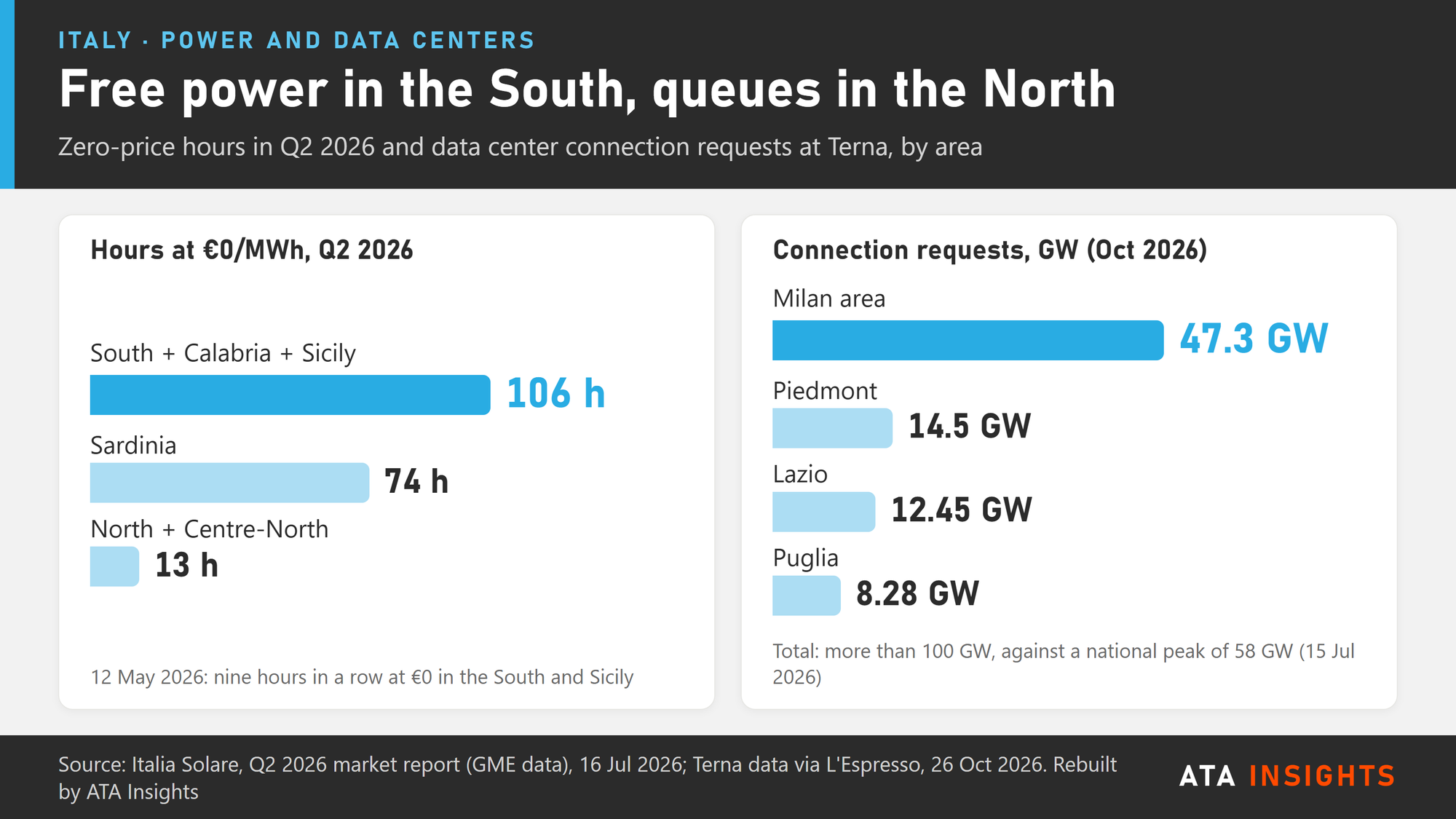
On 12 May 2026 electricity in southern Italy was worth nothing. For nine hours in a row, from mid-morning to late afternoon, every hourly price in the South and Sicily zones cleared at €0/MWh. Italy's wholesale market clears zone by zone, and that day the South simply had more sun than wires. It was the low point of a quarter in which the South, Calabria and Sicily logged 106 zero-price hours, against 13 in the North and Centre-North, according to Italia Solare's analysis of market data. On 14 October Sicily and Calabria went one better, clearing below zero for the first time, by a single cent.
At the top of the peninsula the problem runs the other way. By October Terna, the transmission system operator, held more than 100 GW of connection requests from data centers, roughly 1.7 times the 58 GW national peak set on 15 July. Lombardy, overwhelmingly greater Milan, accounts for nearly half. Michele Gallo, secretary general of IDA, the Italian Data Center Association, calls it the power paradox: demand is no longer the bottleneck; the grid is. Much of the queue is speculative, and IDA expects only 1.5–2 GW to actually be built by 2030, against about 760 MW of IT capacity installed today.
Speaking at a RENMAD webinar, Gallo put it more simply: there are "two Italies". One has electrons with nowhere to go, the other has customers who cannot take delivery. Moving the power north means new wires, and wires are slow. The more interesting fix is to move some of the demand south and let a battery stand between the two.
Bankable, but thin
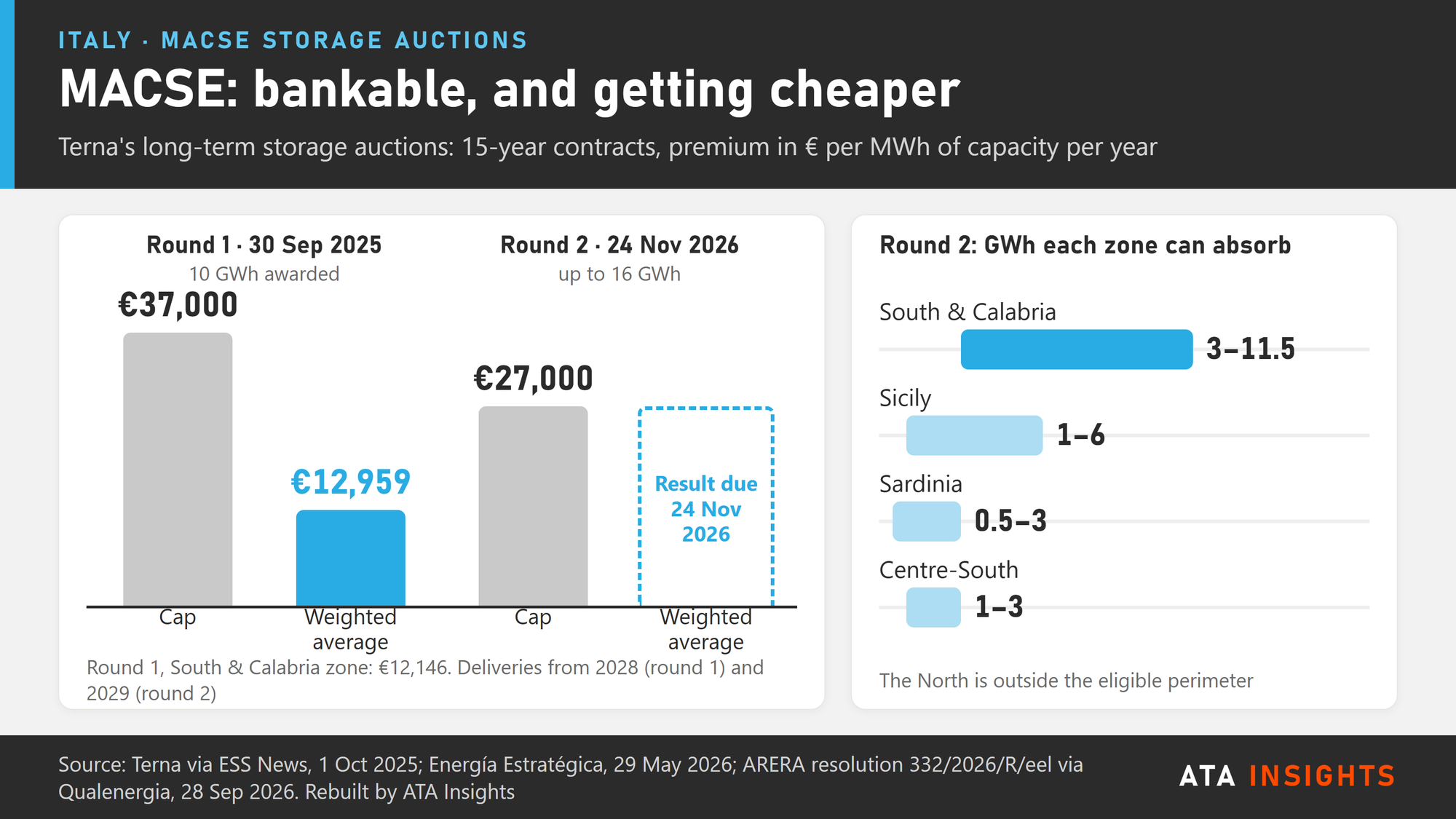
Start with the batteries. Italy's utility-scale fleet went from under 0.1 GW in early 2023 to 1.9 GW at the end of 2025, on IDA's figures. The next wave is being turned into an asset class by MACSE, Terna's long-term storage procurement. Winners receive a fixed annual premium for each MWh of capacity, for 15 years, and in return that capacity is committed to Terna, which takes the right to use it. The first auction, on 30 September 2025, awarded 10 GWh, with deliveries starting in 2028. Bids came in at more than four times the volume on offer, and the weighted average premium cleared at €12,959 per MWh a year, about a third of the €37,000 cap. In the South and Calabria zone it fell to €12,146.
Lenders, who adore 15 years of contracted revenue, were delighted. "For investors [it] gave a huge signal," Gallo said: "renewable energy can now be bankable, can be stored, can be resold on a secondary market." Developers had less to cheer. Competition that fierce shaves margins to the bone, and most of the capacity that turned up went home without a contract.
Round two raises the stakes. On 24 November Terna auctions up to 16 GWh for delivery in 2029, again on 15-year terms, with the North outside the eligible perimeter. The South and Calabria zone alone can absorb between 3 and 11.5 GWh; Sicily up to 6 GWh. ARERA, the energy regulator, has capped the premium at €27,000 per MWh a year, well below round one's ceiling, though above the €22,000 it first proposed. If developers again bid far below the cap, margins thin further and the search for a second buyer turns urgent.
Enter the offtaker
IDA's slides name that buyer: "Low prices push developers toward private offtakers: data centers are natural candidates." A data center runs around the clock, prizes firm supply over the last euro of savings and signs for years. Better still, it needs a battery anyway.
Gallo is careful about the job description. The UPS, the uninterruptible power supply that holds the IT load without a millisecond's break, stays. A grid-forming battery in parallel takes over within roughly 300–500 milliseconds, so the UPS can need less autonomy and the diesel gensets run less. AI adds a new duty: training clusters swing by tens to hundreds of megawatts in unison. Tim Stocker, system architect for data center solutions at SMA America, described loads leaping from 10–20% to 100% "in a matter of milliseconds". Inverters are quick, but "you could be the fastest response time in the world, but you'll never be as fast as whatever that load is." Hence the "huge interest" he reports in putting the battery between grid and campus at medium voltage, in a double-conversion layout that "completely decouples the data center load from the grid".
The rulebook is heading the same way. Danilo Serioli, development delivery director at Echelon Data Centres, said a draft grid code Terna has been circulating would make fault ride-through (staying connected through a grid disturbance instead of dropping off) standard for data centers, much as in Ireland. There the regulator now requires new data centers to bring on-site or nearby generation or storage: the battery is already the price of admission.
Once installed, it can earn its keep. The catch is that Italian consumers pay a single national price, the PUN Index, whatever zone they sit in, so the South's free midday hours reach a data center only through a PPA, a direct line or its own panels. IDA puts PPAs at €65–80/MWh, which storage can firm into a flatter profile, against a PUN Index that averaged €119/MWh in April and May and €131/MWh in June. On-site solar plus storage, run as a simple production-and-consumption system (SSPC), avoids regulated charges that IDA reckons at about half the bill on self-consumed energy. Ancillary services and the capacity market sit on top. IDA's design rule keeps the stack honest: commercial use never eats into the energy reserved for backup.
Go south, young server
Put those pieces together and the map starts to tilt. "We are also starting to see requests of data center[s] being built closer to where the renewables are," Gallo said, with "a lot of interest in Puglia, where we see already there is a surplus of production." The region hosts about 8 GW of solar and wind, around 14% of the national total by IDA's count, and new data cables are already arriving on its Adriatic coast. Developers have lodged some 8.3 GW of data center connection requests there. In a survey of 18 operators that IDA presented at the webinar, six said they are evaluating the region.
The South is not a natural home for servers. Stocker noted that solar and wind production "is not necessarily where the data centers naturally want to go": data centers dislike very hot climates. Yet he also pointed out that the great majority of new halls now use closed-loop liquid cooling, which ends the thirst for evaporative water. Heat is still a cost; it has simply moved onto the cooling budget.
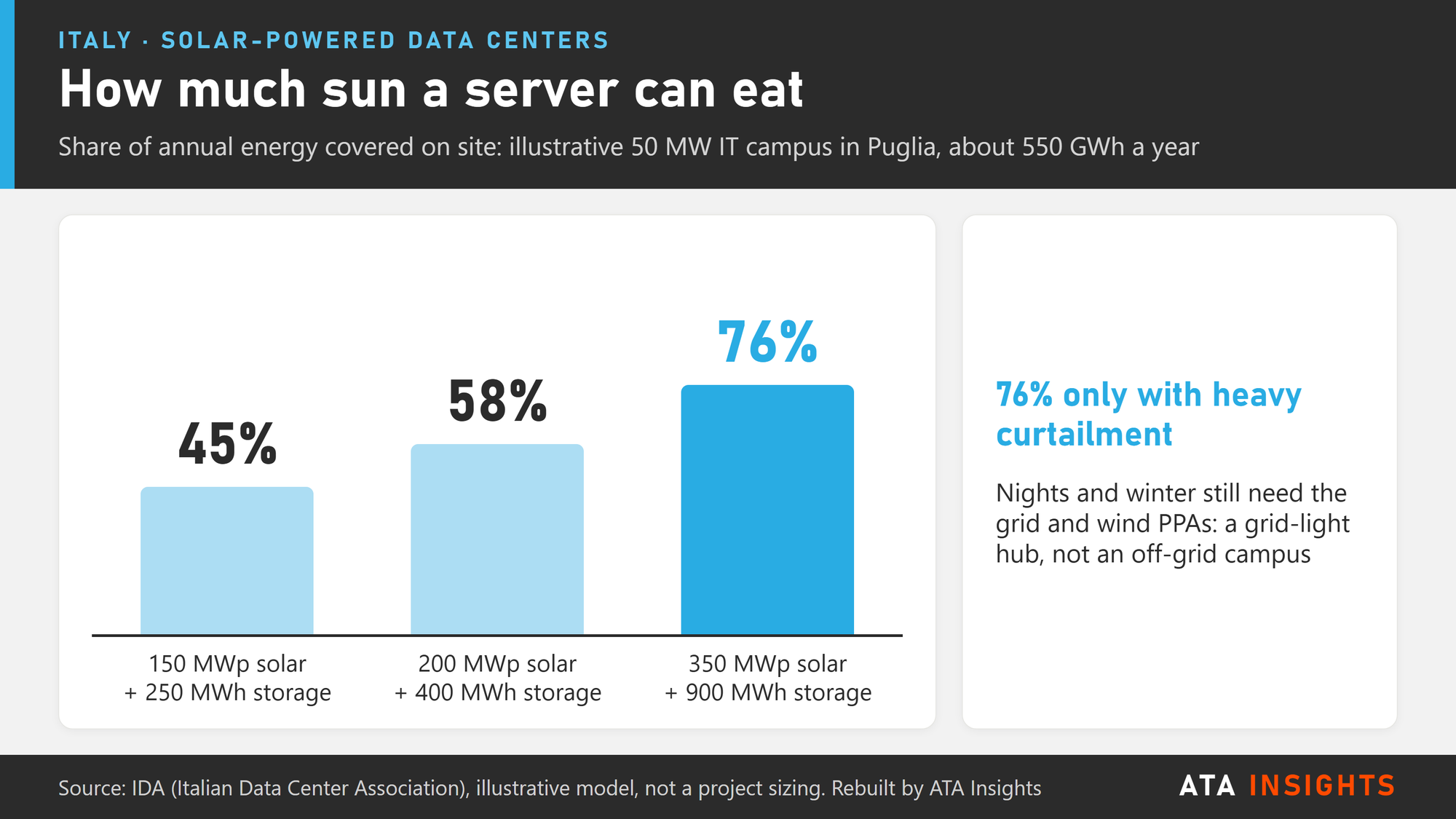
What the South cannot offer is a sunny night. IDA's illustrative model, explicitly not a project sizing, takes a 50 MW IT campus drawing about 550 GWh a year. Pair it with 150 MWp of solar and 250 MWh of storage and the site covers 45% of its annual energy on its own; 350 MWp and 900 MWh take it to 76%, and only by throwing away a great deal of midday output. Nights and winter still need the grid and wind PPAs. Hence IDA's careful choice of words: a grid-light energy-digital hub. Nobody is promising to cut the cord.
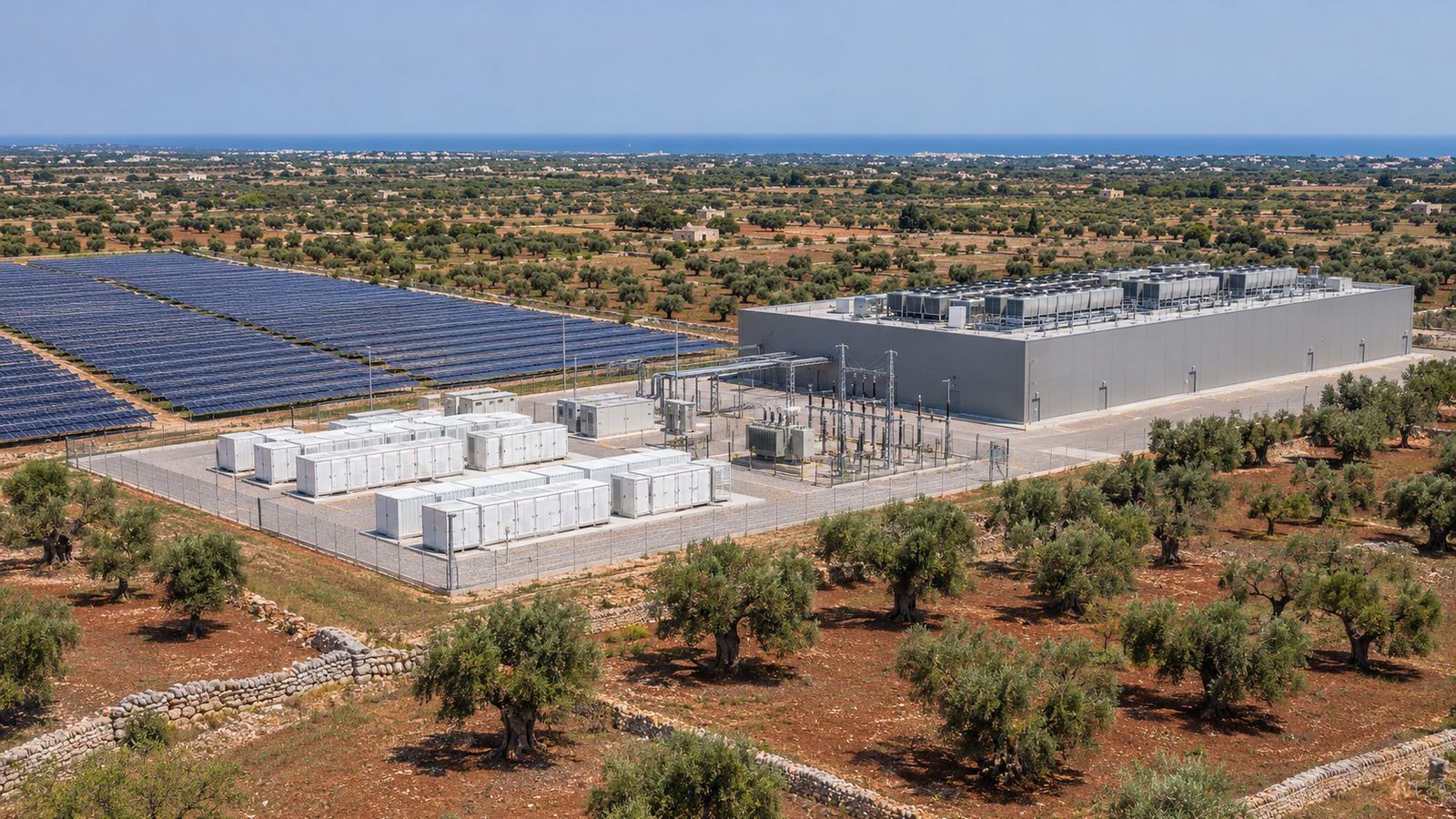
Room to manoeuvre
Serioli's rule is blunt: "We should all size the BESS against the electrical event, not on the DC load." The reflex is 100 MW of batteries for a 100 MW campus; the right question is which event the battery covers, for how long and how often. His example, illustrative but drawn from a live project, is a 90 MW AC system that needs a compound of 2,861 m², about 40% of a football pitch. On a crowded metropolitan campus, every one of those square metres comes out of the white space, the hall floor that tenants actually rent. Late integration, he warned, "usually requires a redesign", and delays in a data center mean "huge losses that no one wants to have."
A southern site beside a solar park has room to spare, but needs someone to fill it. "No one is looking for battery suppliers only… we are looking for integrators," Serioli said, and his candidates are the battery developers already in the market, who know grid connections and are used to permitting batteries, which, he admitted, data center developers are not. Those bidding into MACSE fit the description, and some hold projects that went home from round one without a contract.
From pilot to pattern
IDA's proposals, to be pursued with Terna, ARERA and the Ministry, are concrete: phased connections that recognise storage, faster permitting for batteries and for PPAs serving digital infrastructure, technical guidelines for batteries on mission-critical sites, and pilot energy-digital hubs in the South. In IDA's survey, permitting is the first constraint for 16 of the 18 operators, so faster permits matter most. And the headroom is wide: only three of the 18 cite batteries at all.
The pieces fit more neatly than either industry has yet admitted. For a storage developer, MACSE contracts become the floor of a portfolio, and a data center next door the upside for the capacity that does not win one. The data center gets PPA access to the cheapest midday power in one of Europe's priciest markets, plus room for its batteries. And Terna gets a load that brings its own shock absorber and plugs in by stages, a far easier request to approve than another block of raw demand in Lombardy.
Italy has spent years trying to send the South's sunshine north. It may prove quicker to send some of the North's servers south and let a battery broker the deal. Southern comfort, in the end, is a battery that is still full when the sun goes down.
These questions will be on the table at RENMAD Storage Italia, Bologna, 9–10 February 2027.
You reached this analysis because ATA Insights puts independent energy-transition intelligence in front of 86,000+ professionals across the sector. That's exactly what we do for funded projects, events and companies — turn your work into reach.
See how we disseminate work like this →Where this analysis came from
This piece draws on the ATA Insights / RENMAD webinar BESS for data centers: power, resilience & renewables. Watch the full session on demand.
The energy transition, in your inbox
Join 86,000+ professionals reading our independent briefings across five sectors.