
Stress-Testing Zero Carbon
A war in the Gulf has doubled gas prices and reopened Europe's oldest hydrogen argument: pay €6 for the green molecule, or €2 for the low-carbon one?

When Iran closed the Strait of Hormuz this spring, the price of European gas did what it always does in a crisis. The Dutch TTF benchmark, the contract that sets the cost of a molecule of methane across the continent, nearly doubled to above €60 per megawatt-hour by mid-March, with storage tanks barely a third full after a cold winter. For most industries that is a bill to dread. For the people building Europe's hydrogen economy it is something stranger: a live test of a question they had been arguing about on paper for two years.
The question is which colour of clean hydrogen Europe should bet on. There is the renewable kind, made by splitting water with wind and solar power, certified under the dense acronym RFNBO. And there is a newer category, "low-carbon" hydrogen, which can be made from natural gas with the carbon captured, from nuclear electricity, or from ordinary grid power, so long as the finished molecule emits 70% less than the fossil fuel it replaces. The first costs around €6 a kilo today. The second can be made for roughly €2. When gas was cheap, that gap looked like a temporary nuisance that subsidies would close. With gas this expensive and this jumpy, the gap looks like a strategic choice.
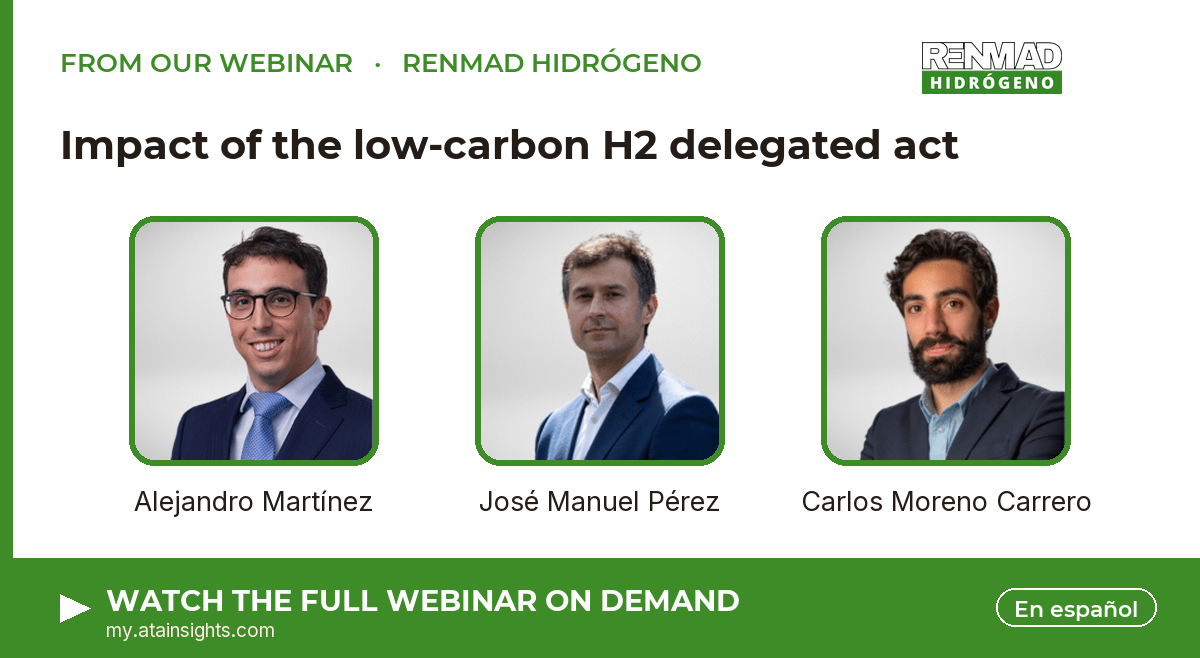
ATA Insights and RENMAD gathered three people who live inside that choice for a webinar on the European Union's low-carbon hydrogen delegated act, the rulebook that finally put numbers to the cheaper molecule. A lawyer to explain what the act actually says. A renewables developer who sees it as a threat. A refiner who sees it as a tool. Months on, with the Gulf in the headlines and the act now in force, their disagreement reads less like a regulatory seminar and more like a forecast.
What the act actually does
Start with the law, because the fight only makes sense once you see how narrow the drafting is. Alejandro Martínez, a senior associate at the law firm WFW, walked through it.
The renewable rules, he explained, already existed in two delegated regulations from 2023. The new act sits alongside them and does something deliberately parallel. "The difference is not so much its contribution to cutting greenhouse-gas emissions as the source from which it draws its energy content," Martínez said. Renewable hydrogen runs on renewable electricity. Low-carbon hydrogen runs on everything else that can still clear the 70% bar: gas with carbon capture, fossil feedstocks, electricity pulled straight from the grid.
One source did not make the cut. "The decision taken in adopting this text is not to allow the use of nuclear energy directly," Martínez said, "but to leave a window open to launch a public consultation before June 2026 and to review the impact of this technology before July 2028." A door left ajar rather than shut.
He was careful about timing, and here the webinar has aged in an instructive way. At the time of recording the act had been adopted by the Commission but still had to clear the European Parliament and Council. That hurdle is now behind it. Parliament chose not to object in a plenary vote in late October 2025, and the regulation entered into force in December. It came with assurances from the energy commissioner that renewable producers had been pressing for, including grandfathering for early projects and a promise to work out a method that would eventually let both nuclear and renewable power-purchase agreements count toward low-carbon production. In other words, the cheaper route is no longer hypothetical. It is law.
The developer's view: a definition is a market
José Manuel Pérez runs hydrogen regulation and government affairs for EDP, a utility whose Spanish business is built on wind, solar and grids, and which is converting its old coal plants into renewable projects. He did not hedge.
"We saw it, and we still see it, as a threat," Pérez said of the parallel category. His objection is subtle and worth following, because it is not really about emissions. It is about the power of a word. "The moment you create a definition of something," he said, "you create the need to place it, to promote it, and to enter into competition against RFNBO hydrogen."
For a country like Spain the worry sharpens. The cheap low-carbon route leans on nuclear power or natural gas, and Spanish energy policy is pointed at neither. A definition written in Brussels, Pérez argued, could let other member states set their own low-carbon quotas, open subsidy auctions to the gas-based molecule, and quietly relax the renewable targets that give green hydrogen its only real customer. He flagged a quieter danger too: depending on where the gas comes from, the lifecycle emissions of low-carbon hydrogen can be calculated as negative, a feat the renewable molecule, made from water and sunshine, can never match. The cheaper fuel could end up looking cleaner on paper than the clean one.
And yet Pérez was not asking for the act to be torn up. He was the one who put the hard number on the table. Gas-based hydrogen, he said, lands "at €2 a kilo, round," once you add the cost of the carbon, against an RFNBO molecule that a Spanish price index now pegs "at €6 a kilo at the least." He knows that gap will not be wished away, and he knows €6 hydrogen needs an obligation to buy it. So even EDP plans to use both. "The fundamental objective will be to produce as much RFNBO hydrogen as possible," he said, "but it will be extremely complicated and extremely expensive to produce 100% RFNBO." The last 10%, 20%, 30% of output that fails the strict renewable test would then be certified as low-carbon. A threat to be resisted in the law, used in the plant.
The refiner's view: a portfolio, not a purity test
Carlos Moreno, who analyses hydrogen regulation and certification at Repsol, builds from the same starting point and lands somewhere else. Spain's genuine edge, he agreed, is sun and wind, which makes renewable hydrogen the prize. "We perceive this delegated act as an opportunity for countries that perhaps do not have the competitive advantages in solar and wind that we have," he said. The act, on his reading, was written for somebody else's grid. The interesting part is what Spain can still pull from it.
Repsol's logic is that of a refiner that has to keep its plants running. "Repsol sees hydrogen as one more solution within a technologically neutral portfolio," Moreno said, sitting beside biofuels, recycled-carbon fuels and electricity. A refinery needs a steady supply of hydrogen, and pure renewable production, hostage to whether the wind blows, does not always provide it. So Repsol wants to make the maximum renewable hydrogen its solar and wind allow, and then certify the inevitable fossil-tinged tail as low-carbon rather than waste it. Why throw away a molecule, he asked in effect, that still cuts emissions 70% against diesel?
His real plea was for the boring machinery to work. The methods for splitting emissions across co-processing, where renewable, fossil and bio feedstocks pour into the same refinery unit, "do not become completely clear," he warned, and he wants the Commission to publish worked examples before anyone commits capital. He also wants Spain to publish the data that would let the cheaper grid route pay off at home, such as the hourly emissions factor of grid electricity, since Spanish power is already relatively clean. Get the plumbing right, he argued, and the rules reward exactly the kind of asset conversion the energy transition needs.
Moreno was alert to the same risk Pérez named, from the other side. If the low-carbon rulebook ends up more generous than the renewable one, he said, "Spain would really lose out." His comfort is the Commission's promise to keep the two methods aligned and to keep renewable hydrogen "preponderant" in the regulation. The deeper goal, he reminded everyone, is the one the war keeps underlining: after Ukraine, and now after Hormuz, Europe has learned what an "excessive dependence on external suppliers" costs, and the way out runs mostly through renewables.
The question the war answers
So: does the act open a door or move the goalposts? After this spring, the honest answer is both, and that is the point.
Move the goalposts, certainly, if you are the renewable developer. A €2 molecule with a state-issued definition behind it will compete for quotas and subsidies that green hydrogen was built to win. Every spike in the gas price makes the captured-gas route look temporarily painful too, which is the case for not betting the continent on it. The lesson of a Gulf war is not that cheap gas hydrogen is safe. It is that anything tied to a pipeline can be held hostage in a week.
But open a door, also, if you are honest about cost. Renewable hydrogen at €6 needs subsidy and obligation to find a buyer, and neither of those is guaranteed to arrive at scale on schedule. A cheaper, imperfect molecule that still cuts emissions by 70% is what keeps electrolysers running and refineries converting while the green premium slowly comes down. Both speakers, the threat-caller and the tool-user, ended up in the same practical place: maximum renewable, with a certified low-carbon tail. The argument was never really whether to use both. It was who gets to set the price of admission.
Europe spent two years stress-testing zero carbon on paper. The Strait of Hormuz did it in three weeks. The renewable molecule is still the one that owes nobody a pipeline. It just has to get cheap enough to prove the point before the next crisis makes it for everyone.
You reached this analysis because ATA Insights puts independent energy-transition intelligence in front of 86,000+ professionals across the sector. That's exactly what we do for funded projects, events and companies — turn your work into reach.
See how we disseminate work like this →Where this analysis came from
This piece draws on the ATA Insights / RENMAD webinar Impact of the low-carbon H2 delegated act. Watch the full session on demand.
The energy transition, in your inbox
Join 86,000+ professionals reading our independent briefings across five sectors.