
The battery that pays for itself
Spanish solar now earns less than half the average market price, and the money has found the remedy on the same plot of land: a battery. Each asset insures the other. The policy has just one awkward clause: both have to belong to the same owner
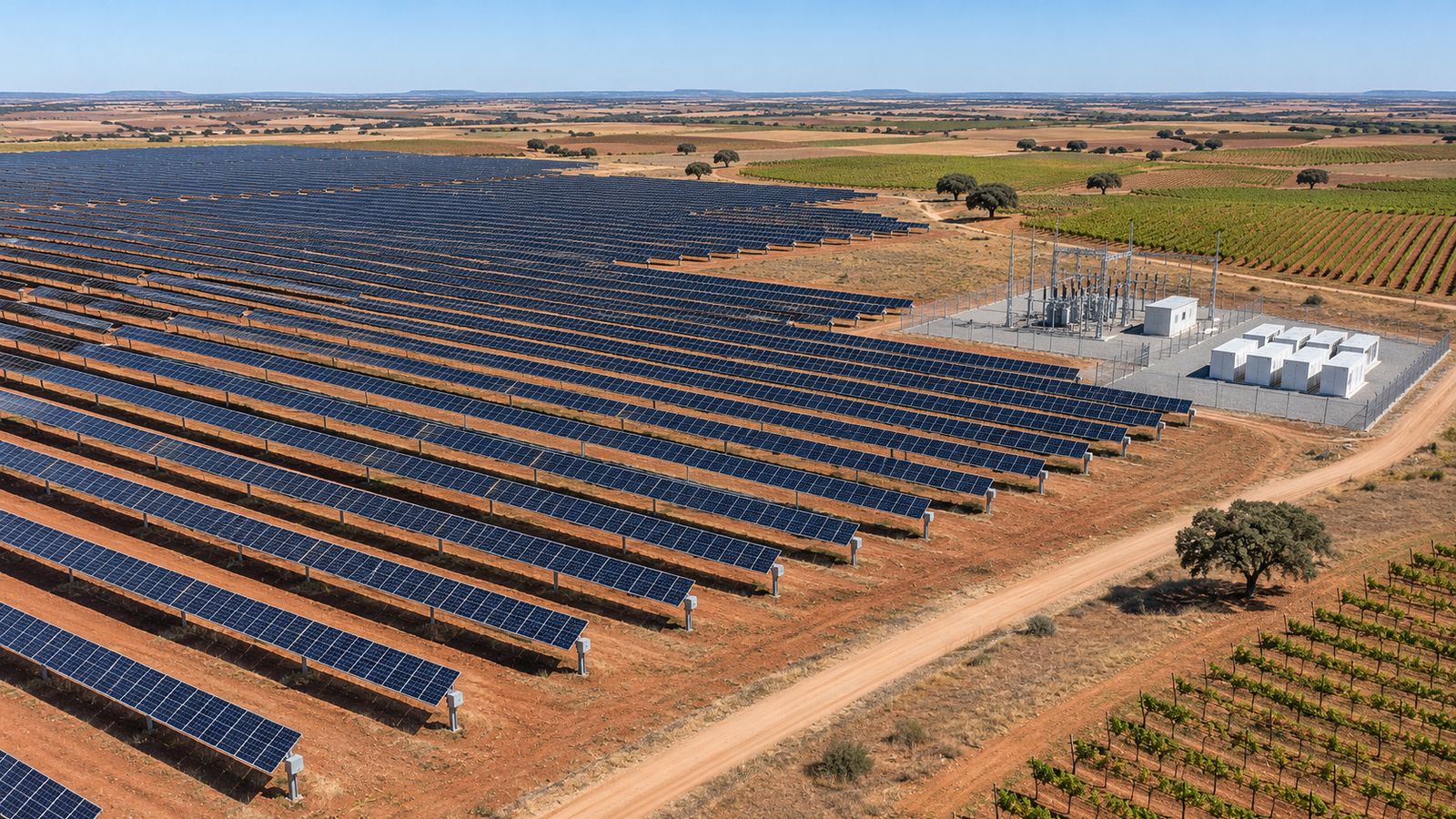
On 19 November in London, a listed Spanish solar company presented investors with a €440 million platform to install some 5 GWh of batteries before the end of 2028. The batteries will not go looking for new land. They will sit on the company's own operating solar plants, using the grid connections those plants already hold. The firm's chief executive argued that batteries double those plants' revenues, and the company reckons that hybridising saves it more than two years of permitting compared with starting from scratch.
The day before, at the RENMAD webinar "Who finances BESS? Banks, funds and private credit", a bank, a fund, an adviser and an optimiser had described the same move from the other side of the table. Miguel Ángel Amores of Triodos Bank summed it up in one line: "the battery […] is a hedge in itself". And what it hedges is the solar plant next door.
Solar is serving a free lunch
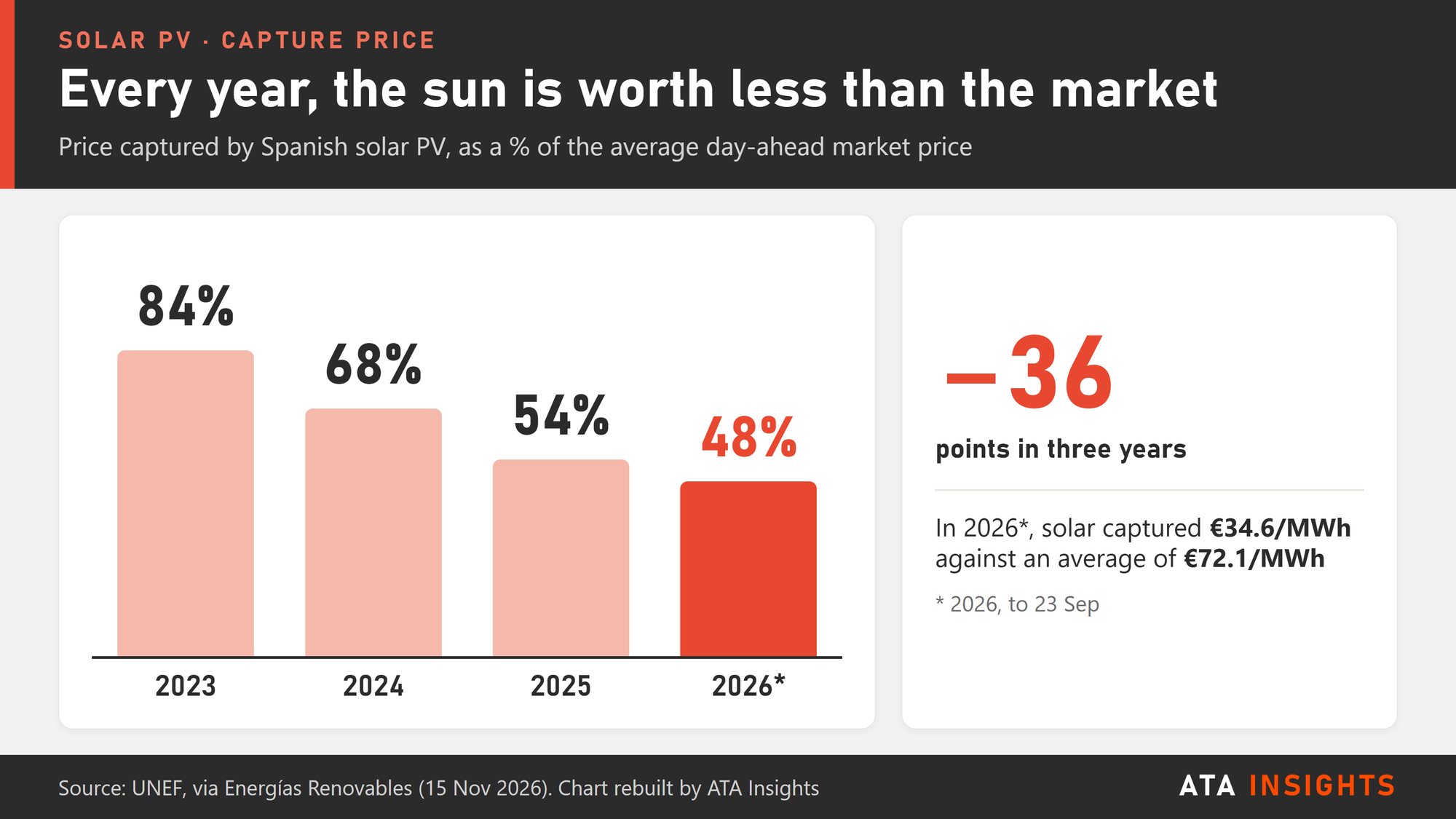
The damage is measured in capture price: what a plant actually earns for each MWh, set against the average price on the day-ahead market. According to UNEF, Spain's solar industry association, Spanish solar captured 84% of that average in 2023, 68% in 2024 and 54% in 2025. In 2026, up to 23 September, it captured 48%: €34.6/MWh against €72.1. By that date the year had clocked up 903 hours of zero or negative prices.
For anyone carrying debt, that percentage marks the line between paying and renegotiating. A study by the Universidad de las Hespérides, using its own methodology, put the capture price at end-August at €31.2/MWh. That is above the levelised cost of energy (€30.55), but below the €33.02 a typical plant needs to service its debt. The plant covers what it costs, not what it owes.
If expensive gas flatters the year-end figures, warned Chema Zabala of Alantra, it will be "a mirage": by his count another 7 GW of solar has been installed this year, and gas prices will not stay where they are. In October the day-ahead market paid an average of €82.88/MWh between 10:00 and 18:00, and €208.31 over the rest of the day. The battery lives off that €125 gap.
For richer, for poorer
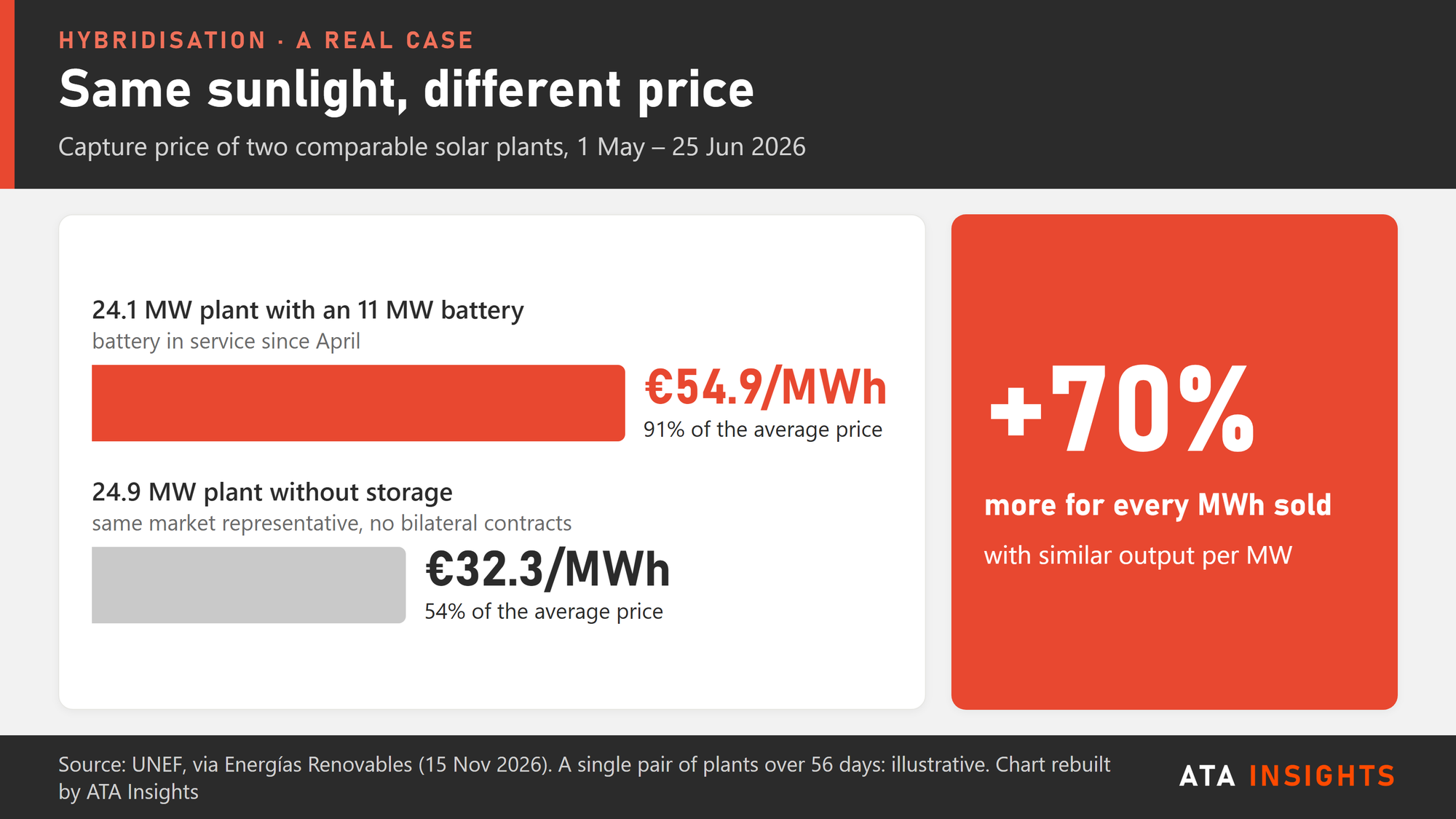
The mechanism is simple. The battery charges at midday, when energy is worth next to nothing, and discharges as the sun goes down, when prices peak. Between 1 May and 25 June, a 24.1 MW plant with an 11 MW battery captured €54.9/MWh, 91% of the average daily price. A 24.9 MW plant without storage, with the same route-to-market provider and no bilateral contracts, managed €32.3/MWh, or 54%. With similar output per megawatt, the first earned 70% more for every MWh.
What lenders like is that the hedge works in both directions. If solar keeps growing and midday prices sink further, the battery has a wider spread to arbitrage. If instead the spread narrows, the solar plant's prices recover, because plenty of storage means, as Optimize Energy's head of markets pointed out, more demand in the middle of the day. The two assets sit "within the same financing perimeter", in Mr Amores's words, and the hybrid ends up balancing itself out. Mr Zabala got there too from the market side, with one caveat. "The first thing they will do," he said of batteries, "is shave off the highest prices," and the effect on low prices will take a good deal longer. Even so, a hybrid that can charge from the grid, with a battery sized to the plant, is "a very resilient asset".
That symmetry changes the conversation with the bank. A solar plant without a battery is usually expected to contract around 70% of its revenues. Mr Amores thinks a hybrid can go lower, with a hybrid PPA of about ten years and an investment-grade counterparty. And Triodos counts that PPA as contracted revenue, the slice on which it demands the thinnest cushion over debt service.
The risk models have yet to catch up. Optimize Energy's head of markets put the awkward question about the classic "low case", the pessimistic solar price scenario used to size the debt: "how does that low case, with low prices, translate into a battery asset?" In a hybrid, a bad scenario for one asset tends to be a good one for the other, and Mr Zabala conceded that the bankability scenarios of the past are probably not the right yardstick.
The money has already found its match
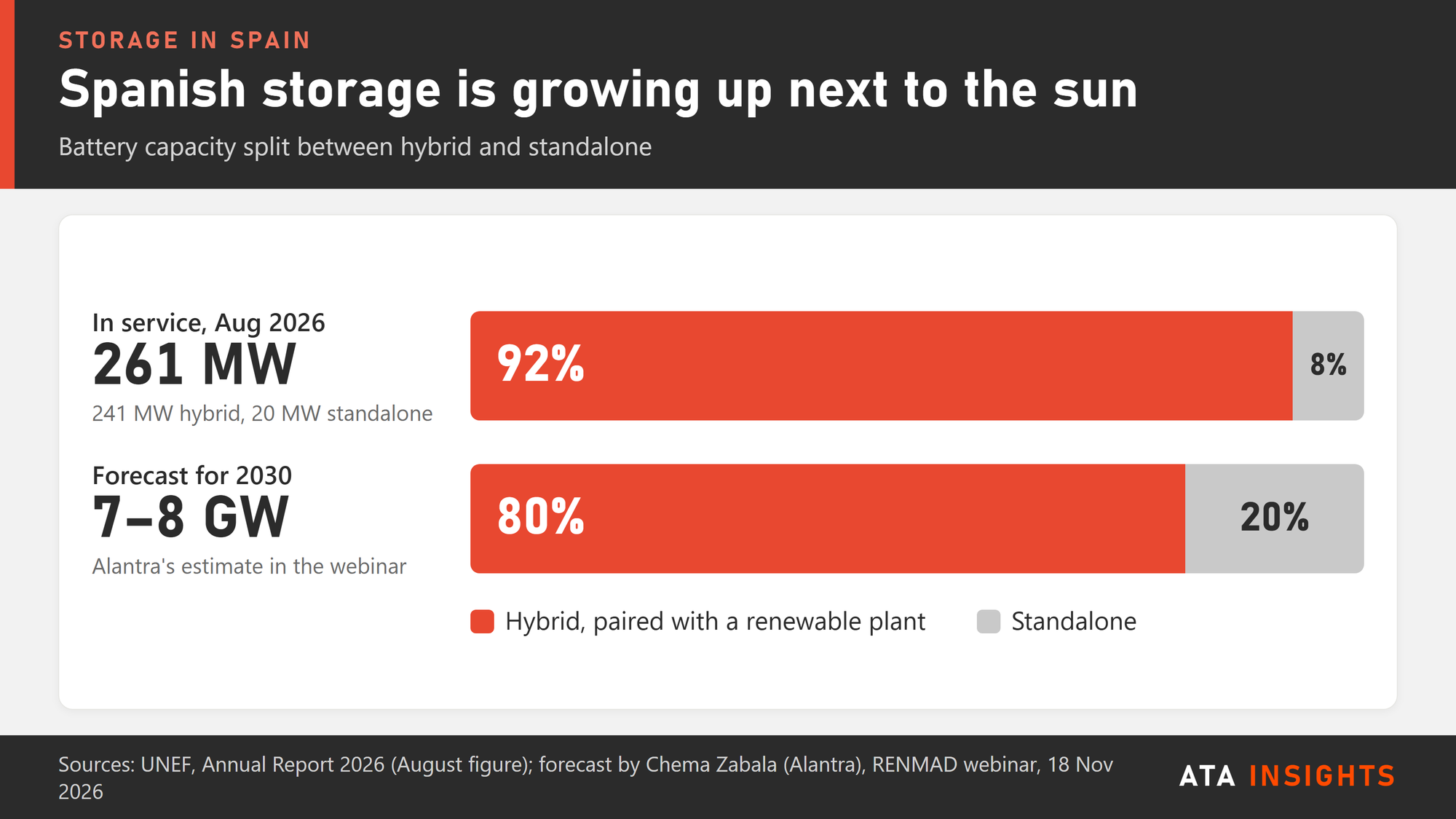
Of the 261 MW of batteries in service that UNEF counted at the end of August, 241 MW were hybrid and only 20 MW standalone. The installed base is small; the queue is far longer. According to Mr Zabala, close to 25 GW of hybrid storage holds access and connection permits, against about 8.5 GW of standalone storage (batteries connected to the grid on their own), down from close to 10 GW and still falling as projects drop out. His forecast for 2030 is 7 to 8 GW in operation, 80% of it hybrid.
The reasons are mostly red tape. Adding batteries to a plant that already has grid access "is a right", Mr Zabala pointed out. A standalone project has to find room on a saturated grid and cannot claim public-utility status, the designation that makes it easier to build the export line. The hybrid also skips much of the permitting, which Miguel Lizaso of A&G Global Investors calls the factor "nobody can quantify, either in timing or in conditions". Mr Lizaso sees a battery beside solar as "a natural hedge for the business plan".
The banks have a motive of their own, too. Mr Amores hopes his peers at other banks will see hybridisation as "an opportunity to fix a situation that has already been created": solar portfolios capturing less than their models promised. Early this year an 858 MW portfolio of operating solar was refinanced on a non-recourse basis for €474 million, with an accordion tranche (an expandable facility) to build up to 650 MW of batteries within the same debt perimeter. And Mr Zabala said that in Spain's first hybrid refinancings, risk committees have accepted fixed delivery profiles and even baseload structures, the same energy every hour of the day.
The small print: no prenups
The policy comes with a condition, and it is no small one. "The general rule," Mr Amores explained, is that the owner of the solar plant and of the storage "has to be the same". Mr Lizaso gave the regulatory reason: "a hybrid has a single grid connection point, so for regulatory purposes there can only be one owner." Splitting the flows afterwards strikes him as inefficient, and it risks losing the very value being sought: "We see it as a single asset." Lawyers are working on structures with two owners, Mr Amores admitted, but their bankability has yet to be proven.
If the plant already carries debt, there are three ways out: the existing lender extends its financing, it lets another lender in pari passu (something "delicate", in Mr Amores's view), or a new bank refinances the lot. For a small owner short of cash, like the one who asked from the audience, none of that is a formality. Mr Zabala sees an opening there for debt funds, which cost more: a two-to-four-year bridge for developers who are not at the top of the banks' lists, until the asset matures and can be refinanced by commercial banks. There is no shortage of candidates: more than 50 GW of solar whose owners will, some more keenly than others, weigh up adding storage.
What this means if you own a solar plant
If you have solar in your portfolio, the battery is probably your best argument for refinancing. It comes with two strings attached. First, a balance sheet able to put up capital: for a 100 MW battery project, Mr Amores spoke of around 50% equity. Second, a good optimiser to run it, because in the UK, according to Optimize Energy, the "difference between the best and the worst optimiser" has been as wide as ten to one. The panel closed on the question everything else hangs on: "What structure is a bank or a lender actually going to believe in?" RENMAD Invest, in Madrid on 26 January 2027, will be a chance to keep looking for the answer.
Meanwhile, the plant that sells cheap at noon and the battery that sells dear after dark cover for each other, in sickness, in health and in a price slump. Joint names only, mind. Sign a prenup and the policy does not pay.
You reached this analysis because ATA Insights puts independent energy-transition intelligence in front of 86,000+ professionals across the sector. That's exactly what we do for funded projects, events and companies — turn your work into reach.
See how we disseminate work like this →Where this analysis came from
This piece draws on the ATA Insights / RENMAD webinar Who finances BESS? Banks, funds and private credit. Watch the full session on demand.
The energy transition, in your inbox
Join 86,000+ professionals reading our independent briefings across five sectors.