
The loved project is the bankable project
In rural Spain, social licence has quietly become a financial metric. The projects communities want get built faster, cheaper and with easier financing — and biomethane holds the best hand of any renewable to earn it.
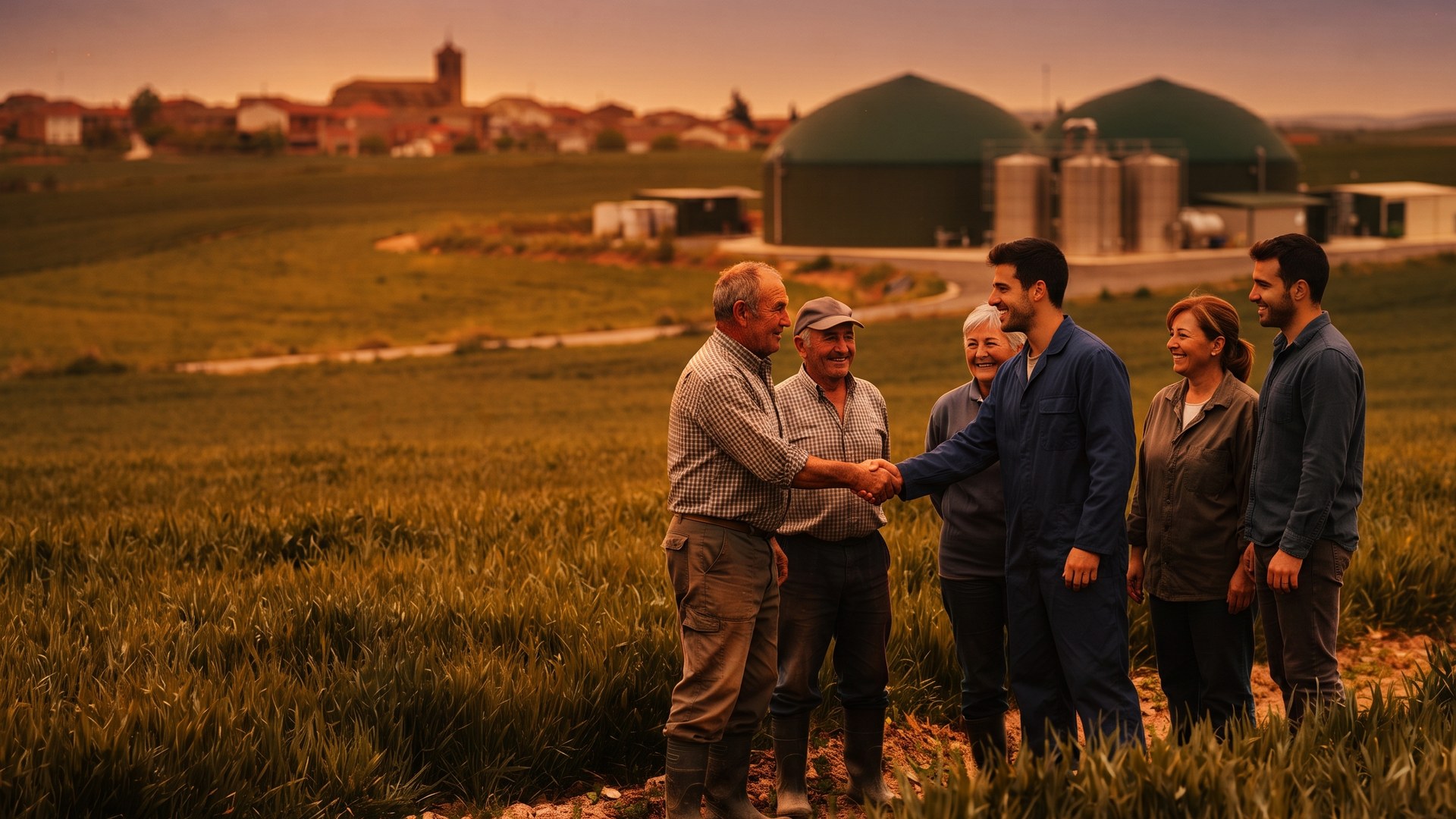
Spain has installed around 95 GW of renewables and now draws more than half its electricity from them: 55.5% in 2025, according to Red Eléctrica. The next frontier, though, is not measured in megawatts. It is whether the countryside moves from tolerating the energy transition to actively asking for it — and that shift is worth money.
The evidence is starting to be quantified. Work from the Institute of Regional Development at the University of Granada finds acceptance rises by 30–35% when a territory perceives a genuine economic or environmental return from a project. Since social conflict is paid for in years of delay, every month of early groundwork on the ground is among the most profitable investments in the pipeline. As RENMAD Biometano's recent deep dive on social licence put it: the loved project is also the fastest, the cheapest and the most financeable. Banks already look at it; soon they will require it.
The licence you can't get at a window
The distinction that reframes the whole discussion came from David Muñoz Sánchez, territorial delegate at Naturgy Renovables. "The town hall gives you the administrative licence; it doesn't give you the social licence," he said. "That second licence isn't requested at a window — it's built."
Building it, he and Inés Monroy — founder of Licencia Social Energía — argued, follows a surprisingly concrete playbook. Arrive before the project, with a specialist team and its own budget, present in the territory before any design or paperwork. Design with the community rather than for it, and treat a well-timed "no" as a win too. Plug into the rural economy that already exists instead of landing on top of it. Treat the relationship as a thirty-year conversation, where credibility is earned only by keeping what was agreed. And measure the invisible work — community hours, response times — as KPIs as real as any permitting milestone.
The sheep nursery that guarded a solar farm
Muñoz's proof point was not a biomethane plant but a 300-hectare solar farm, where six livestock families still graze their flocks inside the fence — with access cards, water troughs and dedicated gates. When a small fire started, it was those herders who arrived first, with tractors and water tanks, to defend the plant. When the war in Ukraine sent feed prices soaring, the company sowed pasture in the free space and bought the green harvest from local farmers. "I no longer know whether it's a solar farm or a sheep nursery," Muñoz joked. The infrastructure had become a neighbour.
The lesson travels to biomethane with interest. If a solar plant can be embraced by weaving itself into the farm economy, a plant whose very feedstock is that economy starts with the work half done.
Biomethane's structural advantage
That is the crux of the financial case. Biomethane does not have to compensate the territory, because it is not an installation that lands on the countryside — it is, structurally, an agricultural business. Its raw material is produced by the village, its fertiliser returns to the village, and its jobs stay in the village. Manure management stops being a regulatory cost and becomes a recurring income line for the farmer; digestate replaces bought mineral fertiliser; where nitrate pressure bites, the plant decontaminates rather than occupies. As the deep dive put it: the farmer is not the affected neighbour — he is supplier, client and, in the best designs, partner.
That structural advantage is precisely what a lender wants to see de-risked. A biomethane project that has secured its feedstock agreements, its digestate outlet and its community relationships has removed the very uncertainties — social opposition, permitting delay, an outlet for the by-product — that sink returns. The "soft" work of social licence turns out to harden the numbers.
The regulator lines up a prize
And the incentive is on its way. Regulatory work under way in Spain will create a standard of social, territorial and environmental excellence; those who can certify it will be better placed on the three issues that keep the sector awake — grid access and connection, priority in processing, and regulated tariffs — with biomethane earmarked for special consideration within that framework.
Put together, the message to developers is that social licence has crossed from the CSR slide into the financial model. The countryside is not an obstacle to be managed but an asset to be earned; and biomethane, uniquely, arrives solving a problem the village already had. You don't win that with brochures. You win it with early presence, shared design, promises kept and a return people can see and touch. The manual exists, the data back it, and the regulator is already preparing the prize. The projects that internalise this won't just be the most welcome — they will be the ones that get financed.
David Muñoz Sánchez (Naturgy Renovables) and Inés Monroy (Licencia Social Energía) spoke at the RENMAD Biometano webinar on social licence on 21 May 2026, moderated by Belén Gallego (ATA Insights).
You reached this analysis because ATA Insights puts independent energy-transition intelligence in front of 86,000+ professionals across the sector. That's exactly what we do for funded projects, events and companies — turn your work into reach.
See how we disseminate work like this →Where this analysis came from
This piece draws on the ATA Insights / RENMAD webinar The strategic key for energy projects: how social support decides success (or failure). Watch the full session on demand.
The energy transition, in your inbox
Join 86,000+ professionals reading our independent briefings across five sectors.