
The million-euro decimal point: why PUE, not planning permission, now decides an Italian data centre's margin
Italy is sitting on 96 GW of data-centre connection requests and a grid that peaks near 60. Now that permitting has been compressed, the number separating a fundable project from a stranded one is a ratio most boards have never had to read.
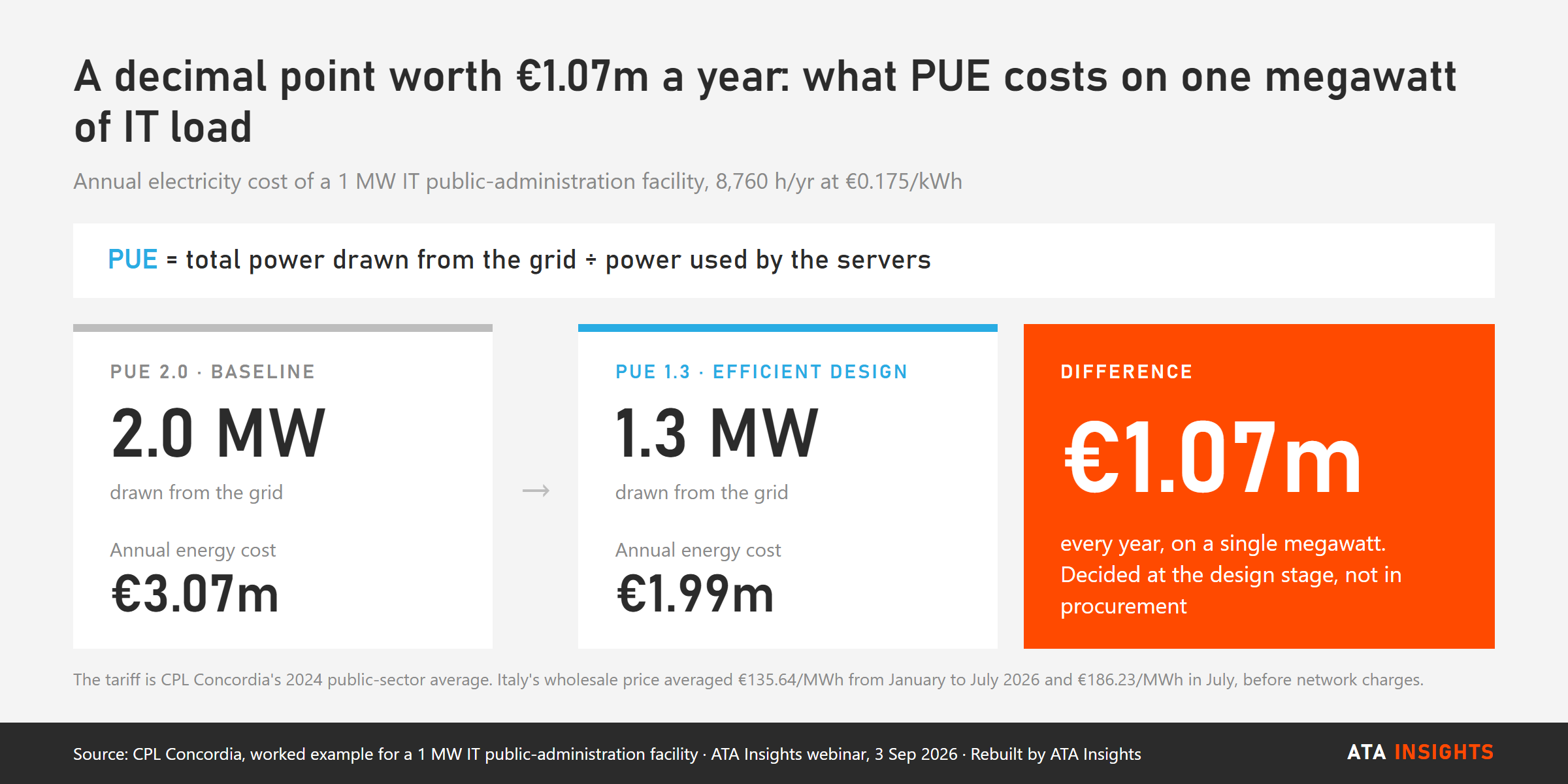
Between 1.3 and 2.0 sits a million euros a year.
That is the distance, on a single megawatt of IT load, between a well-engineered Italian data centre and a merely functional one. Neither procurement nor running the plant harder recovers it; it is decided years earlier, on a drawing.
The ratio is PUE — power usage effectiveness, total power drawn from the grid divided by the power that actually reaches the servers. At PUE 2.0, every kilowatt spinning a server drags a second one behind it into cooling, UPS losses and lighting. Salvatore Bustelli, commercial lead for BESS and data centres at CPL Concordia, put the arithmetic on screen at an ATA Insights webinar on 3 September: a 1 MW IT public-sector facility running 8,760 hours a year at €0.175/kWh costs €3.07m to power at PUE 2.0 and €1.99m at PUE 1.3. The gap is €1.07m a year, found entirely in a decimal point.
That assumption is now the conservative one: Italy's wholesale price averaged €135.64/MWh over the first seven months of 2026 and €186.23/MWh in July alone, before network charges. The gap is widening.
"The first cost item in a data centre's operation is the cost of the electricity that runs it," said Sabina Pinto, chief executive of Redelfi, the Milan-listed developer building battery storage in Italy and the US and data centres at home. Her deck puts it more bluntly: energy is not an operating cost but a condition of development.
Where the money actually goes
Roughly 70% of a data centre's consumption is the IT load. The remaining 30% — cooling and electrical infrastructure — is the only part an engineer can argue with, and where the entire million euros lives. It is also a thermal problem, not an electrical one. "More than 90% of the electricity that reaches a GPU or a CPU is converted into heat," Bustelli noted. Everything spent above the IT load is the cost of moving that heat somewhere else.
The market is not one asset class, either. A public-administration rack draws 3–10 kW, telco and edge 5–20 kW, AI and hyperscale over 100 kW. Move from a 5 kW public-sector rack to a 120 kW GPU cluster and the electrical distribution, cooling regime, structural loading and UPS all change. Specify the wrong one and you have bought a cooling system that quietly costs the decimal point for twenty years.
Turning the heat into the hedge
The 30% is unusually tractable, and Italy already has the plant to attack it. CPL's reference case is a trigeneration plant at a leading Italian colocation operator: 2 MW electrical and 1.5 MW thermal as chilled water, with heat recovered from the engine exhaust and cooling circuit driving absorption chillers. Waste heat becomes cold, self-production displaces grid draw and the PUE falls with both. The reciprocating engines underneath are already rated to blend up to 20% hydrogen, so the asset is not a stranded bet on gas.
Beyond the fence, that heat is worth money to somebody else. Pinto pointed to closed-loop cooling and district heating as the destination for recovered warmth — widening the perspective, as she put it, beyond cooling the building to sending the heat somewhere it generates value again.
Storage does the rest, though it pays to be precise about what it does. It shaves peaks, cuts micro-interruptions, keeps diesel generators from starting and opens the ancillary-services markets. It does not replace the grid, and neither regulation nor physics lets it delete the UPS or the diesel — it resizes them. "A BESS is equipment that supports the energy strategy behind a data centre," said Bustelli. That is a specification, not a disappointment — and the version that gets financed.
Redelfi is building exactly that in Lombardy: a data centre and a battery designed as one site, not as neighbours. "It isn't a matter of putting a BESS alongside in case it's needed," Pinto said. "It's an integrated development of demand, power and the relationship with the grid."
The decimal point goes public
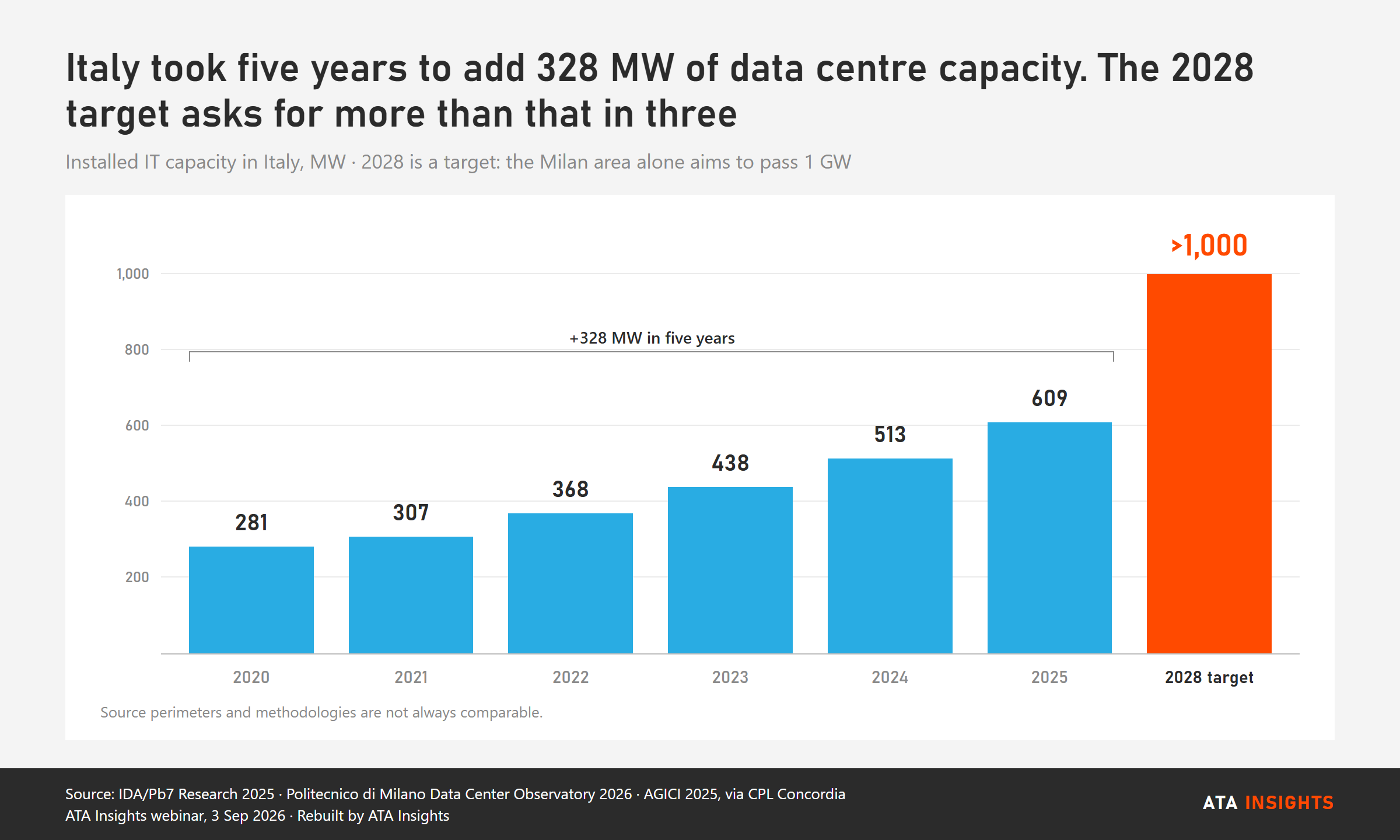
Timing has made this urgent. February's DL Bollette created a single national authorisation with a 10–13 month ceiling, removing permitting as the binding constraint and leaving power alone in its place. Terna held 529 connection applications for 95.86 GW at the end of July, against national peak demand near 60 GW. The Milan area alone runs 414 MW, 68% of Italy's installed capacity, with another 318 MW under construction and some 600 MW more in environmental assessment. All compete for the same electrons, and those arriving with their own generation, storage and heat strategy are cheaper to run and easier to consent: Pinto was explicit that building cogeneration, solar or storage in from the outset materially improves a scheme's environmental assessment.
The number is about to stop being private. Under Article 12 of the EU Energy Efficiency Directive, every European facility above 500 kW of IT load now reports PUE, water usage, energy reuse factor and renewable share into a common European database; the latest annual deadline passed on 15 May.
PUE spent a decade as a line in a sustainability report. At €1.07m per megawatt, in a queue where only buildable projects survive, it is now the business case — and Italy's data centres are about to find that efficiency is not what you disclose, but what you can afford to build.
Salvatore Bustelli (CPL Concordia) and Sabina Pinto (Redelfi) spoke at the ATA Insights webinar "Alimentare i data center: garantire l'energia per l'economia digitale". Both will be at RENMAD Datacenters Italia, Milan, 11–12 November 2026.
You reached this analysis because ATA Insights puts independent energy-transition intelligence in front of 86,000+ professionals across the sector. That's exactly what we do for funded projects, events and companies — turn your work into reach.
See how we disseminate work like this →Where this analysis came from
This piece draws on the ATA Insights / RENMAD webinar Powering data centres: securing energy for the digital economy. Watch the full session on demand.

The energy transition, in your inbox
Join 86,000+ professionals reading our independent briefings across five sectors.