
The Neighbour Worth Having
Spain's biomethane boom keeps stalling at the town-hall door. The fix is not better engineering — it's a better conversation.
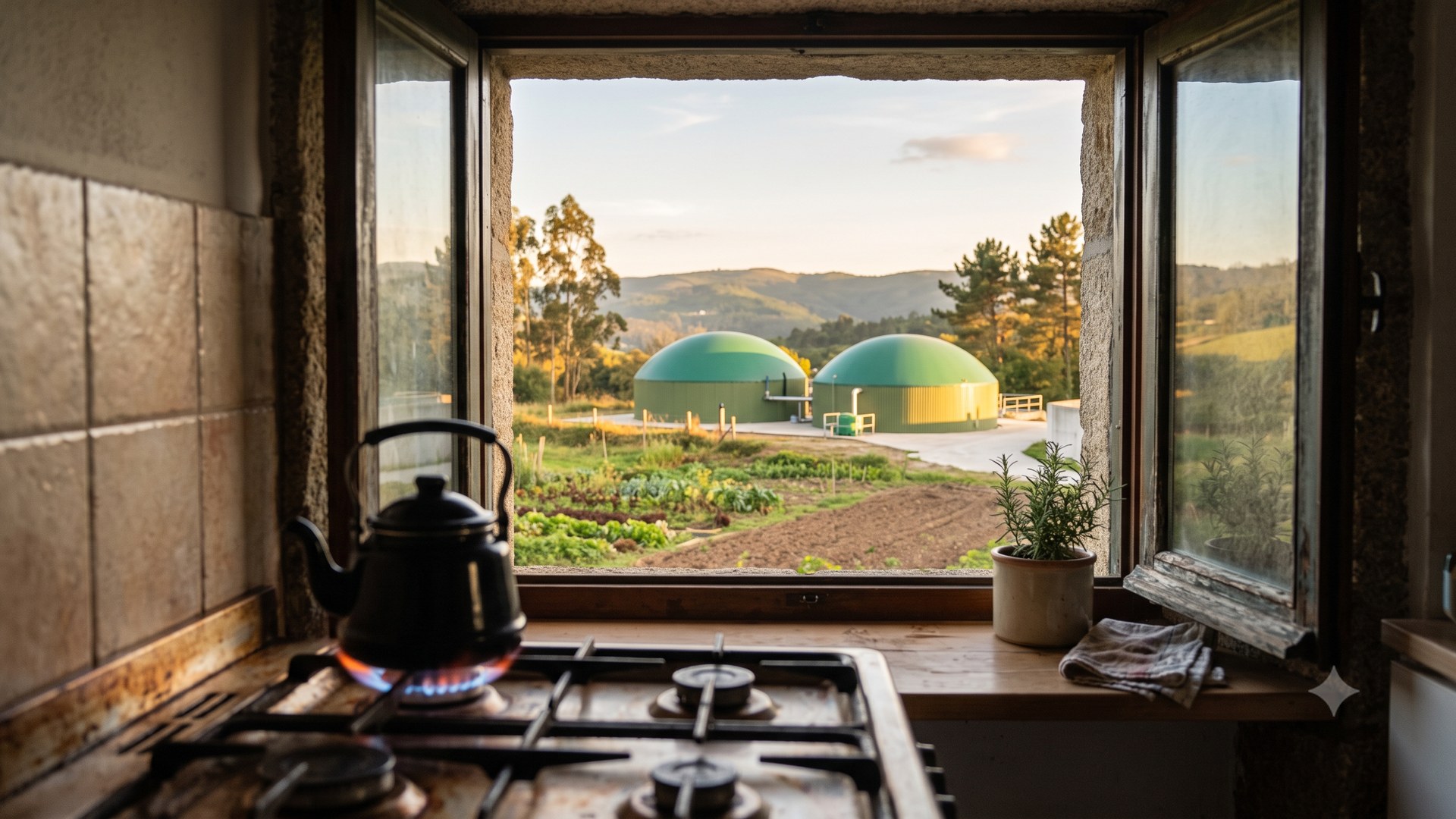
A village in Castilla-La Mancha will spend the next decade deciding whether the lorry that passes twice a day is carrying its future or threatening its peace. The lorry brings slurry, food scraps and crop waste to a digester that turns them into gas and fertiliser. On paper it is one of the cleanest things that will ever happen near that village. In practice it may never get built, because somewhere between the planning notice and the first public meeting, fear arrived faster than facts.
Spain has more than a hundred biomethane projects in development and a queue of grid connections waiting behind them. The technical case for each is settled. The financing, increasingly, is there. What stops shovels going into the ground, over and over, is the same thing: a community that has decided, before anyone explained otherwise, that it does not want the plant. Social rejection is now the single biggest brake on Spanish biomethane permitting. And the uncomfortable, hopeful truth running through a recent ATA Insights webinar, "Biometano seguro, sostenible y socialmente responsable," is that this is not really a safety problem at all. It is a communication gap wearing a safety costume.
Two people who build and run these plants for a living spent an hour saying so, plainly. Amaya Arias-García, chief operating officer at Heygaz, has built or operated more than fifty plants and visited some two hundred across Canada, Australia and Europe. Buenaventura Gómez, biomethane development director at ID Energy Group, has plants running in Poland with, in his words, zero recorded incidents. Luis Puchades Rufino, president of the Spanish biogas association AEBIG, hosted. None of them sounded like people on the defensive. They sounded like people who have seen how the story ends elsewhere, and cannot understand why Spain insists on rewriting the beginning.
A plant that holds its breath
Start with what is actually inside the fence. The mental image most people carry — a vast tank of explosive gas sitting on the edge of town — is wrong in a way that matters. These plants barely store gas at all.
"The domes you see don't hold more than three hours of storage," Gómez explained. Gas is produced and, within a couple of hours, it is gone: injected into the national grid as biomethane, or burned in a co-generation engine, or fed to a boiler. "The plants have no storage capacity beyond two hours." A facility that empties itself every two hours is a very different animal from the gas bomb of the public imagination.
That is also why the dreaded Seveso directive — the EU's rulebook for genuinely dangerous industrial sites — keeps drifting in and out of the conversation without ever landing. Arias-García has spent close to fifteen years doing Seveso analysis. "I have never come across a biogas plant that the Seveso directive applies to," she said. To trip those thresholds you need a quantity of hazardous product on site that these plants simply never accumulate. The gas is made, then it leaves. There is nothing to pile up.
And the gas itself? It is the same methane already running under every Spanish street. "In our homes we all have gas around us, below us, above us," Arias-García pointed out. "If you live in a flat, gas reaches every home. We're talking about the same gas that reaches our houses, that runs through our cities." The fear, she added, deserves to be respected — fear is a terrible thing to live with — but in this case it has been manufactured out of unfamiliarity, not danger.
The explosion that wasn't
Every industry has its cautionary photograph, and biogas has one too: a plant in England, a column of flame, the word "explosion." Both speakers put it on screen. Then Arias-García, who happened to know the site well, took it apart.
"In reality it wasn't an explosion. This was in Oxford, and I knew this plant very well. What actually happened was a fireball. It didn't reach the point of exploding. There were no injuries." A digester had been struck by lightning. The cause of the damage was not the technology working as designed; it was a single piece of protective kit that had been left off.
"This could have been mitigated very easily if they had installed a lightning rod," she said. "The people working at this plant didn't believe a lightning rod was necessary." A second plant belonging to the same company had already had the same problem. A metal pole — the humblest item in the whole catalogue of industrial safety — would have prevented both.
What the incident damaged, in the end, was not people. It was reputation. "It did a lot of harm to the industry," Arias-García said, and an economic loss on top. This is the quiet injustice the sector lives with: a preventable, injury-free event becomes a permanent slide in someone else's objection deck, while the lightning rod that would have stopped it goes unmentioned.
Gómez's plants assume exactly this kind of external threat. The lightning rod is chosen for the specific strike probability of the site; the design is built around five core risks and eight redundant layers of protection, each one catching what the last might miss. "These plants are safe," he said, "as long as they are well designed and well operated." That conditional is the whole job. It is also, conveniently, entirely within the industry's control.
We have done this before
If all of this sounds like an argument the sector is destined to lose, history says otherwise — and Puchades reached for a memory to prove it.
"I remember, because I'm quite old," he said, "that when Europe forced us to install wastewater treatment plants, nobody — no municipality — wanted them in their area. And in the end they were installed, they're working, and society is grateful for the treated wastewater." He drew the parallel with a smile. "If back then we solved the problem of the waste produced by two-legged creatures, now it's our turn to do the same — but with the four-legged ones."
The point is not nostalgia. It is precedent. A sewage works is, by any honest measure, a less appealing neighbour than a biomethane plant, and Spain learned to live beside thousands of them. Arias-García made the same case from the other direction: many wastewater treatment plants are themselves biogas plants, sitting quietly close to housing. "Nobody knows they're there, and there's no problem."
The lesson both drew is that proximity is an engineering choice, not a hazard. "If the plant is well designed, it can be placed near the population," Arias-García said. "In fact, we have them." The reflex to push every plant far from town treats a communication failure as if it were a physics one.
The benefit you can spread on a field
The conversation's most persuasive stretch had nothing to do with what might go wrong and everything to do with what plainly goes right. A biomethane plant does not only make gas. It hands the surrounding farmland a better version of something it is already using.
Right now, Arias-García explained, livestock farmers spread raw slurry on their fields. "We take it on loan. We strip out some of the carbon and the odours, we stabilise it, and we give it back." What returns is digestate — and it is the same nutrients, in a chemistry the soil can actually use. "When raw slurry goes onto the land, those nutrients are lost to the water much more easily. When we give back what we borrowed, it's in a form that is much more favourable for the land." Fewer emissions on the way in, more available nitrogen on the way out. The plant is a nutrient laundry for the whole district.
Here Spain is quietly handicapping itself. The country's rules still treat liquid digestate as a waste to be managed rather than a fertiliser to be used, forcing costly treatment that can sink a project's economics. Both speakers pointed to the same neighbour for the answer. "We don't have to look very far — we look to Portugal," said Gómez, where digestate reaches "end-of-waste" status and can go straight onto the field. Spain's national fertiliser register, he argued, should already have a category for liquid digestate and does not. Closing that gap is administrative, not technical. The benefit is sitting there, waiting for a signature.
The real safety system
Asked directly how the public's worries should be handled, the speakers reframed the question rather than ducking it. The biggest fear people raise, Arias-García noted, is hydrogen sulphide — and yes, in large quantities it can kill. But in these plants it is produced "in such small quantities that no accidents happen," and where it does appear it is scrubbed out anyway, mostly because it ages the engines and the membranes, not the neighbours. The danger people name is real in the abstract and vanishingly small in the plant.
Gómez offered the line the whole sector should tape to its wall. "I think the real alert," he said, "is the information reaching society — or rather, the disinformation. And that alert should trigger our safety system as an industry." Treat the rumour like a gas leak. Detect it, respond fast, and not only at the ministerial level but street by street, town hall by town hall, explaining what the plant actually does and what it gives back.
Arias-García, who has watched this play out on four continents, was blunt about how unusual Spain's reaction is. "What I'm seeing in Spain, I haven't seen anywhere else." Elsewhere — Poland, Hungary, soon Portugal — the plants go up without the dread, because the explaining was done first. The fix she named is not a new valve or a thicker wall. "The key is to educate, and to stop those fears from growing." Do that, she argued, and the suffering on the other side dissolves too: it is no fun to sit in your own home convinced something nearby is about to wreck your way of life, when nothing of the sort is coming.
This autumn the conversation gets a venue. An EOI-ATA workshop on the social licence of biomethane is built squarely around the gap these speakers kept circling — the distance between what a plant is and what a town fears it is. It is the right room at the right moment.
Picture, then, the village ten years on. The lorry still passes twice a day. The fields drink a cleaner fertiliser. The slurry that used to run off into the groundwater now comes back as something the soil can hold. The plant injects gas that would otherwise have been imported, and the town that once gathered to keep it out is the one whose name appears, with a certain pride, on the supplier's map. The neighbours who fought hardest tend to become the loudest hosts — once they discover what they were fighting. From most resented to most wanted: it has happened with sewage, and it will happen here. The only question is how many good projects Spain loses while it relearns a lesson it already knows.
You reached this analysis because ATA Insights puts independent energy-transition intelligence in front of 86,000+ professionals across the sector. That's exactly what we do for funded projects, events and companies — turn your work into reach.
See how we disseminate work like this →Where this analysis came from
This piece draws on the ATA Insights / RENMAD webinar Biomethane: safe, sustainable & socially responsible. Watch the full session on demand.
The energy transition, in your inbox
Join 86,000+ professionals reading our independent briefings across five sectors.