
The Pipeline That Outruns the Demand
Europe has lined up more renewable hydrogen than its own rules will oblige anyone to buy. The projects that survive to 2030 will be the ones chained to demand that is already mandated, not merely hoped for.
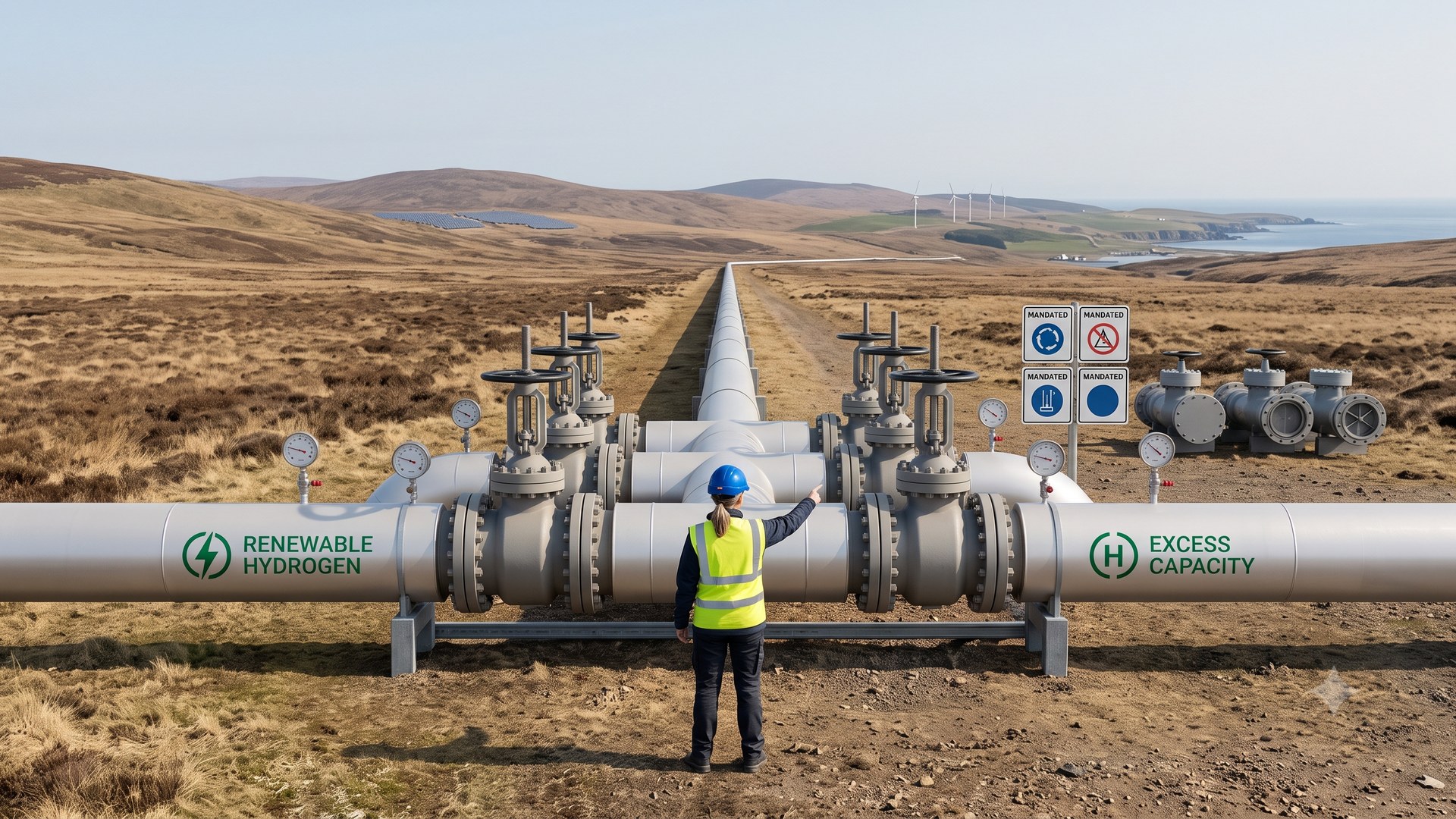
A grant calendar in search of customers
Open the European hydrogen file in mid-2026 and the striking thing is not how little money is on offer. It is how much. Brussels keeps publishing fat calls for proposals, and developers keep announcing electrolysers, while the question that decides whether any of it gets built sits one step downstream: who is actually obliged to buy the stuff.
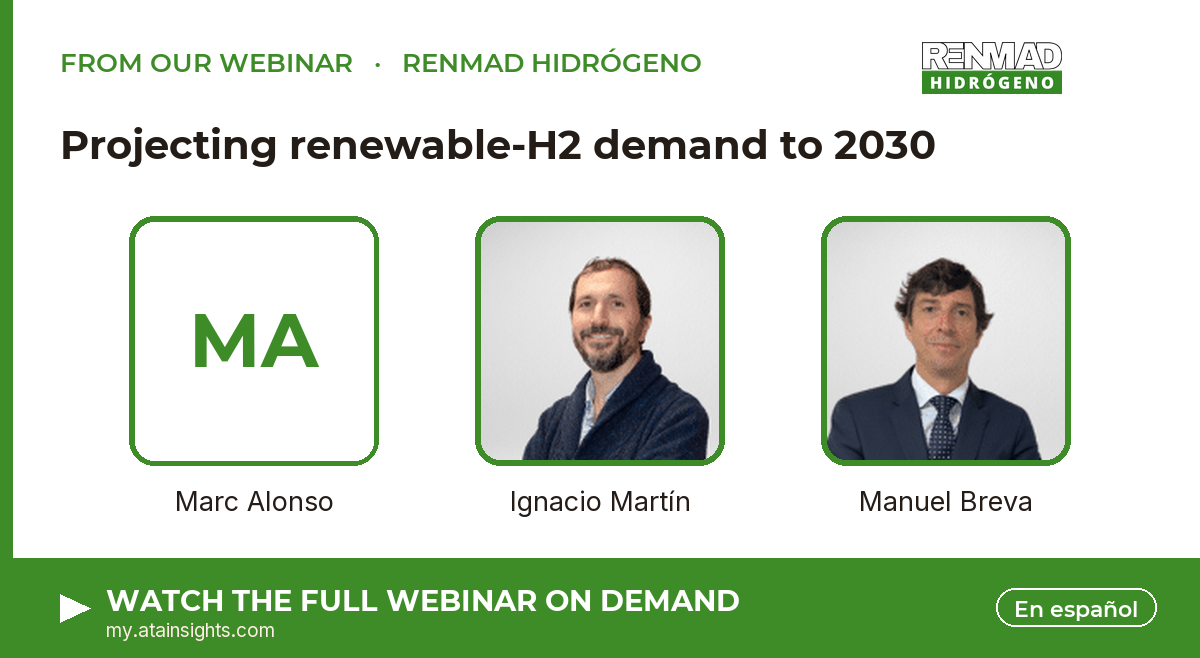
That was the uncomfortable premise of a RENMAD Hidrógeno webinar run by ATA Insights, "Proyección de la demanda de H2 renovable 2030: retos, regulaciones y oportunidades." The framing, set by moderator Andrea Renieblas of ATA, was blunt. "The question of renewable hydrogen demand is one of the biggest challenges the sector has to face," she said. Not production. Not cost curves. Demand, and the uncertainty around it.
It is the right place to start. Europe's announced renewable-hydrogen supply runs far ahead of the consumption its own regulations will create. The supply side has done its homework. The demand side is a policy document that several governments, Spain among them, have not yet finished writing.
Where the money is, and where it isn't
Marc Alonso, manager in Deloitte's Global Investment & Innovation Incentives team, walked through the public funding that exists today, and the map he drew was telling. Aid is spread across the whole value chain, he noted, "from production, including storage and transport, through to the uses, which is the demand." His own talk, he said, deliberately leaned toward "the demand part."
The instruments he singled out were the EU Innovation Fund and CEF Transport's alternative-fuels infrastructure line. The Innovation Fund, fed by emissions-trading revenue, had a 2.4-billion-euro round open at the time, paying up to 60 percent of relevant investment costs for technologies that reach industrial scale for the first time. "It is not R&D," Alonso stressed. "What you have to innovate is directly the capex investment in a technology that reaches the market, or industrial scale, for the first time thanks to these projects." CEF Transport's hydrogen-refuelling line, by contrast, tops out at 30 percent for Spanish applicants, since Spain cannot draw on the more generous cohesion envelope.
Useful money, all of it. But read the small print and a pattern emerges. These are supply-side and infrastructure subsidies: build the plant, build the refuelling station, reach industrial scale. They lower the cost of making hydrogen and of installing the kit to dispense it. None of them oblige a single customer to consume it. Alonso was candid that the Spanish demand-pull schemes, the PERTE for decarbonisation and the rest, were closed, with new calls only hoped for "over the course of the year." The grant calendar, in other words, is busy at the factory gate and quiet at the till.
The rule that makes a market
This is where transposition stops being jargon and starts being the whole game. The real 2030 demand for renewable hydrogen in Europe is not a forecast. It is a legal obligation, written into the third Renewable Energy Directive and its rules on renewable fuels of non-biological origin, the RFNBOs. By 2030 those rules require 42 percent of the hydrogen used in industry to be RFNBO-compliant, plus a sub-target of 1 percent of transport energy. That mandate is the demand. Strip it out and most of the announced offtake evaporates.
Alonso traced his own brief back to exactly this source. The funding push, he explained, "came initially on the back of the publication of the RED III directive, which aimed to increase the share of renewable energy." The subsidies are downstream of the directive; the directive is what is meant to conjure the buyers.
The trouble is timing. RED III had to be written into national law by May 2025. A year on, almost no member state has fully transposed the hydrogen rules, and the Commission has opened infringement proceedings against nearly all of them; only Denmark has put the transport quota into national law. Spain is in the late pile. Worse for anyone counting on the mandate, Spain is one of five governments, with Austria, Germany, the Netherlands and Poland, lobbying Brussels to soften the additionality and hourly-matching rules and to push parts of the regime out toward 2035. The demand-side rulebook is both unfinished and being argued over. The pipeline is real. The obligation to buy from it is, for now, a draft.
Small but certain beats large but vague
Faced with that gap, the webinar's most practical advice came from Ignacio Martín, who leads the industrial-process decarbonisation group at the technology centre CIRCE. His message was not to wait for the grand mandate to land, but to chase consumption wherever it is already real.
"The hydrogen that gets sold is the hydrogen that gets consumed," Martín said, "and any of its applications is welcome, because it will build a green-hydrogen market." He pressed the audience to look past the obvious giants of heavy industry and long-haul transport toward smaller, nearer niches, logistics hubs, hydrogen as a reducing agent in steelmaking, the valorisation of hydrogen-rich residual streams. Every molecule actually burned, in his telling, thickens the market for the next one.
He was equally firm that hydrogen is not the answer to everything, and that pretending otherwise damages the case for it. "Hydrogen is not the solution for everything," he said. "We have to know what the direct alternatives are, in order to size, from a techno-economic point of view, the most appropriate solution for each case. Otherwise we are projecting an image of hydrogen that is not fair or not complete." Electrification, he argued, wins the low-temperature processes; hydrogen earns the high-temperature ones where electrification "is a very big problem." Biomethane and carbon capture each have their slots. The point of the honesty is commercial, not academic: demand that is mis-sold collapses, demand that is correctly matched sticks.
The grip handle that nobody opens
Martín put his finger on the psychological bottleneck behind every slow procurement decision. When CIRCE talks to industrial users, he said, the recurring worry is disarmingly simple: "What do I do with hydrogen once I've managed to integrate it into my plant? Do I open a tap and it comes out automatically and that's it? I have a lot of doubts, as a user."
Those doubts, he argued, are where demand actually stalls, in the internal hierarchies of factories that cannot get comfortable enough to sign. The remedy is unglamorous: data, trials, certainty. He pointed to a furnace CIRCE built to test burners on different blends, "even running 100 percent hydrogen," precisely so that an industrial buyer can see that "my part works under the conditions I want" before betting a production line on it. Confidence, not subsidy, is what converts a curious plant manager into an offtaker.
The captive customers worth courting
If the lesson is to bind projects to obligation rather than optimism, the obvious place to look is the industries that already use hydrogen by the tonne and have nowhere to hide from the RFNBO target: refining, ammonia and fertiliser, certain chemicals. These are the captive consumers. They buy hydrogen now, grey and unpriced for carbon; they will be the first compelled to switch a defined share to the renewable kind. A project wired into a refinery's existing hydrogen balance or a fertiliser plant's ammonia loop has a buyer the day the mandate bites. A project waiting for a fleet of fuel-cell trucks that has not been ordered does not.
That is also the through-line that connected the panel. Marc Alonso's funding tracks the value chain but does not create offtake. Ignacio Martín's niches and trials build trust one user at a time. Both point to the same conclusion the regulation already implies: the demand that can be relied on in 2030 is the demand someone is legally required, or operationally compelled, to meet.
The panel's third voice belonged to Manuel Breva, secretary general of ANFFECC, the national association of frit, glaze and ceramic-colour makers concentrated around Castellón, a fiercely energy-intensive cluster with high-temperature kilns that look, on paper, like textbook hydrogen candidates. "I'll be able to give you more data on what we do and what we represent, and what challenges we have from a decarbonisation standpoint," Breva told the audience as he introduced his sector. His presence on the panel made the point on its own: the firms most exposed to the carbon maths are the ones doing the hardest sums about whether, and when, hydrogen pencils out.
Get the demand right and the pipeline has somewhere to go
The good news in all this is that the binding constraint is one Europe controls. Electrons, electrolysers and engineering are largely solved or improving on schedule. What is missing is the finished demand-side rulebook, and that is a matter of legislative will, not physics. Transpose RED III cleanly, hold the RFNBO sub-targets steady instead of bargaining them away, and reopen the demand-pull schemes that have lapsed, and the enormous announced pipeline suddenly has a destination.
Developers can act before the politicians do. Anchor the project to a customer who is already obliged or already buying. Build the trust that lets a cautious industrial user open the tap. Treat every small, certain offtake as worth more than a large, speculative one. The 2030 problem was never going to be making the hydrogen. It was always going to be selling it. Europe has built a magnificent on-ramp. It is time someone finished the road.
You reached this analysis because ATA Insights puts independent energy-transition intelligence in front of 86,000+ professionals across the sector. That's exactly what we do for funded projects, events and companies — turn your work into reach.
See how we disseminate work like this →Where this analysis came from
This piece draws on the ATA Insights / RENMAD webinar Projecting renewable-H2 demand to 2030. Watch the full session on demand.
The energy transition, in your inbox
Join 86,000+ professionals reading our independent briefings across five sectors.