
Three Buyers, Three Prices
Spain has the gas and the buyers for biomethane. What it lacks is a price the banks can see.
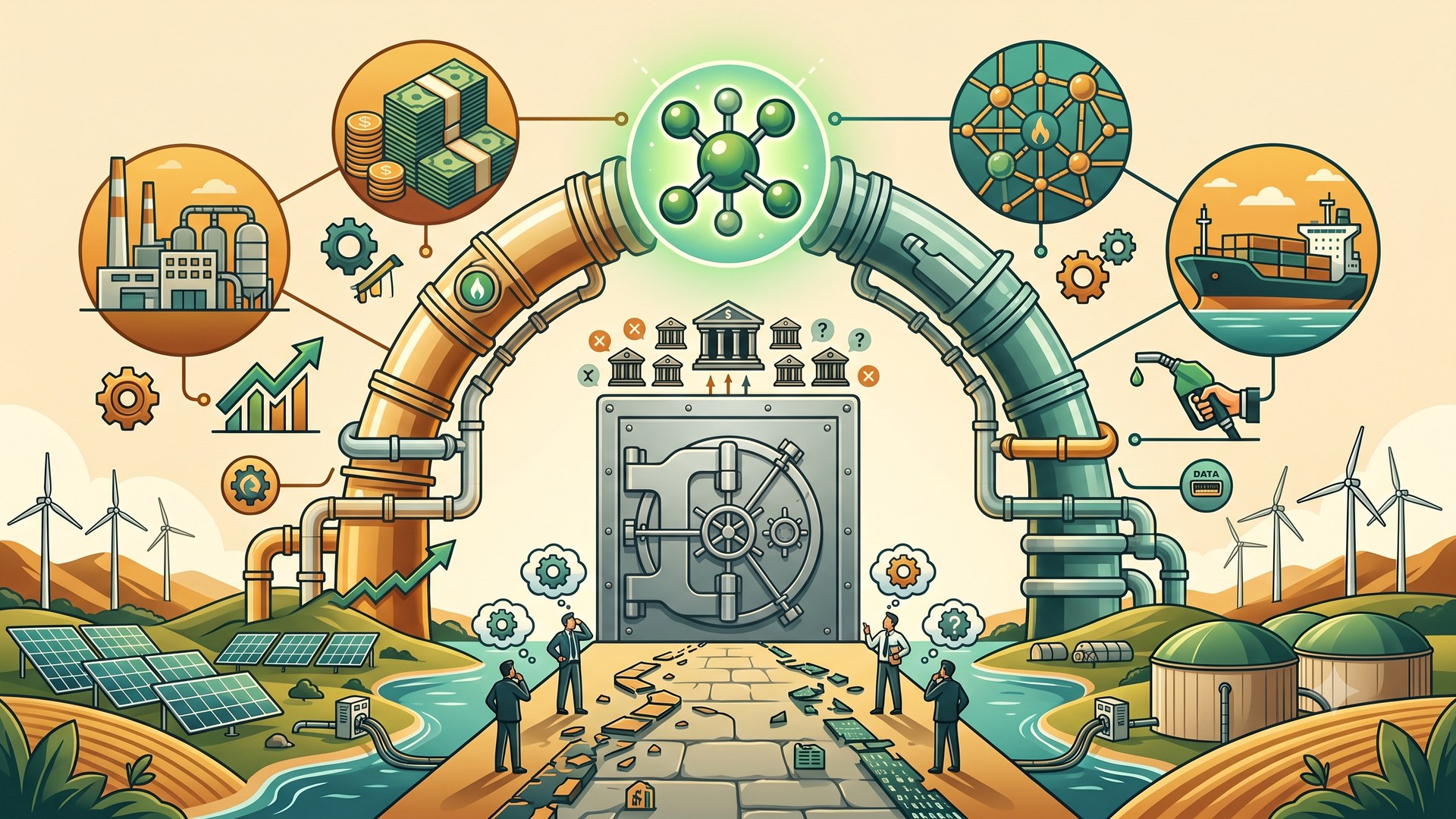
A draft decree is sitting in a Madrid ministry, waiting for the summer to end. When it lands, it will tell hauliers and shippers how much renewable gas they must blend into their fuel. The sector has been promised it before the holidays, then after; the best current guess, voiced on a recent RENMAD webinar, is that the homework comes due "back to school" in September. That single document explains why roughly 300 biomethane plants are queued for grid access in Spain while the banks that should finance them keep their hands in their pockets.
The puzzle is not that nobody wants Spanish biomethane. Everybody does. The molecule is being snapped up almost as fast as it is made, and forward production is spoken for too. The puzzle is that the people who want it pay wildly different prices for the same thing, and nobody can yet point a lender to a number on a screen and say: that is what this will be worth in 2030. Bankability, it turns out, is a problem of visibility, not demand.
The molecule and the paper
Start with what biomethane actually is once it leaves the plant. It is a gas, and it is a piece of paper. The gas is chemically ordinary methane; the paper is a guarantee of origin plus a sustainability certificate that records how clean the gas is over its life cycle. The two can travel together or apart, which is the first thing that makes pricing slippery.
Marta Montero Jimena, who runs business analysis and portfolio management for gas in Iberia at Endesa, laid out the trade from the buyer's side. Endesa has made a deliberate choice about where it stands. "From Endesa we have decided our strategic position towards biomethane, which is as a buyer of the molecule plus certificates, not within the investment in the production plant," she said. The utility is a marketer with a book of clients; its job is to get the gas and the certificates to the customers who need them. It will buy the molecule. It will buy the paper. It will not, as a later question forced into the open, buy a slice of the plant.
That distinction is the whole financing gap in one sentence. The off-taker is willing; the equity is missing.
Voluntary, opportunistic, obligated
Montero's central argument was that demand is not one thing but three, and the three pay on completely different scales.
The first buyer is voluntary. No rule compels this customer; a company wants greener gas for its own reasons and is content with a guarantee of origin and not much else. "This is a client who is willing to pay, willing to pay the lowest band," Montero said. They are not fussy about the feedstock or the carbon footprint, they contract short, and they happily soak up cheaper subsidised certificates from other countries. Useful volume, but the thinnest of margins.
The second buyer is an arbitrageur. This customer faces some regulation and does the maths between buying allowances and buying biomethane, paying whatever is cheaper on the day. They might stretch to the gas price plus a premium for the certificate, Montero explained, but "we are still very far from the prices producers need to make projects viable." Worse, this buyer too can shop abroad for subsidised molecules. Demand, yes. Bankable demand, no.
The third buyer is the one that matters: the obligated party. These are the customers caught by mandates, by the renewable energy directive and by the national transport rules that the draft decree is about to impose. They pay more, Montero said, "above all because they have concrete penalties." They also have specific needs, often a particular feedstock and a very negative carbon footprint that lets them count double. Only this buyer pays enough to close a project's numbers. The lesson is uncomfortable and clear: a viable Spanish biomethane sector is one built on obligation, not goodwill.
What a tonne is worth, roughly
Pressed by an attendee for an actual number, Montero gave one with the caution it deserved. Take a public reference for the molecule of around 18 euros, add the certificate, and the combined figure lands somewhere near 50 to 51 euros at current quotations. From there it climbs in steps, depending on how negative the carbon footprint is. The cleaner the gas, the higher the rung. There is no single price because there is no single product; there is a ladder, and which step you sell on depends entirely on which of the three buyers you are selling to.
That is fine for a trader who lives inside the market every day. It is hopeless for a bank trying to underwrite fifteen years of cash flow.
The number the banks cannot see
Here the conversation turned to Germany, and to envy. In a mature market, Montero said, pricing is simply indexed to gas plus the published certificate quotations. The quotes are public. That single fact "simplifies things enormously" and, more important, gives lenders the visibility and the projections they need. A German developer can take a multi-year contract indexed to gas plus certificates to a bank and raise finance against it, because the certificate trades on a market that quotes a price.
Spain has the molecules. Spain has the buyers. What Spain does not have is that public certificate-price reference. "Right now in Spain we don't have it very clear which way to point," Montero said, "and I think that is a problem the banks are running into too." No visible forward price, no fifteen-year contract a lender will accept, no project finance. The molecules pile up in the application queue; the paper has no public ticker; the money stays away.
This is the bankability dilemma, stripped of jargon. It is not that the gas won't sell. It is that nobody can yet show a banker, on a screen, what a Spanish certificate will fetch the year after next.
A motorway argument for renewable gas
José Luis Vidal, who heads mobility at the gas-network operator Redexis, came at the same problem from the asphalt up. Transport is where obligated demand will bite hardest and where biomethane has a clean shot, because heavy trucks have few good ways to decarbonise and the engines already exist.
Vidal's pitch rested on total cost of ownership, the figure a fleet owner actually cares about: every cost of running a vehicle across its whole life. On that measure, he argued, a biomethane truck already sits among the cheapest options, shoulder to shoulder with diesel, once you count both the capital and the running costs. Renewable gas is reaching fossil-fuel cost at many stations, he said, putting it "on a par" with conventional fuel for the operator. The technology is not waiting to arrive; it is selling fuel today.
What is missing is the same thing Montero named from the trading floor: pressure and a price. Vidal was blunt about the mechanism. The infrastructure is being built and a market is being created, "but the market, the final user, is not moving until regulatory pressure says so." The trucks work. The economics work. The demand will not switch on by itself; the mandate has to flip the switch. Transport, he noted, is responsible for around a third of EU emissions, and Spain carries a meaningful slice of Europe's freight. Decarbonising it is not optional if the targets are to be met.
The shape of the unlock
Put the two halves together and the picture is almost hopeful. The feedstock is there; Spain's long-run potential runs to many terawatt-hours. The plants are there, or queued: roughly 300 applications, helped along by a recent change to the grid-access rules meant to speed renewable-gas connections. The buyers are there, in three flavours. The off-takers, Endesa among them, are ready to take the molecule and the paper off producers' hands.
What is missing is two things that arrive together. One is an obligation — the transport mandate now sitting in draft — that turns polite interest into a hard buyer who pays enough. The other is a transparent certificate market that quotes a public price, so that a developer can wave a fifteen-year contract at a bank and have it taken seriously. Demand without visibility cannot be financed. Visibility without obligation does not pay. Spain is one decree and one price screen away from having both.
Montero called the marketer's role in all this a kind of hinge, the joint that lets producers and final customers swing into a contract that actually gets signed. It is a good word for the moment the whole sector is in. Everything is in place; the hinge just needs the door to be pushed. As the moderator put it, quoting the line the event has used since its first edition: biomethane is not the future. It is the present. The present, he added, keeps arriving.
You reached this analysis because ATA Insights puts independent energy-transition intelligence in front of 86,000+ professionals across the sector. That's exactly what we do for funded projects, events and companies — turn your work into reach.
See how we disseminate work like this →Where this analysis came from
This piece draws on the ATA Insights / RENMAD webinar Distribution & demand: the bankability dilemma. Watch the full session on demand.
The energy transition, in your inbox
Join 86,000+ professionals reading our independent briefings across five sectors.