
Unplugged, for now
A Spanish data centre can power itself if the grid is late, and nobody at RENMAD Talks Datacenters Off-Grid ruled it out. The sharper point came later: the island that is easiest to finance is the one that comes with a return ticket
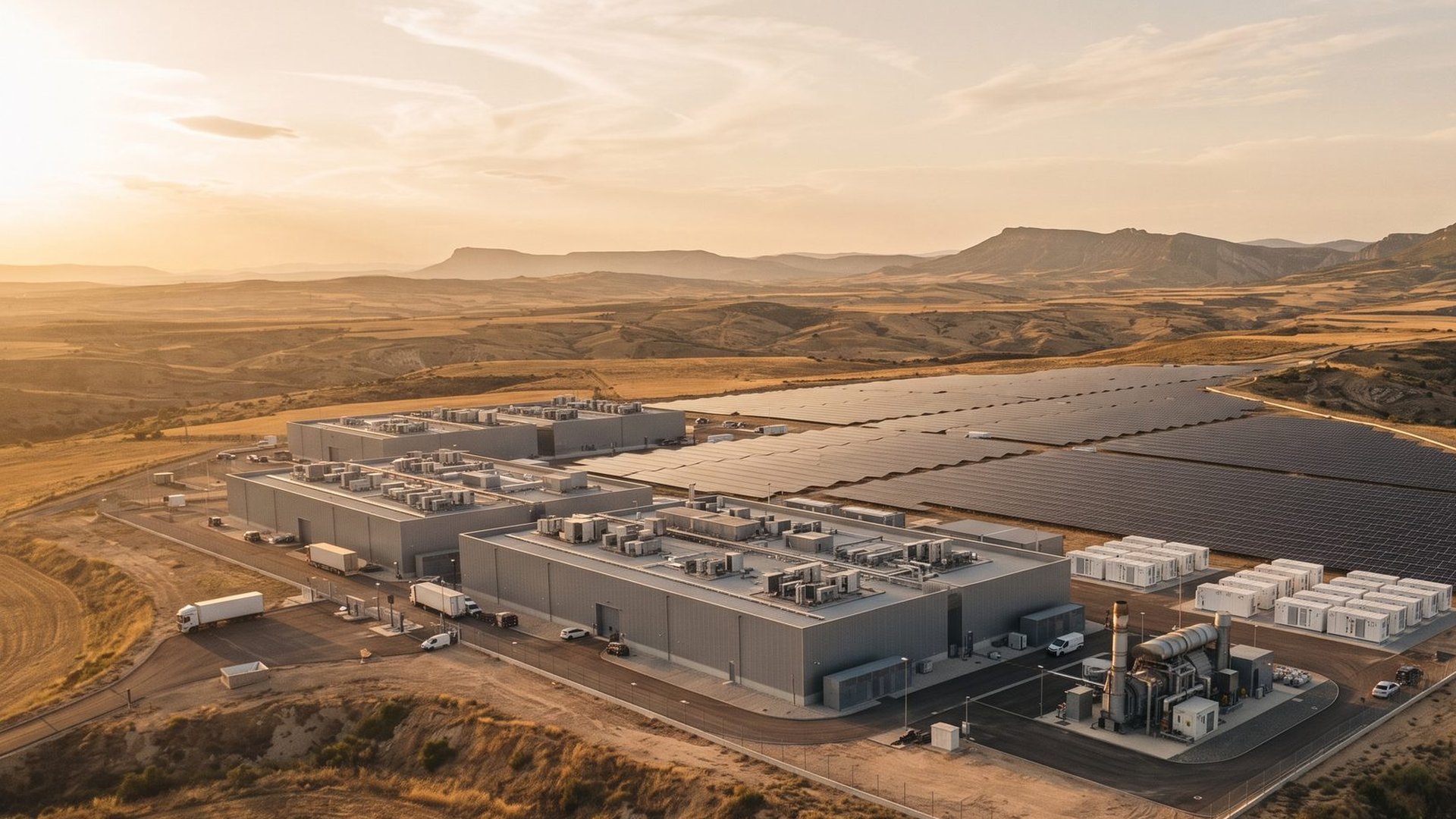
Building a data centre takes 12 to 18 months. Connecting it to the grid takes five to seven years. That mismatch was on the programme when the second RENMAD Talks, organised by ATA Insights with PwC España, opened at Torre PwC in Madrid on 13 October, and nobody challenged it all morning. The question on the bill was whether a Spanish data centre can live unplugged. Panel by panel, the answer came back more nuanced and a good deal more useful: it can, and increasingly it will, but the money lies in designing the island so that one day it can rejoin the mainland.
Sun-rich, socket-poor
The first panel, chaired by Andrea Renieblas of ATA Insights, set out the problem without sugar-coating it. José Luis Herrero, chief executive of Walhalla and a board member of Spain DC, the Spanish data centre industry association, called for regulation "with a scalpel, not an axe". He then described what, in his view, the draft royal decree on data centres, still out for consultation, has already done: "Spain is no longer at the table where the big investors make their decisions." Anyone who has already bought land and secured grid access, he pointed out, now has six months to adapt to the new rules.
Luis Bravo, senior principal analyst at Datacenter Hawk, offered the most painful comparison. Two or three years ago Madrid and Milan were neck and neck, at around 200 MW leased. Today Milan is at roughly 900 MW; Madrid is still at 200 or 250 MW.
Óscar Barrero, partner in charge of Energy and Utilities at PwC España, added the Spanish paradox. For six years the country has led Europe in long-term power purchase agreements (PPAs). This year it has racked up more than 600 hours of zero or negative prices, and it curtails around 6% of its renewable output because nobody is there to use it. Data centres account for 0.8% of demand, against 4% in Germany. Even so, he said, the draft would require them to prove that 80% of their consumption is renewable in every single hour. "Perhaps we've put the plaster on before there's a wound."
With so much surplus sun and so little cable to go round, Manuel González, head of Ignis Projects, sketched the way out: two or more megawatts of solar or other renewables for every megawatt of data centre, backed by large-capacity batteries, so that two-thirds of the energy comes from on-site generation and avoids the variable part of network tariffs and system charges. If the power is next door and the grid is years away, plug into the neighbour.
Islands by design
The central panel, "Data Valley", chaired by Belén Gallego, chief executive of ATA Insights, turned the question on its head. Christian Lipperheide of PQC, an engineering firm that has spent almost thirty years designing data centres, put it like this: "All data centres are actually off-grid. The grid is the cheap-energy alternative." A data centre, he explained, is "a factory with air quality approaching a hospital's and the security of a military base", designed to depend on nothing from outside. Generators, batteries and uninterruptible power supplies (UPS) have always been part of the kit. What has changed is that the grid is no longer the fast lane.
Lipperheide was also the most cautious about full islanding in Spain. Technically it can be done, was the gist, but nobody is doing it here today: "Yes, it exists, just not here." The reply came at once, with a smile: "Oh ye of little faith. Give us a few months and we'll tell you all about it."
Felipe Hernández, innovation director at FRV, made the case for an on-site hybrid: 70 or 80% renewables, "even more", with gas as back-up to fill the gaps that sun and batteries leave. He disarmed the climate objection with simple arithmetic. In those hours, power drawn from the grid would come from a combined-cycle gas plant anyway. "You're not increasing gas consumption, you're just moving the place where the gas gets burned."
The moderator then asked for a number. By 2030, what share of Spain's new IT capacity will be islanded, or will pair on-site generation with a grid connection? Antonio Henarejos of Elecnor offered a "conservative" 40 to 50%. Carlos Olmeda of Exera Energía said 70 or 80%; Hernández, practically all of it. Lipperheide would not be drawn: it could be 10%, it could be 100%. If much of the new capacity is going to be born with its own power plant, the real question is what happens on the day the cable finally arrives.
No data centre is an island
Olmeda, head of data centre operations and maintenance at Exera Energía, had the answer that turned the problem into an opportunity. Show Red Eléctrica, Spain's transmission system operator, that you can run in island mode and you are no longer the big consumer straining the transmission node. You can ask for a much smaller connection, offer yourself as flexible demand and, further down the line, use your storage to provide balancing services (which the operator uses to match supply and demand) and inertia, the cushion that slows sudden drops in frequency. The data centre would go from villain to part of the solution. Someone in the same discussion pointed out that flexibility "won't be optional": Nordic countries such as Finland already have proposals on the table to make it mandatory for data centres.
The panel on the 24/7 challenge, chaired by Cédric Marie Bérard, co-founder of Ikenga, grounded the idea in hardware, which here means batteries. Javier Prada, business development director for data centres at iQuord, put the standard that banks will finance at four hours: a 100 MW data centre needs 400 MWh, or about 80 containers. Beyond that, firm generation becomes the better bet.
Luis Casero, global head of product marketing at Vertiv, explained what else the batteries are for. When a conventional data centre detects a disturbance, it disconnects and runs on its own batteries. At today's scale, dropping that much load in one go destabilises the system: "we could end up where we ended up in the big blackout," he warned, referring to the Iberian blackout of 28 April 2025. Storage can soften the blow. Casero also updated the industry's motto to "bring your own power and cooling", with waste heat from on-site generation turned into cooling by absorption chillers.
Alfonso Lezcano, head of electricity origination and supply at Galp, offered proof that island and mainland are not mutually exclusive: a self-consumption project of more than 400 MW that stays connected to the grid precisely so that it can lean on it for back-up without building a combined-cycle plant. José Luis Gómez Pardo, chief executive of Nixval, reminded the room that not every data centre is a gigawatt campus. For traditional colocation serving SMEs (renting out space and power to third parties), the draft's measures are, in his words, "pure fantasy".
In his talk, Rubén Miralles of LONGi argued for treating the data centre as a microgrid, with a single party responsible for the whole system. He cited a BNP Paribas analysis that puts energy infrastructure at around 20% of a data centre's investment, but a 20% that ends up deciding the fate of the entire project. He was also clear that a microgrid does not promise unlimited autonomy, "nor does it remove the need for a grid".
Three clocks, one island
The last panel, chaired by Carmen Izquierdo, chief executive of nTeaser, talked money. Luis Fuente, executive director of Sustainability & Low Carbon Advisory at BBVA, boiled it down: "This is a market about time, not price." A project that cannot deliver energy sooner than the grid would is worth less. In the United States, he noted, more than half the pipeline already has a behind-the-meter component (generation beside the load that bypasses the grid), and around 10% is fully off-grid.
Elliot Zounon, head of data centre solutions at CBRE Iberia, described three clocks that keep different time: GPUs last three to five years, the building 20 to 30, energy contracts 10 to 20. José María Otero, corporate development director at Edison Next, explained why the island complicates everything. In a grid-connected project, if the energy buyer fails, there are alternatives. On an island, "the GPU owner has no alternative if you go down", and nor does the property owner. That leaves three parties tied to the same island and writing cheques of very different sizes: in his example, around €6bn for the GPUs, €1bn for the property and €1.5bn for the energy. If each brings its own lenders, that also means three bank syndicates sitting down to carve up the risk. That market, he admitted, is not mature yet, although some banks are already working on it.
Which is why Otero's answer in the closing round summed up the morning best: islanded in the short term and, in the medium term, "transformed into behind-the-meter, with a connection".
An island with a return ticket
For anyone developing, financing or supplying energy to a data centre in Spain, on-site generation has gone from plan B to the quickest way of arriving on time. The projects that are easiest to finance will be those born islanded and designed to connect, with batteries sized to provide services to the system and contracts that accept that the GPUs, the building and the plant run on different clocks.
The first large-scale test already has a postcode. In Monfarracinos (Zamora), Edison Next and FRV-X are developing a campus with 200 MW of IT capacity and an investment of around €4.6bn. The regional government, the Junta de Castilla y León, is taking it through permitting as a Proyecto Regional, a designation for projects of regional interest, and it is open for public consultation until 23 November 2026. According to project documents reported in the regional press, it would run in island mode on a solar farm, lithium batteries and gas and diesel back-up engines, covering around 70% of its annual consumption with renewables. That is close to the recipe Hernández argued for on stage.
Spain has the sun, the land and energy it curtails today for want of demand. If the grid cannot give the industry time, the industry will make its own, and pay it back in flexibility on the day the cable arrives. Unplugged, then. With the return ticket already booked.
Speakers at RENMAD Talks Datacenters Off-Grid, 13 October 2026, Torre PwC, Madrid, organised by ATA Insights with PwC España: José Luis Herrero, Walhalla; Luis Bravo, Datacenter Hawk; Manuel González, Ignis; Óscar Barrero, PwC España; Christian Lipperheide, PQC; Carlos Olmeda, Exera Energía; Felipe Hernández, FRV; Antonio Henarejos, Elecnor; Javier Prada, iQuord; Alfonso Lezcano, Galp; Luis Casero, Vertiv; José Luis Gómez Pardo, Nixval; Rubén Miralles, LONGi; Luis Fuente, BBVA; Elliot Zounon, CBRE; José María Otero, Edison Next. Moderators: Andrea Renieblas and Belén Gallego, ATA Insights; Cédric Marie Bérard, Ikenga; Carmen Izquierdo, nTeaser. The next RENMAD Talks: Autoconsumo Industrial y C&I, 10 November 2026.
You reached this analysis because ATA Insights puts independent energy-transition intelligence in front of 86,000+ professionals across the sector. That's exactly what we do for funded projects, events and companies — turn your work into reach.
See how we disseminate work like this →Where this analysis came from
This piece draws on RENMAD Talks Datacenters Off-Grid, 13 October 2026, Torre PwC, Madrid.
The energy transition, in your inbox
Join 86,000+ professionals reading our independent briefings across five sectors.