
When the Data Centres Outgrew the Capital
Dublin let its data centres sprint ahead of its grid, and ended up freezing new connections. As Madrid's network fills up, Spain is being handed the Irish playbook — this time with the mistakes already marked in red.
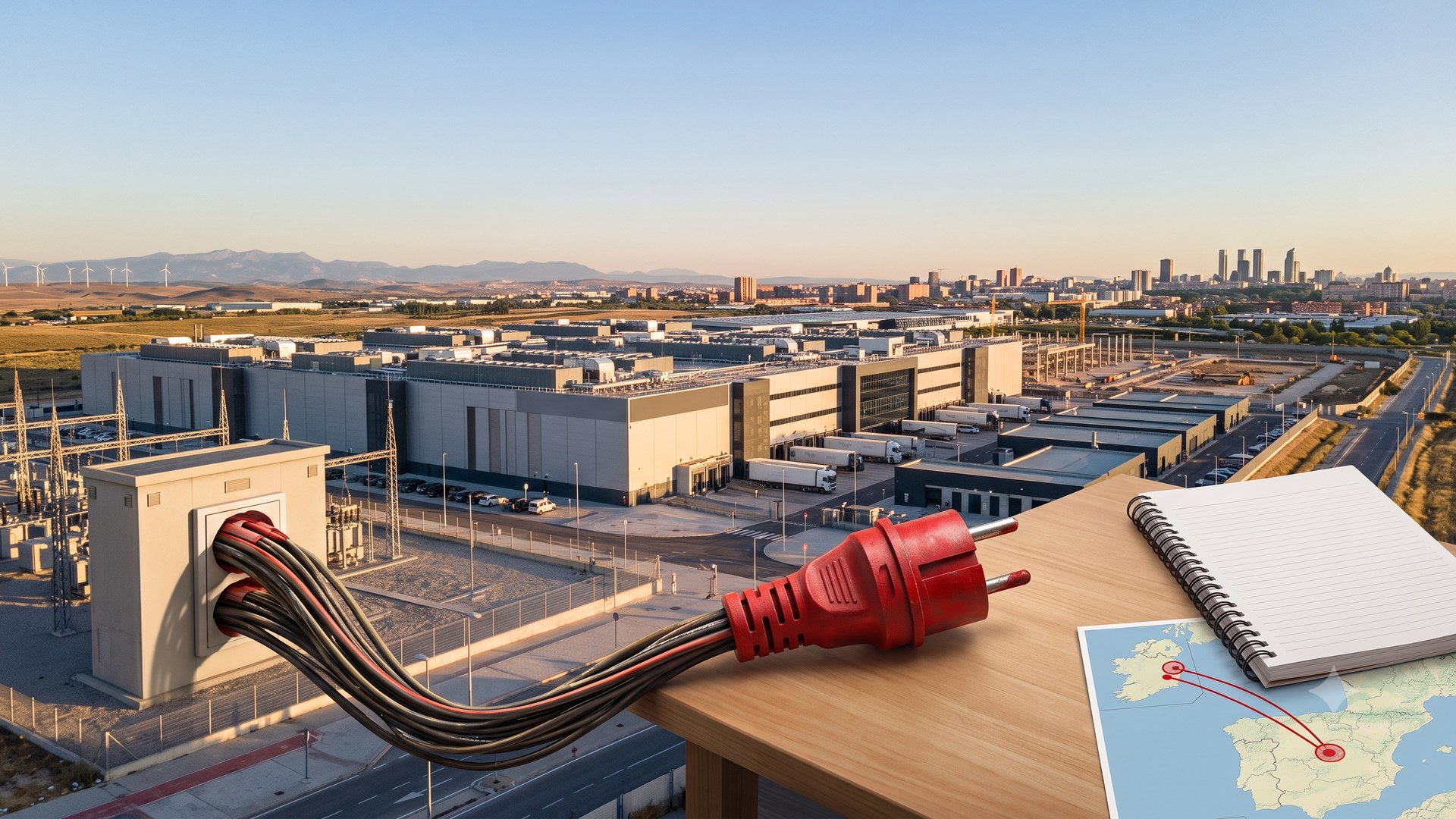
There is a number that ought to keep anyone planning a data centre in Spain awake at night. In Ireland, the machines that store and process the world's data now draw roughly a fifth of the entire country's electricity — a share the national grid operator expects to reach nearly a third within a decade. No other advanced economy has let a single industry colonise its power system quite so thoroughly.
Ireland did not set out to run this experiment. It stumbled into it, one blue-chip tenant at a time, and only noticed the scale of the thing once the grid started to groan. That is precisely why it is worth studying. In a recent ATA Insights webinar, "Growing data centres without breaking the grid: the Irish model," two people who have spent their careers inside that boom walked through how it happened — and what a country like Spain, whose grid is now visibly filling up, might do differently while it still has the choice.
The framing matters. Ireland is not a horror story. It is a cautionary one, which is a different genre. The lights stayed on. The industry is enormous and lucrative. But the country arrived at a place it plainly did not intend to reach — freezing new grid connections in its own capital — and Spain, for once, has the luxury of seeing the ending before it writes the plot.
How a small country ended up with a very large problem
To understand the squeeze, you have to understand the ambition that caused it. Andrew Tobin, Director and Head of European Data Centres at Turner & Townsend, began with the deep history, because the boom did not start with the cloud. It started with a poor country making a shrewd bet.
"The government at the time targeted foreign direct investment because they knew that the indigenous market couldn't sustain what Ireland needed as a country," Tobin said. In the high-unemployment, high-interest-rate Ireland of the 1980s and 1990s, that meant free third-level education, a skilled construction workforce, and tax incentives originally designed to lure pharmaceutical plants. When the digital economy arrived, the incentives fit it just as neatly, and the blue-chip names came to headquarter — and, crucially, to build.
The trouble is arithmetic. The Irish grid is around six gigawatts. Data centres planned for the country added up to roughly 1.9 gigawatts — and the Dublin metropolitan area, where nearly all of them wanted to be, has a total capacity of about 1.7 gigawatts. Read that twice. The data centres queuing up for the capital were sized to demand more power than the capital itself.
"Just to think about it, your main capital city has less demand on it than what your data centres that you're going to build," Tobin said. "It wasn't balanced in any way at all." Layered on top of that: an ageing network, much of it dating to Ireland's electrification half a century ago, and renewables stranded on the wrong coast. The wind is on the west; the demand is on the east, inside the M50 ring road around Dublin, and the two are too far apart to marry easily. Everyone wanted to plug in at the same handful of nodes, and the grid could not take it.
The moratorium nobody wanted
What happens when supply meets that kind of demand is not a gentle price signal. It is a wall.
Keith Newman, a partner in the energy team at the Dublin law firm Mason Hayes & Curran — who has advised on data-centre projects from the developer's side and the hyperscaler's in-house side both — put the legal scaffolding on Tobin's diagnosis. By 2021, the concentration in the greater Dublin area had produced what he called "a perfect storm" of security-of-supply concerns. The regulator issued a direction that made new grid connections for data centres extraordinarily hard to secure, and the transmission operator went further still, effectively closing the door around Dublin.
"It introduced significant criteria that data centre developers would have to satisfy," Newman said, "which effectively meant it was very, very difficult for data centre developers to secure new electricity grid connections." Denied the wire, developers reached for gas: build your own on-site generation, connect to the gas network instead. The gas regulator promptly shut that route too. Projects stalled. Investment sat on the back burner. Ireland had accidentally invented a category — the permitted, financed, un-buildable data centre — and then watched it multiply.
Here the panel was refreshingly unsentimental about their own country's record. A 2019 grid policy was, in Tobin's words, "pushed on" but never properly implemented. A 2022 government strategy paper laid out sensible preferences — favour projects that bring renewables, that co-locate with supply, that engage with communities — but, Newman noted, "it didn't lead to any legislative changes." Ireland is only now, years into the crunch, converging on a firm connection policy for large energy users with real criteria attached. The lesson is not that Ireland lacked good ideas. It is that it had them, and moved too slowly to make them bite.
Spain's better hand — and how to misplay it
Now turn to the country that commissioned this post-mortem. On paper, Spain holds a far stronger hand than Ireland ever did. It is a much larger country with a much larger grid, a genuinely good energy mix — abundant solar, strong renewables, conventional backing — and serious interconnection through Bilbao, Barcelona, Madrid and the Aragón region. Tobin was generous about all of it.
Then he named the trap. "That can lead to great congestion, and that's exactly what we saw in around the Dublin metro region. You don't want that to happen." Everything congesting Dublin is now visible in Madrid, which has become Spain's leading data-centre market for exactly the reasons Dublin once was: connectivity, proximity to business, an established base of operators. Spain's regulator, the CNMC, now publishes monthly maps of available grid capacity, and they show a transmission network already heavily saturated at node level. The wire, once again, is the binding constraint — and the gravitational pull toward the capital is the very force that broke the Irish model.
Tobin's prescription was blunt and repeatable: do not get sucked into the metro. "Don't get gridlocked, don't get sucked into the metropolitan areas." Spread the load. Zone deliberately — planning restrictions where the grid is tight, active encouragement where there is headroom. Distinguish, ruthlessly, between the kinds of data centre, because they are not interchangeable. Enterprise sites need to sit near their users; colocation can move to the suburbs; hyperscalers, self-sufficient by design, can go almost anywhere. "The hyperscalers, they can locate on their own in more remote areas because they're self-sufficient," Tobin said. Treating all three as one undifferentiated blob of demand — which he and Newman agreed both policy and the press habitually do — is how you end up rationing the wrong things in the wrong places.
Newman's takeaway was aimed squarely at Madrid's ministries rather than its developers. What Ireland lacked, and what Spain can still supply, is speed and certainty of decision-making. "There needs to be clarity of direction, certainty of desired outcome and real urgency in decision-making," he said. The single biggest brake on Irish investment, in his telling, was not hostility to data centres — it was the glacial pace at which the rules got written. Spain has the maps, the mix and the land. What it has to prove is that it can decide.
The upside hiding in the demand
It would be easy to read all this as a case for keeping data centres out. Both speakers argued the opposite, and this is where the Irish experience becomes genuinely useful rather than merely alarming.
A data centre is an anchor tenant for the grid. The four largest hyperscalers have between them contracted close to 50 gigawatts of renewable energy — "comparable to the entire generation capacity of Sweden," as Newman put it. Handled well, that appetite pays for transmission upgrades, pulls new renewables onto the system and, increasingly, offers the grid something it badly wants: flexibility. Large operators with campuses across several countries can shift computing loads between geographies, or shave demand on instruction, to help a stressed system balance — a lever the Irish operator holds in reserve as a last resort. Waste heat, largely thrown away today, can be piped into district heating; Ireland, both men admitted, has barely begun.
None of that happens by accident. It happens when a country decides, early, to make the industry pay its way into the grid rather than free-ride on it. Tobin's sharpest regret was precisely this missed lever: Ireland never made developers reinvest in the network they were straining. "Maybe we should have put a tariff on, that they reinvest in the grid," he said. It is the kind of thing that is obvious in hindsight and invisible in a boom — which is exactly why a country still at the start of its boom should write it down now.
Moderator Belén Gallego pressed on the fairness of it, and landed on the political stakes. In the United States, she noted, ordinary ratepayers are increasingly footing the bill for the hyperscalers' build-out — a dynamic that erodes the public's willingness to wave projects through. Get the cost-sharing wrong and the social licence evaporates. Spain, whose grid demand still sits below its 2008 peak, actually needs the new load. It cannot afford to let that need curdle into resentment.
The lesson Spain can still afford
The tidy irony of the Irish model is that its most valuable export is its list of mistakes. A small country made a brilliant bet on foreign investment, watched it succeed beyond all planning, and then discovered its grid could not keep up — because the machines all wanted to live in the same city, the network was old, the renewables were far away, and the rules arrived years late. Every one of those failures is legible from Madrid today. Spain's grid is filling; its capital is the magnet; its policy is being written right now, before the door has to slam.
That is the whole opportunity. Ireland had to learn this the expensive way, with stalled projects and a connection freeze in its own capital. Spain can learn it for the price of an hour's webinar and the discipline to act on it — spread the load, sort the wire before the campus, make the industry help pay for the grid it leans on, and above all decide quickly. The Irish did not break their grid. But they came close enough to see the edge, and they are honest enough to point at it. The only real mistake left would be to walk up and look for oneself.
You can watch the full session, "Growing data centres without breaking the grid: the Irish model," on demand in the ATA Insights webinar archive. And if you are building — or powering — Spain's data-centre boom, this is exactly the conversation that continues in person at RENMAD Datacenters in Zaragoza, where the developers, operators and grid people wrestling with these trade-offs gather to compare notes before the maps turn red.
You reached this analysis because ATA Insights puts independent energy-transition intelligence in front of 86,000+ professionals across the sector. That's exactly what we do for funded projects, events and companies — turn your work into reach.
See how we disseminate work like this →Where this analysis came from
This piece draws on the ATA Insights / RENMAD webinar Data centres & the grid: the Irish model. Watch the full session on demand.
The energy transition, in your inbox
Join 86,000+ professionals reading our independent briefings across five sectors.