
Why the Bids Went So Low
Italy's first storage auction cleared at a third of the reserve price. That was not a mistake — it was a market finding its floor, and every tolling desk in Europe is now reading from it.
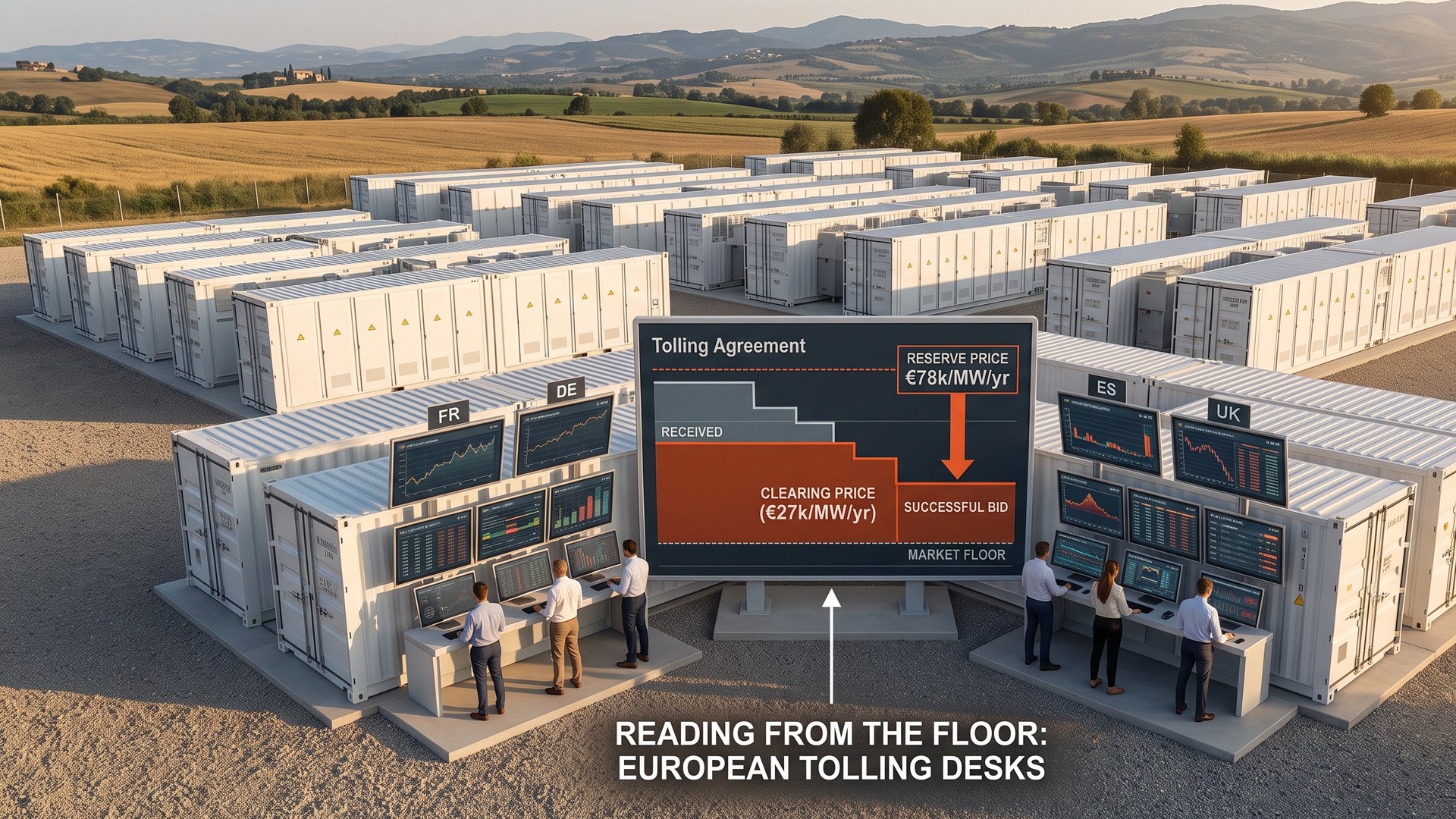
When the envelopes were opened on 30 September, the numbers looked like a typo. Italy had set out to buy 10 gigawatt-hours of battery storage through MACSE, its new tolling scheme, and the system operator Terna had pencilled in a reserve price of €37,000 per megawatt-hour per year. The auction cleared at an average of roughly €13,000 — about a third of the ceiling, and well under the €20,000-to-€25,000 that the market had quietly agreed was the "fair" number. Bids ran to four times the capacity on offer. Two Italian incumbents, Enel and Eni, walked away with about 70% of it.
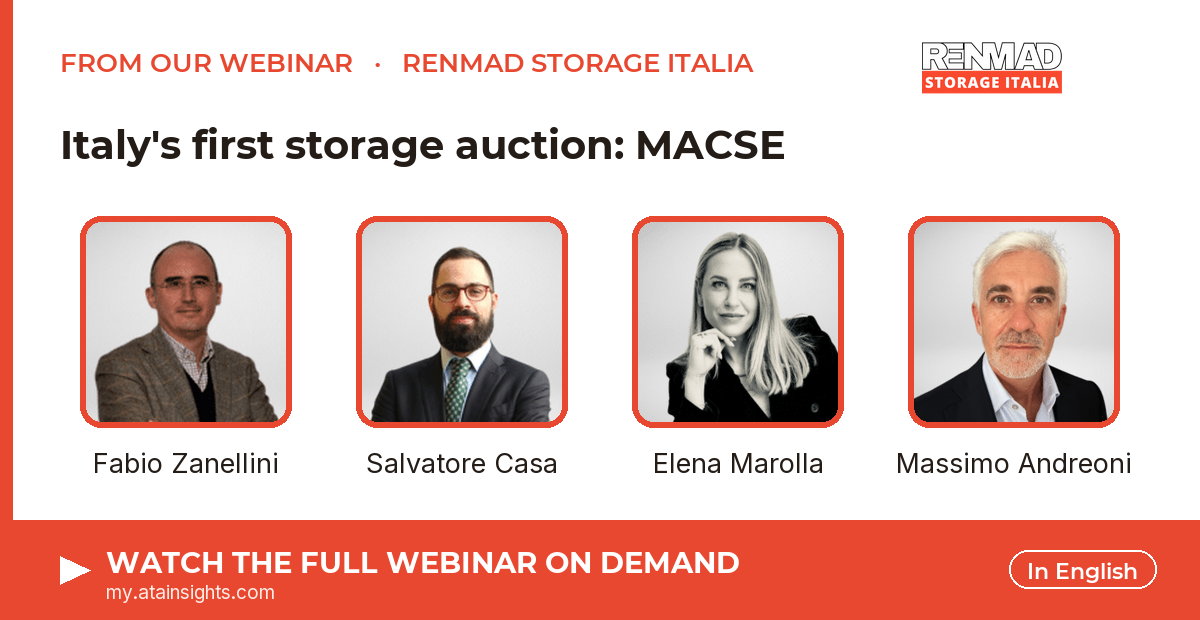
The temptation was to call it irrational — developers bidding themselves into a loss to plant a flag. The four specialists RENMAD gathered a fortnight later, for the opening webinar of RENMAD Storage Italia in Bologna, spent an hour explaining why it was the opposite. The low price was not a bidding error. It was the cost of a battery in Italy, told plainly for the first time.
A price, not an accident
Fabio Zanellini, who coordinates the storage task force at the industry association ANIE Federazione, set the scene by reminding everyone what MACSE is for. Italy plans to add 50 gigawatts of new solar and wind by 2030, and that flood of midday generation has to be shifted to the evening. MACSE — a 15-year tolling contract awarded by descending-price auction — is the instrument built to pay for the batteries that do the shifting.
On the result itself, Zanellini was unsentimental. "Without doubts, a success for Italy," he said, noting the auction was oversubscribed four to one and cleared far below both the capacity-market benchmark of €37,000 and the rumoured fair value. A success, then, but one that immediately raised an awkward question, which he posed at the end of his slot: whether Italy really needs two separate long-term schemes — the capacity market for adequacy, MACSE for flexibility — when "in the power system book, there is no flexibility chapter, no adequacy chapter." The same battery does both jobs.
The integrated-operator advantage
The clearest answer to "why so low" came from Massimo Andreoni, a partner at the consultancy Althesys. He started from the winners' table. Enel and Eni took the bulk because they do not buy batteries the way everyone else does.
"They don't buy a turnkey battery storage system," Andreoni said. "They buy the single pieces — they buy the battery pack, they buy separately the inverter, the transformers, they do themselves the balance of plant, and they run their own energy management system to integrate the parts." That, he argued, is where the margin hides: you can squeeze value out of each component, but only if you have the experience to make components from different suppliers fit together — a job he called "really difficult" because not everything in a battery is plug-and-play.
Stack the rest on top — a low cost of capital, an aggressive appetite for internal rate of return, in-house construction and operating know-how — and the floor drops. Andreoni put the mechanics in one line: "It's a mixture of low capex, possibility to squeeze from each piece of the components the best value, low IRR, good attitude for risk care, and driven by the fact that you know how to construct and operate such batteries." The two incumbents bid where they did because, for them, that was the cost.
The merchant tail
There was a second engine, and it sits at the far end of the contract. MACSE pays for 15 years; the asset lasts longer than that. Several winners, Andreoni noted, bid on the assumption that the battery would still earn money on the open market after the toll runs out — even though "I don't know if there is any 100-megawatt batteries running after 15 years around the world." That merchant tail is a bet on degradation curves and on the spread still being there in 2040. It is also a bet that let bidders shave the regulated price today.
Elena Marolla, corporate development manager at NatPower — one of the partial winners, with a project in Sicily — confirmed the thinking from the inside. NatPower took 35.4 megawatts against an authorised 130, and she was candid that the clearing levels stung. "We cannot sugarcoat it: price levels were tough, even for us," she said. But the low bids were "not totally a surprise." Her team had spent months on the bidding strategy, watched capex for electrochemical storage fall, and built a hybrid model that leaned on exactly that post-MACSE merchant tail. The conclusion she drew was the one the whole sector is circling: "Renewables plus storage are already fully competitive in Italy." She added a warning that the cheap capex carries its own risk — the supply chain "relies heavily on a small number of Asian manufacturers," a price-volatility exposure the winners now have to manage on the way to delivery.
Is the floor too low?
The most useful dissent came from Salvatore Casa, a partner at the market advisor Elemens, who had advised several bidders and several winners. His point: do not read the headline average as the real price. Strip out the zones distorted by the heaviest incumbent bidding and the auction actually cleared in a tighter, higher band.
"If you look at the closing prices, something in the range of €16.5 to €18 in all the regions not affected by vital participation — I think that this is the real value of MACSE," Casa said. His firm had walked its own price expectation down to roughly €16–18 in the days before the auction, tracking the tenders developers were running for the kit. Run the counterfactual without the two giants, he argued, and the market still clears around €17–18. In other words, the floor is lower than people expected, but it is not a fantasy — it is "reasonable for this kind of industry and this kind of investment."
Casa's deeper message was about what kind of asset this is. MACSE is "a 15-year fully regulated contract — this is not a merchant bet, this is not an investment exposed to market risk." Low risk means low return, and bidders who want more upside have other doors: the capacity market, merchant trading, or tolling deals struck privately with traders. He was sober about that last route. Merchant batteries in Italy are earning well right now — a four-hour asset can clear north of €100,000 per megawatt a year, far above what MACSE pays — but those revenues lean on the ancillary-services market, which the next wave of MACSE and capacity-market assets will steadily cannibalise. And banks will not finance a fully merchant project. Tolling is the usual fix, but Casa counted just two sizeable Italian tolling contracts closed in recent months, both in the volatile north. His verdict: tolling will play a supporting part, but "MACSE will be the key instrument."
The benchmark everyone now quotes
That is the quiet shift the auction produced. Before 30 September, a tolling negotiation in Italy or anywhere nearby had no anchor. Now it has one. As Casa put it, "traders have quite clear price benchmark, which is the MACSE outcome" — and that single data point is reshaping the bid-ask on every private storage deal in the country, with roughly 30 gigawatt-hours of capacity outside MACSE looking for a contract and only a handful of bankable counterparties to sign one.
The European read-across is more cautious. Asked whether Italy's prices would drag down BESS pricing elsewhere, Andreoni declined the easy headline. "Each market goes by themselves," he said, because the technical requirements differ — Italian designs were built around long durations, with average bid durations between six and seven hours, "unique in Europe." A price set for a seven-hour Italian battery does not automatically reprice a two-hour British one. Italy, he added, is "the next big issue for the battery operator interest in Europe" after the UK and Germany, with Spain still to come. Each will find its own floor; Italy has just shown how fast that floor can fall once the cost is laid bare.
What round two changes
The speakers spent as much time on the next auction as on the last one, and the calendar has since firmed up. Terna has confirmed a second MACSE auction for 24 November 2026, targeting 16 gigawatt-hours for delivery in 2029 — a scale-up rather than a redesign, with the format largely intact. Two things to watch, both flagged on the webinar, have started to take shape.
The first is concentration. With two firms holding 70% of round one, Zanellini and Andreoni both argued for caps — a limit on how much capacity any single operator can win in each market zone, and possibly a per-asset cap so one enormous project cannot swallow a fifth of the auction. Andreoni recalled that Italy did exactly this for the fast-reserve tenders back in 2020. Round two does not adopt an explicit per-operator cap, but it does carry zonal minimum and maximum volumes, which pull in the same direction.
The second is qualification. The 2026 round changes how a battery's capacity counts: duration and round-trip efficiency now feed directly into the qualified volume a project can bid, so an operator can no longer offer its full physical nameplate unless the asset is rated on neutral terms. It is a technical tweak with a strategic edge, nudging bidders toward the long-duration, high-efficiency designs the grid actually wants.
Zanellini's closing plea was for something simpler than any rule change: a predictable schedule, so operators know roughly when each MACSE and capacity-market window will open. Casa's was for perspective. With 50 gigawatt-hours of projects already authorised and 50 the national target for 2030, attrition will thin the field, and MACSE "will be there for a couple of years, maybe more." The race is not over because the first lap was fast.
The lesson of 30 September is not that someone got the price wrong. It is that the price was always going to be this low once a market was built to reveal it — and that the rest of Europe now has Italy's receipt to argue from.
Watch the full session, "Italy's first storage auction: lessons from MACSE and what's next," on the ATA Insights / RENMAD recording, and join the debate in person at RENMAD Storage Italia in Bologna on 15–16 April.
You reached this analysis because ATA Insights puts independent energy-transition intelligence in front of 86,000+ professionals across the sector. That's exactly what we do for funded projects, events and companies — turn your work into reach.
See how we disseminate work like this →Where this analysis came from
This piece draws on the ATA Insights / RENMAD webinar the session. Watch the full session on demand.
The energy transition, in your inbox
Join 86,000+ professionals reading our independent briefings across five sectors.